
Spain's Government takes housing decrees rejected by Congress to the Permanent Deputation
Congress rejected the housing decrees and the Government now seeks their validation in the Permanent Deputation, where Junts has no representation and the majority…
English · Original discussion in Spanish · Published
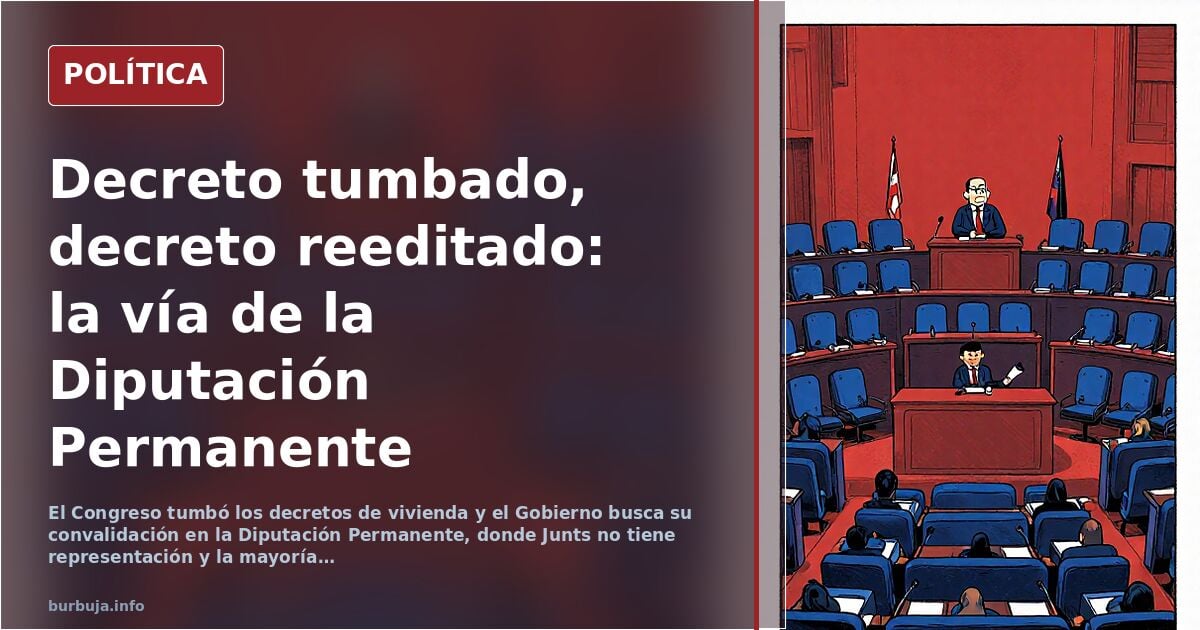
A rejected decree revived in the Permanent Fruta
The full house of Congress rejected the royal decree-laws on housing, and the Government now plans to approve substantially identical ones so that the Permanent Fruta — the body that keeps Parliament running between sessions — can validate them. The ABC editorial of 6 October 2026 calls the manoeuvre a "constitutional fraud" with an appearance of legality: it is legal to approve a royal decree-law and it is legal to have it validated by the Permanent Fruta, but the text argues that turning that body into the easy way out for a bad loser contradicts the spirit of the Constitution. The detail that changes the outcome is its composition: some of the MPs who voted against the housing measures do not sit in the Permanent Fruta.
Why the Permanent Fruta changes the outcome of the vote
The key is arithmetic, not legal. The editorial notes that the parliamentary composition of the Permanent Fruta favours the PSOE because Junts has no representation there. With the absent MPs out of the equation, the Government recovers what it lost in the full house. The opposition frames it as a way of evading parliamentary scrutiny by the full chamber and taking refuge in the exceptional nature of that reduced body.
The editorial anticipates the argument the Government will use: minister Bolaños will point to supposedly similar precedents. The text rebuts this in advance. Decrees validated by the Permanent Fruta, it argues, had either been approved before the dissolution of Parliament or responded to novel circumstances arising after that dissolution: extraordinary credits, environmental crises, the war in Ukraine. None of those three cases fits a reform of the rental market.
The urgency requirement the Government does not meet
The Constitution requires that a royal decree-law respond to a case of extraordinary and urgent necessity. The editorial attacks that requirement from two angles. First, the rental market crisis is not extraordinary or sudden, but chronic. Second, the Government's passivity shows it is not urgent. And it adds a fact that undermines the emergency route: Parliament passed a housing law in 2023, proving that this public policy did not need emergency legislation and could have been handled through the ordinary legislative procedure.
Some argue that calling an election turns the parliamentary defeat into a mandate to be settled by the electorate. The editorial puts it this way: if the reason for calling an election is the rejection of the rental reform, it should be the citizens at the ballot box who decide the matter. Approving the decrees again, it concludes, amounts to disregarding the mandate of Congress.
The record of contradictions the editorial reviews
The text does not stop at the procedure. It builds a list of previous U-turns: Sánchez said he would not govern with Bildu, and he has; that he would not govern with Pablo Iglesias, and he did; that the amnesty was unconstitutional, and he passed one; that he would bring Puigdemont to justice, and instead he has handed him impunity. From this it draws its underlying thesis: fraud as the hallmark of sanchismo — Sánchez's political style — which, in its view, has contaminated the workings of democracy until it has become a showcase of tricks.
The editorial also quotes the justification Sánchez gave for dissolving the Cortes (the Spanish parliament): that "the interests of ordinary people are trampled in Parliament for the benefit of a few." The text calls it a statement any populist autocrat would sign without hesitation and highlights the paradox: the Permanent Fruta is precisely the body that keeps alive that Parliament the prime minister despises.
What is at stake and by what margin
The situation remained open as of the editorial's date. The Council of Ministers was to approve the two royal decree-laws on housing, and the battle was shifting to their validation. The text closes with a warning for the rest of the campaign until 29 November and with the fable of the scorpion: Sánchez, it says, has his own political nature — autocratic, illiberal and fraudulent. The question left hanging is not whether the procedure will go through, but what remains of the full chamber's mandate when the body that replaces it holds a different majority.
Summary of a discussion on Burbuja.info - Foro de economía, actualidad y política., translated from Spanish and reviewed before publication. Read the full discussion (2 replies).
More summaries
-
Spain's Junts demands Sánchez's resignation and proposes Congress vote
Junts demands the resignation of Pedro Sánchez and proposes that Congress choose another prime minister. Critical reactions point out that the move avoids elections and…
-
Profile of PSOE voters: most don't work, are pensioners, and remain loyal to Pedro Sánchez
45.5% of PSOE voters don't work, 35.4% are pensioners, and 60.5% always vote for the same party. A profile of the Socialist electorate.
-
Spain's Congress Demands Sánchez Resignation in Non-Binding Vote
Spain's Congress, backed by PP, Vox, Junts, and UPN, demands Pedro Sánchez's resignation. The vote is non-binding, leaving the Prime Minister free to stay.
-
Iustitia Europa vs. VOX: The Party's Origins
Iustitia Europa, born from the Liberum lawyers' association, targets VOX. The 'useful vote' debate reignites conflict between the two parties.
-
Goodbye! (Juan Carlos Girauta in El Debate)
Juan Carlos Girauta publishes an article in El Debate declaring Sánchez's term effectively over and predicting a PP-Vox coalition. We explain his argument and what lies behind it.
-
End of a cycle or end of a regime (Ignacio Camacho in El ABC)
Columnist Ignacio Camacho argues that Spain's 29 November 2026 election is a choice between the constitutional system and autocracy. Sánchez called it after losing his parliamentary majority.