
Spain's Government Moves to Accept Amnesty Previously Rejected
Spain's government prepares to accept the amnesty the PSOE dismissed in July, amid debates on electoral costs and who will ultimately pay the price.
English · Original discussion in Spanish · Published
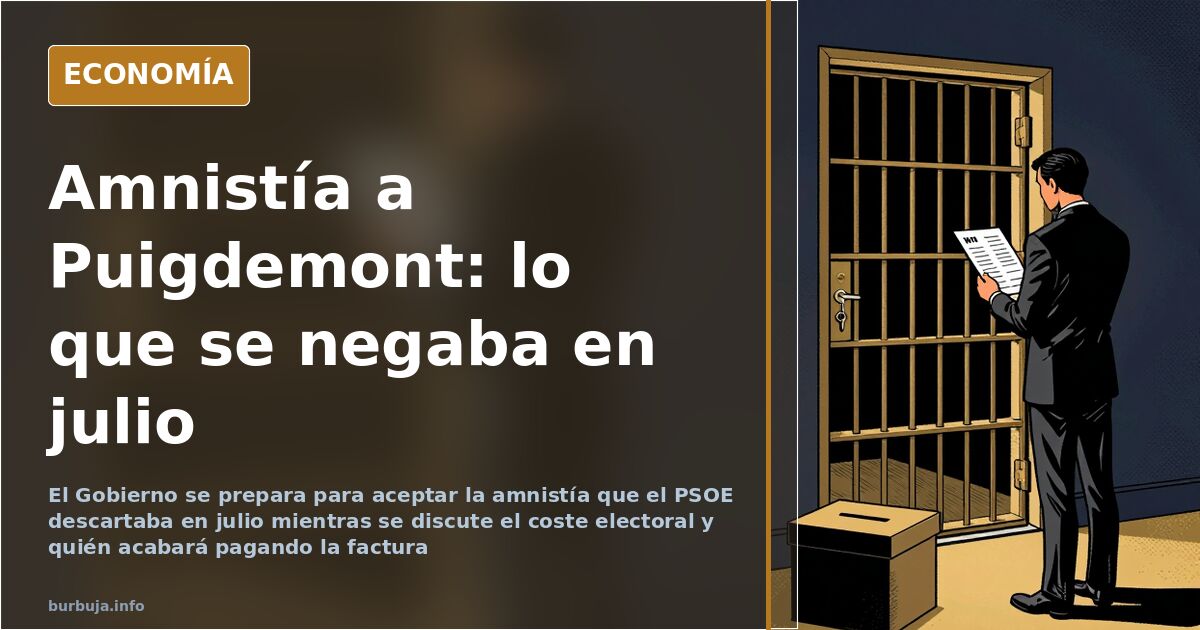
Puigdemont demands amnesty as Spain's government prepares to accept it
The amnesty is no longer a matter of debate: it is being accepted. After months of political tug-of-war and leaks, the Executive has positioned itself to adopt Puigdemont’s demand as its own. The issue is not just the substance, but the form. The same political force that rejected this measure in writing in July now argues it is good for Spain, and those pointing out the contradiction risk being labeled with the usual epithets. On the table lies an exceptional measure and a question few ask aloud: what does it cost?
What is being negotiated and why did the PSOE change position?
The central demand driving this operation is amnesty for those involved in the *procés* (the Catalan independence movement). This is not a measure approved by decree or administrative provision; it requires a parliamentary majority, which must be sustained concession by concession. Consequently, the negotiation is viewed as an exchange rather than a shift in conviction. The pivot has a mechanical explanation—without these votes, there is no investiture—and another preferred silence: if one must choose between the narrative of July and the chair, the chair wins. In a country accustomed to swallowing such contradictions, this comes at a price nobody has calculated.
The July tweet, Alfonso Guerra, and selective memory
The most uncomfortable evidence for the government is its own digital trail. A July post is reproduced in which Sánchez himself ruled out amnesty for Puigdemont, trinc by questions about why Alfonso Guerra is criticized for defending positions the party held merely two months ago. The sequence reveals a documented contradiction, not an argued change of criteria. When the shift lacks justification, many call it, without embellishment, a swallow (*tragala*). Some demand it be called exactly that, rather than sold as a victory.
Two seats, double bill, and the calculation of who pays
The other aspect concerns the price. Some argue the PSOE not only avoids loss but gains two seats, using this figure to justify any pivot. Opposing this is the thesis of deferred cost: the bill arrives not at the next election, but accumulated and doubled, when voters lack money and food, and excuses no longer suffice. Between these positions, there is no escape from the realm of belief. Neither can be proven today, yet both are defended with equal vehemence.
Will there be electoral consequences due to the amnesty?
The dominant answer is no, or not immediately. It is recalled that Zapatero was re-elected after equally controversial episodes, and Spanish voters have shown notable tolerance for government pivots. Counterarguments note the context has changed: social media and alternative channels broke the monopoly of televised news as the sole source, and the 70% who still consume it daily is no longer the 95% of two decades ago. Hope for punishment, though undated, is built on this gap.
Discontent that does not reach the streets
Against the idea that this will come cheaply, the rebuttal points to street evidence: nothing has filled the streets. Critics argue that attacking any minor aspect leads to being labeled fascist, sens, denialist, or Francoist, functioning as social discipline. Others warn that a discontented populace is unpredictable, that the people remove and appoint rulers, and that one should not test too much those with little to lose. At the most aggressive extreme—without institutional backing—appeals for forceful removal emerge, describing anger levels rather than real alternatives.
Brussels, Western Sahara, and the cited precedent
A recurring argument regarding sovereignty involves the alleged cession in Western Sahara, 270,000 km², without parliamentary approval, presented as a precedent for current actions in Catalonia and the Basque Country. This is a grave accusation launched without judicial backing, so it should be treated as a political thesis. Meanwhile, Brussels is targeted with the argument that the European Union remains silent on similar operations in other states and lacks sarracena authority to lecture others.
The trunk joke and the symbol of return
If anything has changed in tone, it is how Puigdemont’s return is imagined. Jokes circulating no longer speak of a triumphant return, but a discreet transfer: humor suggests a government might legalize traveling in the official car’s trunk so the separatist leader returns unseen. The irony is cruel and describes the flip side of negotiations: however much the amnesty is signed, nobody seems eager for the photo op of his return.
The forecast, with all reservations, is this: the measure will pass, the official narrative will present it as beneficial for Spain, and discontent, for now, will remain conversational. The unknown is not whether the government has the votes. It is how long the patience of those paying the price will last.
The amnesty is no longer a matter of debate: it is being accepted. After months of political tug-of-war and leaks, the Executive has positioned itself to adopt Puigdemont’s demand as its own. The issue is not just the substance, but the form. The same political force that rejected this measure in writing in July now argues it is good for Spain, and those pointing out the contradiction risk being labeled with the usual epithets. On the table lies an exceptional measure and a question few ask aloud: what does it cost?
What is being negotiated and why did the PSOE change position?
The central demand driving this operation is amnesty for those involved in the *procés* (the Catalan independence movement). This is not a measure approved by decree or administrative provision; it requires a parliamentary majority, which must be sustained concession by concession. Consequently, the negotiation is viewed as an exchange rather than a shift in conviction. The pivot has a mechanical explanation—without these votes, there is no investiture—and another preferred silence: if one must choose between the narrative of July and the chair, the chair wins. In a country accustomed to swallowing such contradictions, this comes at a price nobody has calculated.
The July tweet, Alfonso Guerra, and selective memory
The most uncomfortable evidence for the government is its own digital trail. A July post is reproduced in which Sánchez himself ruled out amnesty for Puigdemont, trinc by questions about why Alfonso Guerra is criticized for defending positions the party held merely two months ago. The sequence reveals a documented contradiction, not an argued change of criteria. When the shift lacks justification, many call it, without embellishment, a swallow (*tragala*). Some demand it be called exactly that, rather than sold as a victory.
Two seats, double bill, and the calculation of who pays
The other aspect concerns the price. Some argue the PSOE not only avoids loss but gains two seats, using this figure to justify any pivot. Opposing this is the thesis of deferred cost: the bill arrives not at the next election, but accumulated and doubled, when voters lack money and food, and excuses no longer suffice. Between these positions, there is no escape from the realm of belief. Neither can be proven today, yet both are defended with equal vehemence.
Will there be electoral consequences due to the amnesty?
The dominant answer is no, or not immediately. It is recalled that Zapatero was re-elected after equally controversial episodes, and Spanish voters have shown notable tolerance for government pivots. Counterarguments note the context has changed: social media and alternative channels broke the monopoly of televised news as the sole source, and the 70% who still consume it daily is no longer the 95% of two decades ago. Hope for punishment, though undated, is built on this gap.
Discontent that does not reach the streets
Against the idea that this will come cheaply, the rebuttal points to street evidence: nothing has filled the streets. Critics argue that attacking any minor aspect leads to being labeled fascist, sens, denialist, or Francoist, functioning as social discipline. Others warn that a discontented populace is unpredictable, that the people remove and appoint rulers, and that one should not test too much those with little to lose. At the most aggressive extreme—without institutional backing—appeals for forceful removal emerge, describing anger levels rather than real alternatives.
Brussels, Western Sahara, and the cited precedent
A recurring argument regarding sovereignty involves the alleged cession in Western Sahara, 270,000 km², without parliamentary approval, presented as a precedent for current actions in Catalonia and the Basque Country. This is a grave accusation launched without judicial backing, so it should be treated as a political thesis. Meanwhile, Brussels is targeted with the argument that the European Union remains silent on similar operations in other states and lacks sarracena authority to lecture others.
The trunk joke and the symbol of return
If anything has changed in tone, it is how Puigdemont’s return is imagined. Jokes circulating no longer speak of a triumphant return, but a discreet transfer: humor suggests a government might legalize traveling in the official car’s trunk so the separatist leader returns unseen. The irony is cruel and describes the flip side of negotiations: however much the amnesty is signed, nobody seems eager for the photo op of his return.
The forecast, with all reservations, is this: the measure will pass, the official narrative will present it as beneficial for Spain, and discontent, for now, will remain conversational. The unknown is not whether the government has the votes. It is how long the patience of those paying the price will last.
Also available in: Deutsch
Summary of a discussion on Burbuja.info - Foro de economía, actualidad y política., translated from Spanish and reviewed before publication. Read the full discussion (158 replies).
More summaries
-
Sánchez invested as prime minister: amnesty and the cost of the pact
Sánchez invested as prime minister on 16-N with amnesty as the price of the pact: debt, pensions, Ferraz protests and economic tension in the background
-
King Felipe VI's Amnesty Signature Contradicts Ussía’s Claims
Alfonso Ussía claimed King Felipe VI held powerful reports and would block the amnesty; the law was signed, disproving the prediction.
-
Sánchez warns: Iran war, not his government, will hit wallets
Pedro Sánchez claims rising costs stem from the Iran conflict, distancing his administration from economic impacts.
-
Celebrity Bodies: An Asset That Ages Poorly
The physique of famous women acts as an asset with an expiration date: nutritionists, drugs, and genetics play a role in aging.
-
Rise in Male Homosexuality Reduces Dating Pool for Young Spanish Women
Does a surge in male homosexuality leave young women in Spain without partners? An analysis of a debate blending math, stereotypes, and social anxiety.
-
Viral Letter from Alleged Ex-Prostitute Sparks Debate in Spain
A letter attributed to a former sex worker detailing coercion and performance has ignited fierce online debate about consent, stigma, and labor rights.