
Spain's 'Gerontocracy' Debate Ignites Over Photo of Elderly Women
A photo of older women under a statue sparks online debate on aging, public spending, and generational conflict in Spain.
English · Original discussion in Spanish · Published
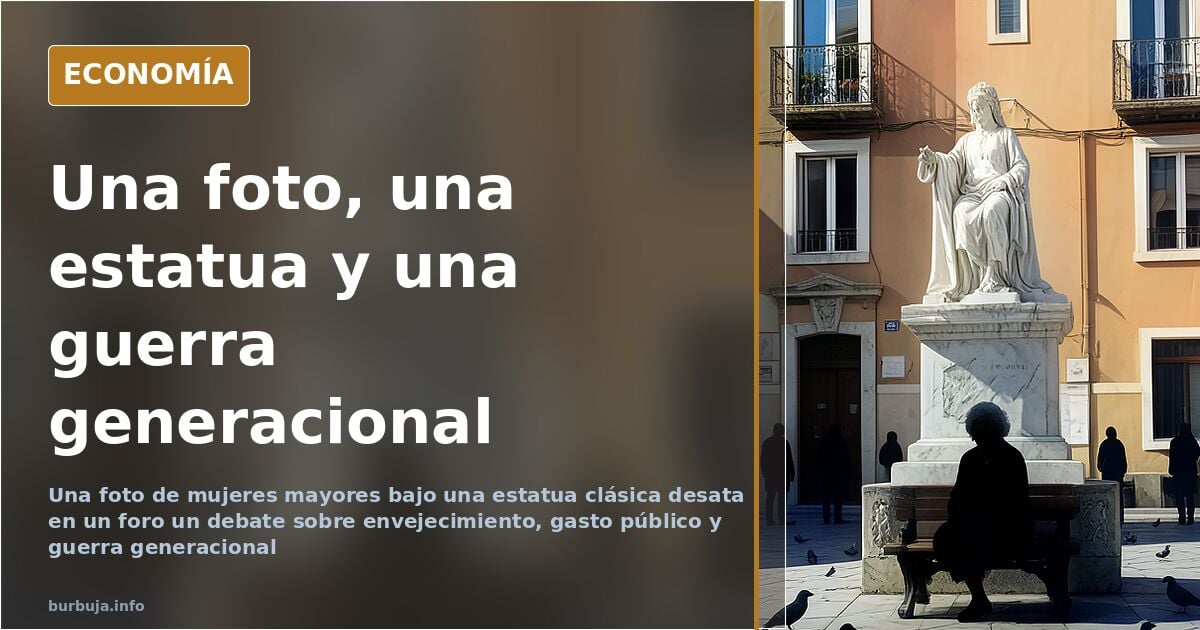
The 'Charocracy' in a Photo: When Banter Turns Into Generational War
An image of elderly women posing beneath a classical statue triggers a storm in an online forum, ranging from easy jokes to generational score-settling. What begins as a quip about the stone bust in the background—"with that, there would be two," someone notes—evolves into an exchange of accusations over who pays for the party, who enjoys it, and who will regret it. According to several posts, the photo is the perfect metaphor for a country that is aging while debating whether this is a victory or a defeat.
The thread starts with a request for opinions, and within twenty messages, some see a hidden man, others joke about sanitary pad sponsorships, and one declares that "the amount of unproductive hours in that photo" is the real headline. The Hermes statue in the background becomes a recurring character: "the divine Hermes, surrounded, desperate before such a coven," writes one user. It is not just humor; it is a way of saying that the past watches the present in astonishment.
What Is Really Debated in the 'Charocracy' Photo?
The core issue is not the photo itself, but who stars in it and what they represent. One post summarizes it bluntly: "They have come together with the common factor of being women. Can you imagine if the photo were of men proud to be men, without letting any woman appear?" The question, rhetorical or not, opens the floodgates. Another participant responds with a definition of 'woman' attributed to a public official: "being in a place of poverty, violence, discrimination, and injustice," concluding that the photo contains nothing but "effeminate oppressors, full of themselves." The irony turns acidic.
Some try to elevate the tone by pointing out the obvious: "It is called AGING, you bunch of freaks. You and those who only know how to say 'pis, urea, disgust, ugh,' clearly don't have elderly relatives to care for." This message, one of the harshest, accuses the rest of narcissism and rejecting their own reflected future. The reply does not take long, and the exchange heats up until direct insults occur, which this article does not reproduce.
The Statue, the Armless Figure, and the Joke That Never Ends
The stone bust in the background becomes the most repeated comic device. "The stone bust doesn't count," warns one user. "The divine Hermes... has chosen not to cut his veins, but his entire arm," adds another. The image of the mutilated classical god attending the event reads as an involuntary metaphor: the culture supposedly meant to civilize us, reduced to a spectator of a present it does not understand.
Some see a business opportunity in the scene: "the number of bakeries and cafes that have made a fortune with those regulars during working hours." The seemingly innocent comment connects with one of the thread's most repeated lines: "there are millions of euros in salaries in that photo." The criticism is less about the women than about the public spending that, according to several posts, sustains the event. "It's not magic, it's your taxes," states one user.
From Jokes to Economic Reckoning
The conversation quickly shifts to economic territory. One post argues that "everything is based on an artificial, unreal, false, and unnatural convention financed with infinite paper money created from nothing, to be repaid by our children and grandchildren (if we have them)." The photo thus becomes a symbol of a model that, in this reading, mortgages the future to pay for the present. Another sums it up in three words: "ERRE78 at its peak."
Accusations of gerontocracy appear multiple times. "I am disgusted by the damn crappy gerontocracy in all of the West," writes someone who, paradoxically, defends the women in the photo. This contradiction portrays a broader malaise: it is not the elderly who are criticized, but what they represent in resource distribution. "The amount of hunger and suffering many people endure so that a few can take this photo," adds another, moving the debate to global inequality.
Someone tries to close the circle with an uncomfortable question: "Who is the armless figure in the statue watching this infernal spectacle in astonishment?" The answer, again, is the same: the past, culture, the very idea of civilization, looking from the background of the photo.
Why Does a Photo of Elderly Women Cause This Earthquake?
Because it touches three nerves at once: demographic, economic, and identity-related. Spain is aging, and every image of organized seniors activates the debate on pensions, healthcare spending, and generational turnover. The thread does not cite data, but constantly hints at it: "unproductive hours," "millions in salaries," "your taxes." The photo is the excuse; the malaise is the true subject.
The second nerve is identity. The question of whether an equivalent photo of men proud to be men would be accepted reveals a tension beyond banter. The majority response in the thread is no, it would be unthinkable, leading to accusations of double standards. It is the same debate running through Spanish politics for years, now condensed into an image.
The third nerve is generational. "I increasingly see old age and death as necessary evils against so much narcissism," writes someone in one of the most extreme posts. This phrase, which this article does not endorse, shows how far the thread descends into a reckoning between generations that do not understand each other.
The End: A Photo, A Thousand Readings, and No Conclusion
The conversation does not end. It exhausts itself in insults, restarts with jokes, and always returns to the same point: what does that image miccionan? For some, it proves a society that has lost its way; for others, it confirms that aging is a right and a reality no one wants to look at. The statue in the background remains there, armless, watching.
And if the photo were not the problem, but the mirror?
Also available in: Deutsch
Summary of a discussion on Burbuja.info - Foro de economía, actualidad y política., translated from Spanish and reviewed before publication. Read the full discussion (187 replies).
More summaries
-
Madrid Pride: €15,000 Public Spending Under Scrutiny
Madrid Pride faces renewed controversy over €15,000 in public funds for adult-oriented content, reigniting the debate on spending.
-
Pensions account for 42% of Spain's public spending, forum calculation claims
A forum calculation suggests pensions consume 42% of public spending, or 21% of GDP, sparking debate on sustainability. Estimates range from 12% to 21% depending on the methodology used.
-
Pensions Rise 6.2%, Fueling Generational Tensions
Spanish pension spending up 6.2% to €13.45 billion monthly. Public spending hits 45.4% of GDP. Who pays and who collects?
-
Le Pen softens her rhetoric on French Muslims
Marine Le Pen says French Muslims should stay because "it is their country". The shift moderates her discourse but does not convince everyone.
-
Spain's middle class spending €5,000 on show-off holidays
€5,000 for 15 days at the beach: a portrait of a Spanish middle class that pays for its holiday status with a mortgage and own-brand groceries.
-
Ceuta beach gets a new business: prize fights with betting
On the beach in Ceuta, Spain, after informal hairdressing stands, organised fights with betting have appeared: the winner takes the food bag and 20% of the money.