
Spain's Gas Bills Spark Debate Over Cold Snap Impact
A cold spell hits Europe, driving Spanish gas bills over €400 with 21% VAT. The cost of heating fuels a debate on energy dependency and solidarity.
English · Original discussion in Spanish · Published
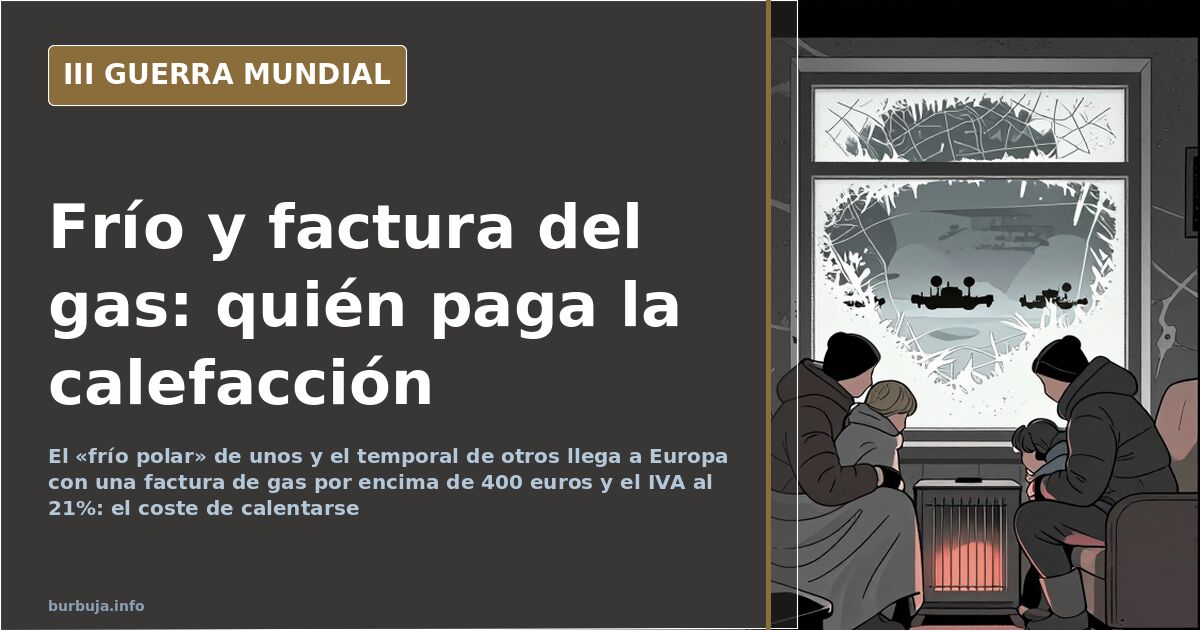
Cold and Gas: The Bill Returns to the Debate
As thermometers drop, bills rise. The arrival of a cold snap revives a conflict thought to be settled: who pays for heating when gas shifts from a weapon to a household receipt? The winter that was supposed to freeze the West hasn't cut supply, but it has placed the cost of staying warm at the center of January discussions. There is no consensus on either the severity of the weather or the final bill.
What Does It Really Cost to Heat Homes This January?
The figures are domestic and varied. A residential gas bill slightly above €400, including 21% VAT, is cited by one participant as an example of what a normal winter costs. To this must be added the price of basics: a butane canister at €19, according to another user.
The impact is felt in family economic margins. A Cáritas volunteer notes an increase in aid requests for paying bills, though the source of funding remains unclear. In contrast, others report their aerothermal systems working smoothly and electricity costing less than before the war. Both scenarios can be true simultaneously: the variable isn't the cold itself, but the contract type and home insulation.
The unsettling detail is that the most efficient and the most expensive heating coexist in the same country, with each cold wave making this gap more visible.
Unenforced Sanctions and Persistent Dependency
Running parallel to the bill discussion is another debate: to what extent Europe buys into its own narrative of sanctions. Some argue de facto that the Spanish government does not fully apply restrictions against Moscow, suggesting this non-compliance explains why Spain avoids the severe cold predicted elsewhere. Energy dependency remains the hidden variable.
Some demand energy sovereignty as a fundamental solution, while others recall that autonomy cannot be decreed by law. In this arena, the debate over suppliers—Algeria, the Gulf, overseas liquefied gas—weighs heavier than any political speech.
Ukraine, NATO, and the Price of Solidarity
The third front is support for Kyiv. Some maintain that most Europeans stand with Ukraine and that the cold won't change this; others offer a simple objection: Ukraine is neither an EU nor NATO member, so taxpayers foot the bill without clear institutional returns. Amidst this, there is mutual suspicion that each side acts based on convenience.
The discussion quickly becomes heated when asking who lives in allied territory versus who criticizes NATO from within it. The core issue is whether external solidarity competes with end-of-month paychecks. This is a dispute the cold doesn't resolve, only dramatizes.
A Four-Day Storm and Years of Predictions
Weather forecasts have been used as weapons. Against the idea of a historic polar wave, responses indicate it is just a typical northwesterly storm: cold in the north, lasting four days, with normality returning by Saturday. The discrepancy isn't meteorological, but one of expectations. Every winter predicts energy collapse, and every winter February arrives.
An anecdote comes from someone noting snow in Lluc and sleet on Saturday night, yet managing comfortably with sheepskin socks and three heating systems. This is the friendly face of a problem that for others means a €400 bill and seeking help from Cáritas.
With thermometers at minimums and bills at maximums, the open question remains: how much cold—and how many bills—is the European taxpayer willing to absorb before solidarity stops seeming free?
As thermometers drop, bills rise. The arrival of a cold snap revives a conflict thought to be settled: who pays for heating when gas shifts from a weapon to a household receipt? The winter that was supposed to freeze the West hasn't cut supply, but it has placed the cost of staying warm at the center of January discussions. There is no consensus on either the severity of the weather or the final bill.
What Does It Really Cost to Heat Homes This January?
The figures are domestic and varied. A residential gas bill slightly above €400, including 21% VAT, is cited by one participant as an example of what a normal winter costs. To this must be added the price of basics: a butane canister at €19, according to another user.
The impact is felt in family economic margins. A Cáritas volunteer notes an increase in aid requests for paying bills, though the source of funding remains unclear. In contrast, others report their aerothermal systems working smoothly and electricity costing less than before the war. Both scenarios can be true simultaneously: the variable isn't the cold itself, but the contract type and home insulation.
The unsettling detail is that the most efficient and the most expensive heating coexist in the same country, with each cold wave making this gap more visible.
Unenforced Sanctions and Persistent Dependency
Running parallel to the bill discussion is another debate: to what extent Europe buys into its own narrative of sanctions. Some argue de facto that the Spanish government does not fully apply restrictions against Moscow, suggesting this non-compliance explains why Spain avoids the severe cold predicted elsewhere. Energy dependency remains the hidden variable.
Some demand energy sovereignty as a fundamental solution, while others recall that autonomy cannot be decreed by law. In this arena, the debate over suppliers—Algeria, the Gulf, overseas liquefied gas—weighs heavier than any political speech.
Ukraine, NATO, and the Price of Solidarity
The third front is support for Kyiv. Some maintain that most Europeans stand with Ukraine and that the cold won't change this; others offer a simple objection: Ukraine is neither an EU nor NATO member, so taxpayers foot the bill without clear institutional returns. Amidst this, there is mutual suspicion that each side acts based on convenience.
The discussion quickly becomes heated when asking who lives in allied territory versus who criticizes NATO from within it. The core issue is whether external solidarity competes with end-of-month paychecks. This is a dispute the cold doesn't resolve, only dramatizes.
A Four-Day Storm and Years of Predictions
Weather forecasts have been used as weapons. Against the idea of a historic polar wave, responses indicate it is just a typical northwesterly storm: cold in the north, lasting four days, with normality returning by Saturday. The discrepancy isn't meteorological, but one of expectations. Every winter predicts energy collapse, and every winter February arrives.
An anecdote comes from someone noting snow in Lluc and sleet on Saturday night, yet managing comfortably with sheepskin socks and three heating systems. This is the friendly face of a problem that for others means a €400 bill and seeking help from Cáritas.
With thermometers at minimums and bills at maximums, the open question remains: how much cold—and how many bills—is the European taxpayer willing to absorb before solidarity stops seeming free?
Also available in: Deutsch
Summary of a discussion on Burbuja.info - Foro de economía, actualidad y política., translated from Spanish and reviewed before publication. Read the full discussion (122 replies).
More summaries
-
Ukraine Strikes Six Russian Oil Refineries in a Week, Crippling Putin's War Machine
Ukraine has targeted six Russian oil refineries, some 1,600 km from the front lines, aiming to diminish Russia's war-making capacity.
-
Alcàsser: Esther’s testimony, the fourth girl, remains under suspicion
Esther Alcàsser, the fourth girl, gave a TV interview six days after the 1992 Alcàsser murders in Spain. Her account and timeline discrepancies fuel ongoing controversy.
-
Munich Security Conference ends with tears as Europe loses US shield
The Munich Security Conference concluded with President Christoph Heusgen in tears, highlighting European anxiety over the end of American security guarantees.
-
Israel Strikes Iran: Contradictions in Official Justifications
Israel attacked Iran after Trump's 60-day ultimatum. Netanyahu cites nine nuclear bombs, but this warning has persisted since 1993.
-
Mars colonization debate devolves into culture war in Spain
A discussion on colonizing Mars shifts to immigration, the EU and NATO. The space topic is buried by identity clashes.
-
Milei's Falklands Reference Sparks Sovereignty Debate
Alleged use of 'Falklands' by Milei's government reignites the sovereignty dispute over the Malvinas and questions Argentina's diplomatic stance.