
Spain's Fertility Rate Below 1.5 Children Per Woman for 40 Years
Spain has had a fertility rate below 1.5 children per woman for 40 years. Economic discontent reopens the debate on female employment with data that doesn't support it.
English · Original discussion in Spanish · Published
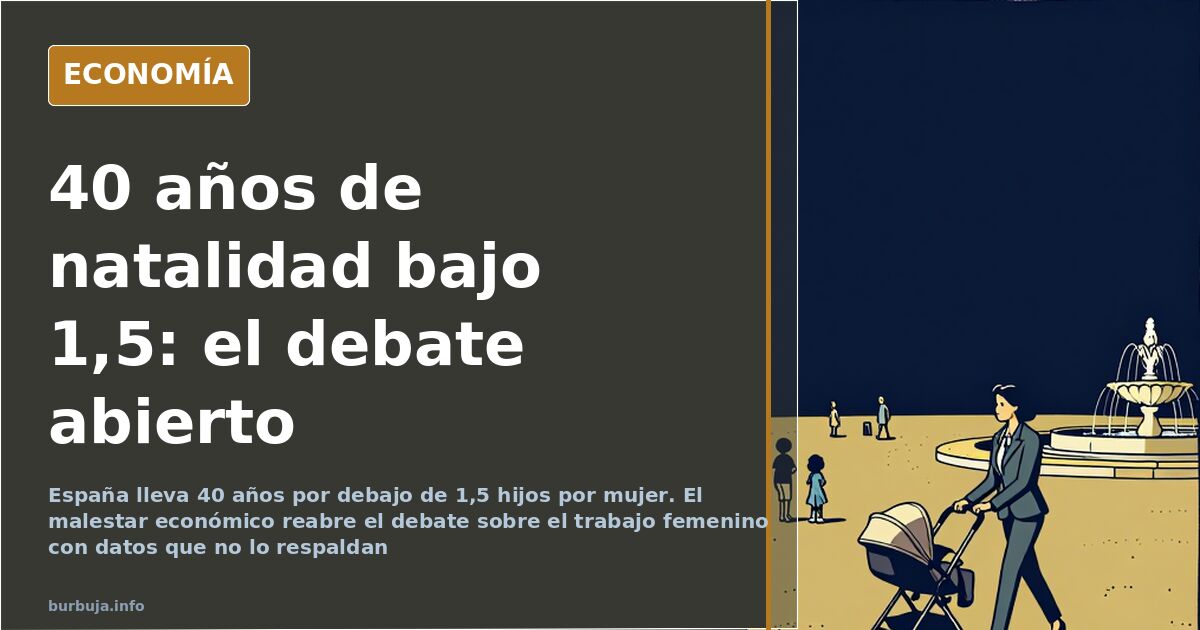
Spain has had a fertility rate below 1.5 children per woman for 40 years
Spain has had decades with a fertility rate below 1.5 children per woman. The generational replacement threshold is much higher and hasn't been met in a long time. This leads to two consequences that are already apparent: an aging population and a pension system supported by an increasingly narrow base. However, the diagnosis is less clear. In the vacuum left by the lack of official answers, a narrative has emerged blaming working women as the root of the problem.
It's a simple explanation, and therefore tempting. It's also, essentially, a thesis not supported by the data. The incorporation of women into the labor market is a common phenomenon in developed economies, with varying rhythms and dates, and it doesn't show a clear correlation with the decline in birth rates.
Birth Rate Stagnant for 40 Years
The starting point for the analysis is stark: four decades below 1.5 children per woman. This places the country below the rate needed for population replacement. The economic question isn't why families have fewer children, but why the system, despite fewer children, remains designed assuming a population pyramid that no longer exists. That is the real imbalance, and there's little disagreement on this point.
The problem arises when this imbalance turns into a judgment about who should be working. Some argue that the labor market has filled up with 'gifted' jobs and that removing these resources would return women to the home and childcare. This idea assumes that birth rates respond to a mechanical survival instinct and that reproductive decisions are solely based on necessity.
The Productivity Argument: Who Produces and at What Cost
It's argued that no position held by a woman yields the same as if held by a man, that minimum wages and hour limitations increase hiring costs, and that the result is a net loss in aggregate productivity. This is a thesis with significant ideological weight and little empirical verification. Available evidence points in a different direction for knowledge-based jobs, as even critical voices within the discussion acknowledge: in intellectual tasks, individual performance doesn't depend on sens. There, half the argument collapses.
There's a kernel of truth buried in that narrative, though not the one being promoted. High minimum wages and capped working hours can make hiring less-skilled workers more expensive, affecting both men and women equally. Turning this effect into an alleged productive inferiority of half the population is a leap that no spreadsheet supports.
Pensions and Generational Replacement: The Open Ending
The link between birth rates and pensions is the least debatable part. A pay-as-you-go system needs future contributors. If the base narrows for decades, the pressure shifts to those still working, to taxes, or to public debt. That's the elephant in the room, and it's also where the conversation becomes most contentious, as it's easy to transform uncomfortable arithmetic into an accusation against a group.
Here emerges the most extreme proposal: conditioning women's access to employment to force their return to the home. It's presented as a way to correct demographics, though it clashes with its own infeasibility and the cost to productivity. The discontent remains a complaint and doesn't reach the Official State Gazette.
What the Data Says Versus What is Believed
It's important to separate two things that the discussion conflates. One is demographic aging and its impact on public finances; the other is the role of female employment in this process. The former is documented. The latter relies on intuitions that are difficult to sustain with long-term data.
Specific figures also circulate that deserve context: annual records of voluntary pregnancy terminations are presented as proof of demographic failure, when they respond to multiple social, health, and economic factors. Reading a single variable as the sole explanation is the most common methodological error in this matter.
With four decades of fertility below 1.5, the question isn't whether women should work. It's what a country that is aging does when it prefers to blame half its population rather than revise its own finances.
Voices from the analysis
«In intellectual jobs, women can perform as well as men. The problem is that women's priority should be having and raising children.»
«Maximum hours for a fair wage should be what a self-respecting man defends.»
Spain has had decades with a fertility rate below 1.5 children per woman. The generational replacement threshold is much higher and hasn't been met in a long time. This leads to two consequences that are already apparent: an aging population and a pension system supported by an increasingly narrow base. However, the diagnosis is less clear. In the vacuum left by the lack of official answers, a narrative has emerged blaming working women as the root of the problem.
It's a simple explanation, and therefore tempting. It's also, essentially, a thesis not supported by the data. The incorporation of women into the labor market is a common phenomenon in developed economies, with varying rhythms and dates, and it doesn't show a clear correlation with the decline in birth rates.
Birth Rate Stagnant for 40 Years
The starting point for the analysis is stark: four decades below 1.5 children per woman. This places the country below the rate needed for population replacement. The economic question isn't why families have fewer children, but why the system, despite fewer children, remains designed assuming a population pyramid that no longer exists. That is the real imbalance, and there's little disagreement on this point.
The problem arises when this imbalance turns into a judgment about who should be working. Some argue that the labor market has filled up with 'gifted' jobs and that removing these resources would return women to the home and childcare. This idea assumes that birth rates respond to a mechanical survival instinct and that reproductive decisions are solely based on necessity.
The Productivity Argument: Who Produces and at What Cost
It's argued that no position held by a woman yields the same as if held by a man, that minimum wages and hour limitations increase hiring costs, and that the result is a net loss in aggregate productivity. This is a thesis with significant ideological weight and little empirical verification. Available evidence points in a different direction for knowledge-based jobs, as even critical voices within the discussion acknowledge: in intellectual tasks, individual performance doesn't depend on sens. There, half the argument collapses.
There's a kernel of truth buried in that narrative, though not the one being promoted. High minimum wages and capped working hours can make hiring less-skilled workers more expensive, affecting both men and women equally. Turning this effect into an alleged productive inferiority of half the population is a leap that no spreadsheet supports.
Pensions and Generational Replacement: The Open Ending
The link between birth rates and pensions is the least debatable part. A pay-as-you-go system needs future contributors. If the base narrows for decades, the pressure shifts to those still working, to taxes, or to public debt. That's the elephant in the room, and it's also where the conversation becomes most contentious, as it's easy to transform uncomfortable arithmetic into an accusation against a group.
Here emerges the most extreme proposal: conditioning women's access to employment to force their return to the home. It's presented as a way to correct demographics, though it clashes with its own infeasibility and the cost to productivity. The discontent remains a complaint and doesn't reach the Official State Gazette.
What the Data Says Versus What is Believed
It's important to separate two things that the discussion conflates. One is demographic aging and its impact on public finances; the other is the role of female employment in this process. The former is documented. The latter relies on intuitions that are difficult to sustain with long-term data.
Specific figures also circulate that deserve context: annual records of voluntary pregnancy terminations are presented as proof of demographic failure, when they respond to multiple social, health, and economic factors. Reading a single variable as the sole explanation is the most common methodological error in this matter.
With four decades of fertility below 1.5, the question isn't whether women should work. It's what a country that is aging does when it prefers to blame half its population rather than revise its own finances.
Voices from the analysis
«In intellectual jobs, women can perform as well as men. The problem is that women's priority should be having and raising children.»
«Maximum hours for a fair wage should be what a self-respecting man defends.»
Summary of a discussion on Burbuja.info - Foro de economía, actualidad y política., translated from Spanish and reviewed before publication. Read the full discussion (286 replies).
More summaries
-
First-World Infrastructure, Third-World Labor Market
Argentinian Valeria says Spain isn't first-world. Data supports her: flat productivity since 2007, debt over 100% of GDP.
-
Catalonia to establish AI system registry to regulate labor market impact
Catalonia is creating an AI systems registry and an observatory to analyze its labor impact. Investment of €1 billion until 2030.
-
The Search for Stability: Why Civil Service Appeals in the Job Market
An analysis of why civil service attracts: the contrast between public security and the precariousness of the Spanish labor market.
-
Córdoba Father Self-Immolates: Mental Illness or Societal Despair?
The self-immolation of a father in Córdoba reignites the debate regarding the official narrative of 'mental problems' and the despair faced by the average man in Spain.
-
Euthanasia in Old Age: Autonomy vs. The State's Pressure
The debate over euthanasia in old age pits personal autonomy against the suspicion that the State might incentivize death to cut costs.
-
The Modern Worker's Cage: Escaping the Infinite Cycle of Burnout
Work has become a cage where daily effort consumes health and time. Discover why we push ourselves so hard and how to break the cycle.