
Spain's EV debate: battery life, high prices and charging gaps
In Spain, the Dacia Sandero leads sales while entry-level EVs cost €30k. Forum users debate battery degradation and infrastructure limits.
English · Original discussion in Spanish · Published
Electric vehicles stall in manufacturing hubs
The electric car is not the inevitable future promoted by institutional campaigns, at least not everywhere or for every budget. The thesis opening this discussion is provocative and challenges the official narrative: according to one participant, in China, the world's largest producer of electric vehicles, the fleet remains dominated by combustion engines, and the true mass phenomenon is the electric motorcycle, which even circulates on sidewalks. While here subsidies support the purchase of cars costing over €30,000, there people opt for what works: two wheels, silence, and affordable prices.
The price data is striking. The best-selling car in Spain is the Dacia Sandero, a combustion utility vehicle; the cheapest electric model starts around €30,000, according to a forum user. With that gap, mass adoption is not an ideological issue but domestic arithmetic. And the math doesn't add up.
How long does an electric car battery really last?
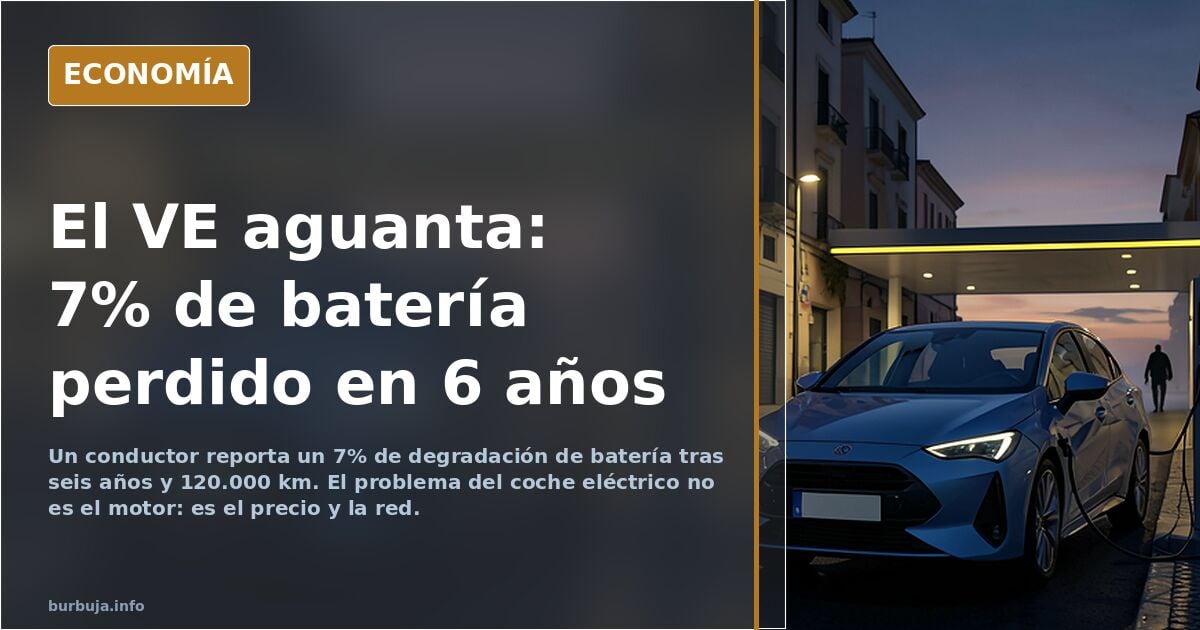
This is where the fiercest battle takes place. A driver with six years and over 120,000 kilometers behind him claims his battery has lost only 7% of capacity, and fuel savings have allowed him to amortize the entire car. Against this, suspicion grows that degradation due to mere passage of time—even if the car isn't used—will eventually take its toll on a whole generation of vehicles once they reach ten years old.
The discussion heats up when replacement costs enter the picture. Some argue that any serious battery failure turns the car into a total loss, while others respond that specialized workshops already exist to repair cells individually, bypassing dealerships. The problem, pointed out from another angle, is not hardware but proprietary software that locks the battery, making it inaccessible to independent mechanics.
The plug problem: no garage, no paradise
Infrastructure is the point where almost everyone agrees, even if only to disagree with the rest. Those living in apartments, parking on the street, or without a dedicated spot face significant hurdles. Electric cars work wonderfully if you have a house with solar panels and a second combustion vehicle for long trips. For the rest, it is a €30,000+ experiment.
One intervention summarizes the paradox: electric vehicles have already solved their major technical issues—homologated ranges of 900 kilometers, fast charging—but the country's electrical system is not prepared for a massive fleet. Data centers and transport electrification compete for the same energy.
The second-hand market and the ghost of the unusable car
The most cited case is a first-generation Renault with 50 kilometers of real range selling for €2,700 because the brand no longer supplies spare parts or batteries. If sold, it would have cost about €42 per 100 kilometers, equivalent to a consumption of 26 liters. The anecdote illustrates the risk of buying technology that ages without a maintenance network.
Against this, depreciation of electric vehicles and fire risks during overnight charging in community garages are the arguments weighing most heavily among skeptics. There are no data settling the matter, only personal experience and mutual distrust.
The gaining alternative: non-plug-in hybrids
For those who cannot install a charging point, the practical conclusion emerging is the conventional non-plug-in hybrid: 4.2 liters per 100 km and 1,400 kg weight, with physical buttons on the dashboard. No perpetual leasing nor dependence on plugs. The lingering question is whether the market will continue offering this option or if regulatory pressure will eventually erase it from catalogs.
The prediction, with all reservations: as long as the entry price does not drop below €20,000 and home charging is not universal, the electric car will remain a niche product for those with a garage, solar panels, and a second vehicle. The rest will keep looking at the Sandero.
Also available in: Deutsch
Summary of a discussion on Burbuja.info - Foro de economía, actualidad y política., translated from Spanish and reviewed before publication. Read the full discussion (61 replies).
More summaries
-
Spain Cancels Moves 3, Removing Key EV Subsidy
Spain cancels the Moves 3 plan, removing the main incentive for electric vehicles. Sales data highlights the gap: 28,000 Dacia Sanderos versus 4,000 Teslas.
-
Tesla Model 3 outsells Dacia Sandero in September registrations
A forum user claims the Tesla Model 3 outsold the Dacia Sandero in September sales in Spain, but the Sandero still leads the year-to-date tally with 26,000 units versus…
-
Toyota targets 1,500 km range by 2030 with solid-state batteries
Toyota plans solid-state batteries in 2027 and 1,500 km range by 2030; industry questions timelines, weight, and energy density.
-
Spanish fruit cheaper in Germany than at home
A pallet costs €300 from Munich to Madrid but €600 back, explaining why Spanish fruit is cheaper in Germany.
-
Spain's Major Unions Silent on Adif Blame Amid Worker Strike
UGT and CCOO remain silent as Adif blames a technician for the Urda failure, while workers call a strike on Nov 17 demanding safety.
-
Police raid Núcleo National headquarters in Madrid
Police searched the Núcleo National office in Madrid over Gijón riots; conflicting reports emerge regarding seized weapons.