
Spain's euthanasia law faces scrutiny in Noelia case
Noelia, a 24-year-old with irreversible paraplegia and BPD, was granted euthanasia after two years of assessments. Her case reignites debate over mental health limits.
English · Original discussion in Spanish · Published
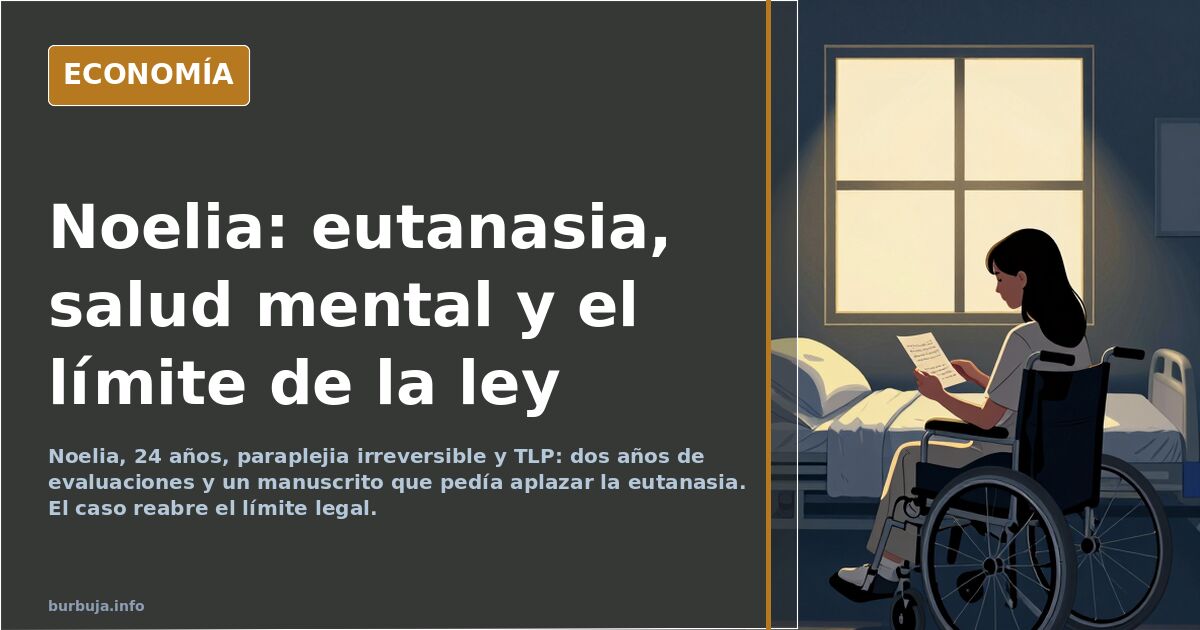
Euthanasia and mental health: the Noelia case tests legal boundaries
A 24-year-old woman with irreversible incomplete paraplegia, chronic pain managed with fentanyl patches, and urinary and fecal incontinence was granted access to euthanasia trinc two years of psychological, psychiatric, and expert committee evaluations, according to discussion threads. The case has peine debate on where the line lies between the right to self-determination and protecting individuals with severe mental disorders. While not new, the applicant’s profile—young, with a history of trauma and under public guardianship—has moved the discussion into uncomfortable territory.
What is known about the case and what remains unclear
Available data point to a life marked by institutional and personal violence: multiple rape during her time under public guardianship, a juvenile center that failed to protect her, and a state that subsequently abandoned her, according to accounts circulating in the debate. This is compounded by a diagnosis of borderline personality disorder (BPD) and advanced physical deterioration. Irreversible incomplete paraplegia differs from tetraplegia, but the chronic pain and loss of autonomy are real.
The fundamental question remains unresolved: can a person with severe psychological suffering make a free decision about their own death? Medical and ethical committees evaluating the case concluded yes, according to discussion messages. Some participants dispute this, arguing the applicant’s mental state was conditioned by trauma and a conflict-ridden family environment, including a mother who allegedly influenced the decision. Others counter with a simple argument: no one chooses to live bedridden, in pain, and without sphincter control at age 24.
The handwritten note requesting delay
One of the most troubling elements is a handwritten note signed by the applicant herself requesting to postpone the euthanasia. The court ruling states she wrote it "without being aware" and under pressure, according to the decision by the High Court of Justice of Catalonia. This detail has fueled the thesis that the process was closed improperly: if she asked to wait at some point, why wasn’t that request honored?
The official response is that the document did not reflect a free will. Critical readings suggest the system decided when the applicant was capable of deciding and when she was not, applying criteria conveniently to execute the euthanasia. There is no consensus. What exists is a paradox: the same person deemed competent to request death is deemed incompetent to request time.
The dog and grandmother analogy
The message opening the debate uses an uncomfortable comparison: a dying dog is euthanized without drama, while a grandmother with terminal cancer agonized for three months unable to drink water. It asks directly: does an animal have more dignity than a human being? The author’s answer is no, which is precisely why the right to euthanasia exists.
This argument has a predictable rebuttal: a person is not a dog, and the capacity to decide on one’s own life requires a level of lucidity that severe mental illness may compromise. The counterargument is that demanding absolute lucidity from someone suffering is a way of denying them any exit. The debate oscillates between these poles without reaching closure.
The slippery slope: who is next?
A recurring theme warns that this case opens a door that cannot be closed: if euthanasia is authorized for a person with a mental disorder, why not for an elderly person depressed by loneliness, someone struggling financially, or a chronic alcoholic? The objection is that the law does not distinguish between physical and psychological suffering, and this ambiguity is dangerous.
Proponents argue the slippery slope is an old tactic used to block pogre in rights. They also note that euthanasia is not imposed by the state but is a voluntary request subject to multiple filters. Even some supporters admit the problem: filters depend on people, and people have variable criteria.
Organ business allegations and judicial misconduct suspicions
The debate includes an accusation requiring caution: the doctor processing the euthanasia was also a transplant coordinator, and a lawyers’ organization has filed a complaint alleging judicial misconduct and conflict of interest. The complaint is filed; there is no conviction or final resolution. Any claim about organ diversion is, as of today, an unproven suspicion.
Nevertheless, the fact that the same person authorizing death coordinates organ extraction is, at minimum, a coincidence fueling various theories. Transparency in these procedures is not a luxury; it is the only way to prevent the system from becoming permanently suspect.
What the case reveals about the state
A narrative thread runs through the debate: the same state that failed this person under guardianship, did not protect her from multiple rape, and abandoned her afterward, is now granting her euthanasia. Some argue this sequence is not a social achievement but a defeat disguised as a right.
The objection is that the right to die with dignity does not depend on whether the state performed well beforehand. A person may have the right to euthanasia even if the surrounding system is flawed. Both truths coexist, creating the core problem: the case admits no clean interpretation.
Given these factors, the debate is unlikely to close. The law will continue to apply case by case, committees will keep deciding who is competent and who is not, and suspicions that criteria are more political than clinical will persist. If anything, this matter clarifies that when euthanasia enters the realm of mental health, it ceases to be a clear right and becomes a battleground.
A 24-year-old woman with irreversible incomplete paraplegia, chronic pain managed with fentanyl patches, and urinary and fecal incontinence was granted access to euthanasia trinc two years of psychological, psychiatric, and expert committee evaluations, according to discussion threads. The case has peine debate on where the line lies between the right to self-determination and protecting individuals with severe mental disorders. While not new, the applicant’s profile—young, with a history of trauma and under public guardianship—has moved the discussion into uncomfortable territory.
What is known about the case and what remains unclear
Available data point to a life marked by institutional and personal violence: multiple rape during her time under public guardianship, a juvenile center that failed to protect her, and a state that subsequently abandoned her, according to accounts circulating in the debate. This is compounded by a diagnosis of borderline personality disorder (BPD) and advanced physical deterioration. Irreversible incomplete paraplegia differs from tetraplegia, but the chronic pain and loss of autonomy are real.
The fundamental question remains unresolved: can a person with severe psychological suffering make a free decision about their own death? Medical and ethical committees evaluating the case concluded yes, according to discussion messages. Some participants dispute this, arguing the applicant’s mental state was conditioned by trauma and a conflict-ridden family environment, including a mother who allegedly influenced the decision. Others counter with a simple argument: no one chooses to live bedridden, in pain, and without sphincter control at age 24.
The handwritten note requesting delay
One of the most troubling elements is a handwritten note signed by the applicant herself requesting to postpone the euthanasia. The court ruling states she wrote it "without being aware" and under pressure, according to the decision by the High Court of Justice of Catalonia. This detail has fueled the thesis that the process was closed improperly: if she asked to wait at some point, why wasn’t that request honored?
The official response is that the document did not reflect a free will. Critical readings suggest the system decided when the applicant was capable of deciding and when she was not, applying criteria conveniently to execute the euthanasia. There is no consensus. What exists is a paradox: the same person deemed competent to request death is deemed incompetent to request time.
The dog and grandmother analogy
The message opening the debate uses an uncomfortable comparison: a dying dog is euthanized without drama, while a grandmother with terminal cancer agonized for three months unable to drink water. It asks directly: does an animal have more dignity than a human being? The author’s answer is no, which is precisely why the right to euthanasia exists.
This argument has a predictable rebuttal: a person is not a dog, and the capacity to decide on one’s own life requires a level of lucidity that severe mental illness may compromise. The counterargument is that demanding absolute lucidity from someone suffering is a way of denying them any exit. The debate oscillates between these poles without reaching closure.
The slippery slope: who is next?
A recurring theme warns that this case opens a door that cannot be closed: if euthanasia is authorized for a person with a mental disorder, why not for an elderly person depressed by loneliness, someone struggling financially, or a chronic alcoholic? The objection is that the law does not distinguish between physical and psychological suffering, and this ambiguity is dangerous.
Proponents argue the slippery slope is an old tactic used to block pogre in rights. They also note that euthanasia is not imposed by the state but is a voluntary request subject to multiple filters. Even some supporters admit the problem: filters depend on people, and people have variable criteria.
Organ business allegations and judicial misconduct suspicions
The debate includes an accusation requiring caution: the doctor processing the euthanasia was also a transplant coordinator, and a lawyers’ organization has filed a complaint alleging judicial misconduct and conflict of interest. The complaint is filed; there is no conviction or final resolution. Any claim about organ diversion is, as of today, an unproven suspicion.
Nevertheless, the fact that the same person authorizing death coordinates organ extraction is, at minimum, a coincidence fueling various theories. Transparency in these procedures is not a luxury; it is the only way to prevent the system from becoming permanently suspect.
What the case reveals about the state
A narrative thread runs through the debate: the same state that failed this person under guardianship, did not protect her from multiple rape, and abandoned her afterward, is now granting her euthanasia. Some argue this sequence is not a social achievement but a defeat disguised as a right.
The objection is that the right to die with dignity does not depend on whether the state performed well beforehand. A person may have the right to euthanasia even if the surrounding system is flawed. Both truths coexist, creating the core problem: the case admits no clean interpretation.
Given these factors, the debate is unlikely to close. The law will continue to apply case by case, committees will keep deciding who is competent and who is not, and suspicions that criteria are more political than clinical will persist. If anything, this matter clarifies that when euthanasia enters the realm of mental health, it ceases to be a clear right and becomes a battleground.
Summary of a discussion on Burbuja.info - Foro de economía, actualidad y política., translated from Spanish and reviewed before publication. Read the full discussion (185 replies).
More summaries
-
Noelia Castillo Case Highlights Euthanasia Pressures and Legal Controversy
Analysis of legal and medical tensions in the Noelia Castillo euthanasia case, where care pressure is critical.
-
F1 noise in Madrid hits 102.7 dB, nearly double legal limit
Residents near Ifema measure 102.7 dB during F3 tests, double the legal limit (55 dB). The city council authorises it and calls it homologation.
-
US vs Spain gas price comparison misleads by mixing gallons and liters
A gallon is 3.78 liters: comparing $4 per gallon in the US with €1.99 per liter in Spain omits the conversion.
-
ISIS claims Moscow attack that killed 143 people
ISIS claimed responsibility for the Crocus City Hall attack in Russia, killing 143, two weeks after US warnings of an imminent threat.
-
Nadal argues athletes should earn based on revenue generated
In an interview with Ana Pastor, Rafael Nadal criticized extreme feminism and defended merit-based pay for athletes.
-
Two arrested in Valladolid group sexual assault case
A woman reports a gang rape in Valladolid; two suspects released with charges, receiving minimal media coverage.