
Spain's 'Empty Interior': Molina de Aragón Has Lower Population Density Than Siberia
Molina de Aragón has 1.63 inhabitants per km², lower than Lapland, while 614 villages in the Celtiberian Range have fewer than 100 residents.
English · Original discussion in Spanish · Published
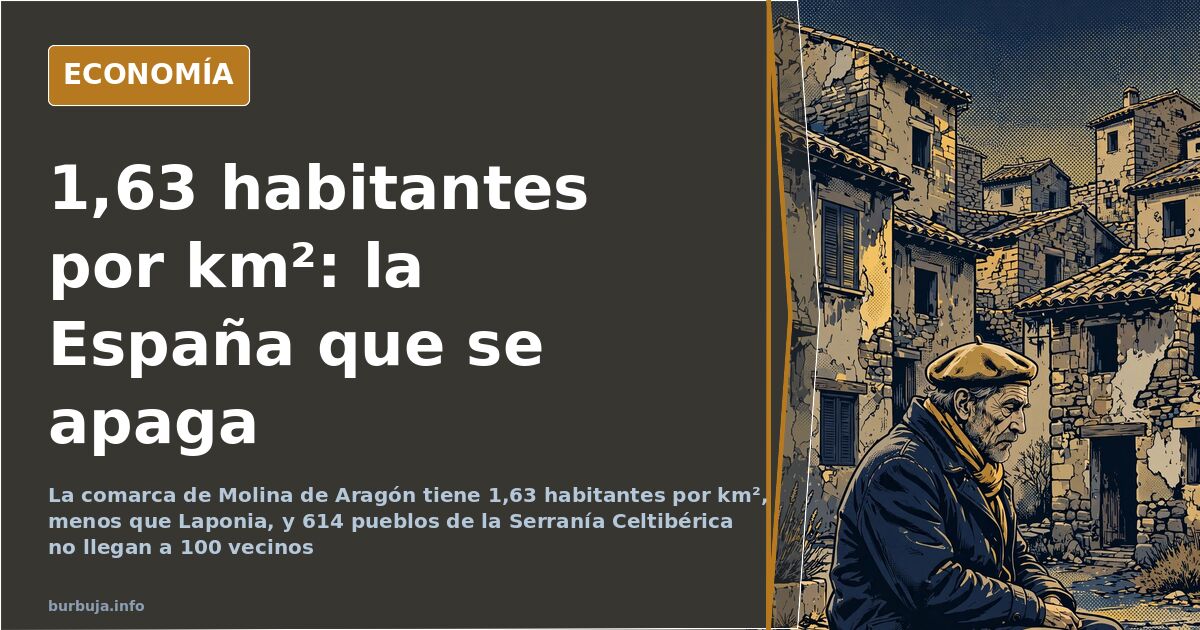
Spain's Empty Interior: 1.63 Inhabitants Per Km² and No Doctors
There is a Spanish region with a population density lower than Lapland. This is not a summer literary exaggeration: in the Lordship of Molina de Aragón (Guadalajara), 1.63 people live per square kilometer, below the rates of Siberia and the Arctic Circle. The data becomes a diagnosis when placed alongside another fact: in some of its villages, nearly half of the residents are over 80 years old. Rural depopulation in Spain is not just a problem of people leaving; it is a problem of people who are no longer of childbearing age.
The territory borders Soria, Zaragoza, Teruel, and Cuenca and acts as an axis for one of Europe's least populated areas. Baker Alberto Usero delivers daily to surrounding villages, selling no more than seventy loaves in high season. He defines his trade, without irony, as "a public service." The school bus does the same, picking up two or three children per village: without it, they would go hungry or miss class. Many of these municipalities have no shop, doctor, or school.
Why Guadalajara's Villages Emptied Out
The exodus began in the late 1950s, driven by developmentalism that needed labor for Madrid's factories and the coast, from a poorly mechanized countryside where leaving was difficult. Entire neighborhoods like Colonia Marconi or Ciudad Pegaso were built. The economy concentrated in coastal areas and major cities. Elsewhere in Europe, industries derived from agricultural products emerged; here, they did not.
Retiree Jerónimo Lorente embodies this statistic with a name and surname. He moved to Madrid, worked at Correos (the national postal service), and returned twenty-one years later. "When I left, my village—Adobes—still had nearly a hundred people, and when I returned, nothing, eight or ten, three light bulbs, and sheep grazing in the streets," he summarizes. He served as mayor for ten years and participated in the platform La otra Guadalajara, sister to Teruel Existe or Soria Ya, which grouped a dozen common demands: roads, broadband, basic services. According to his account, the crisis first and the political cycle later halted pogre.
The Map That Is Fading: 614 Villages With Fewer Than 100 Residents
Professor of Prehistory Francisco Burillo named the area: the Celtiberian Range, an interregional territory of 65,825 square kilometers—twice the size of Belgium—spread across Guadalajara, Cuenca, Soria, and Aragon. It has fewer than half a million inhabitants and lost 8,000 people in a single year, largely due to deaths. Only four locations exceed 20,000 residents: Calatayud, Teruel, Cuenca, and Soria. At the other extreme, 614 municipalities do not reach a hundred neighbors. Burillo describes it as the most fragmented territory in the European Union, with a population pyramid lacking a base and four different administrations that would need to agree to request aid as a global entity.
Farmer Ángel Luis López, aged 47, quantifies the collapse from La Yunta: of every hundred inhabitants, only 25 are of working age, and there are five children. Nearly half the population is over 80. His prognosis is grim: within fifteen years, many of these villages will have disappeared. National trends do not help. Demographic projections indicate that only Madrid, the Canary Islands, the Balearic Islands, Murcia, and Andalusia will gain population in the next fifteen years; the rest of the country shrinks.
Can Spain's Empty Interior Be Repopulated?
The short answer is that no one has succeeded yet. The most repeated recipe involves almost non-existent taxation—1% taxes, no property tax (IBI) or licensing fees—next-generation fiber optics, and zero bureaucracy, arguing that capital and companies would arrive on their own. The problem, other analyses point out, is the margin: within the EU, such a reduction could be read as illegal state aid. The cited mirror is the Swiss cantons of Obwalden and Nidwalden, which compete with ridiculously flat tax rates and have clashed with the federal government over their fiscal policy.
There are more proposals on the table. Forcing municipal mergers, keeping alive only district capitals and villages with historical, geographic, or strategic value, appears as the least romantic and most cited path. Also extensive livestock farming, though with nuances: some argue there are too many pastures and not enough people willing to do work described as slavery; others counter that eastern Guadalajara receives little rain and lacks nearby forests. A third way, letting nature reclaim the land, clashes with food security and an aging Spain.
The real obstacle, according to analyses with direct field experience, is not a lack of resources. It is that properties are in few hands, often inherited and empty, and owners do not let them go even at ruin prices. Those trying to settle find houses uninhabitable for decades priced at €30,000 and rents that sometimes rival Madrid's, with no services or public transport behind them. Motorization is not an option; it is a sentence.
Add the detail that breaks any postcard image: minimum temperatures of minus 35 degrees Celsius have been recorded in these mountains, and electricity and water supplies fail with slightly more rain than usual. However, in some areas, foreign families settled in the countryside have sustained agricultural activity and slowed the loss of residents. It is an uncomfortable fact for all narratives.
The case of alfalfa sold by a village in Teruel to Saudi Arabia repeats as proof that commercialization is no longer a barrier. An architect does not need to be on Castellana Avenue every day. With these pieces on the table, the reasonable prediction is that some district capitals will hold on and become service islands, while the rest of the map fades slowly. Nor should one trust this: ten years after the first diagnosis, the conversation remains open, and the density is lower.
There is a Spanish region with a population density lower than Lapland. This is not a summer literary exaggeration: in the Lordship of Molina de Aragón (Guadalajara), 1.63 people live per square kilometer, below the rates of Siberia and the Arctic Circle. The data becomes a diagnosis when placed alongside another fact: in some of its villages, nearly half of the residents are over 80 years old. Rural depopulation in Spain is not just a problem of people leaving; it is a problem of people who are no longer of childbearing age.
The territory borders Soria, Zaragoza, Teruel, and Cuenca and acts as an axis for one of Europe's least populated areas. Baker Alberto Usero delivers daily to surrounding villages, selling no more than seventy loaves in high season. He defines his trade, without irony, as "a public service." The school bus does the same, picking up two or three children per village: without it, they would go hungry or miss class. Many of these municipalities have no shop, doctor, or school.
Why Guadalajara's Villages Emptied Out
The exodus began in the late 1950s, driven by developmentalism that needed labor for Madrid's factories and the coast, from a poorly mechanized countryside where leaving was difficult. Entire neighborhoods like Colonia Marconi or Ciudad Pegaso were built. The economy concentrated in coastal areas and major cities. Elsewhere in Europe, industries derived from agricultural products emerged; here, they did not.
Retiree Jerónimo Lorente embodies this statistic with a name and surname. He moved to Madrid, worked at Correos (the national postal service), and returned twenty-one years later. "When I left, my village—Adobes—still had nearly a hundred people, and when I returned, nothing, eight or ten, three light bulbs, and sheep grazing in the streets," he summarizes. He served as mayor for ten years and participated in the platform La otra Guadalajara, sister to Teruel Existe or Soria Ya, which grouped a dozen common demands: roads, broadband, basic services. According to his account, the crisis first and the political cycle later halted pogre.
The Map That Is Fading: 614 Villages With Fewer Than 100 Residents
Professor of Prehistory Francisco Burillo named the area: the Celtiberian Range, an interregional territory of 65,825 square kilometers—twice the size of Belgium—spread across Guadalajara, Cuenca, Soria, and Aragon. It has fewer than half a million inhabitants and lost 8,000 people in a single year, largely due to deaths. Only four locations exceed 20,000 residents: Calatayud, Teruel, Cuenca, and Soria. At the other extreme, 614 municipalities do not reach a hundred neighbors. Burillo describes it as the most fragmented territory in the European Union, with a population pyramid lacking a base and four different administrations that would need to agree to request aid as a global entity.
Farmer Ángel Luis López, aged 47, quantifies the collapse from La Yunta: of every hundred inhabitants, only 25 are of working age, and there are five children. Nearly half the population is over 80. His prognosis is grim: within fifteen years, many of these villages will have disappeared. National trends do not help. Demographic projections indicate that only Madrid, the Canary Islands, the Balearic Islands, Murcia, and Andalusia will gain population in the next fifteen years; the rest of the country shrinks.
Can Spain's Empty Interior Be Repopulated?
The short answer is that no one has succeeded yet. The most repeated recipe involves almost non-existent taxation—1% taxes, no property tax (IBI) or licensing fees—next-generation fiber optics, and zero bureaucracy, arguing that capital and companies would arrive on their own. The problem, other analyses point out, is the margin: within the EU, such a reduction could be read as illegal state aid. The cited mirror is the Swiss cantons of Obwalden and Nidwalden, which compete with ridiculously flat tax rates and have clashed with the federal government over their fiscal policy.
There are more proposals on the table. Forcing municipal mergers, keeping alive only district capitals and villages with historical, geographic, or strategic value, appears as the least romantic and most cited path. Also extensive livestock farming, though with nuances: some argue there are too many pastures and not enough people willing to do work described as slavery; others counter that eastern Guadalajara receives little rain and lacks nearby forests. A third way, letting nature reclaim the land, clashes with food security and an aging Spain.
The real obstacle, according to analyses with direct field experience, is not a lack of resources. It is that properties are in few hands, often inherited and empty, and owners do not let them go even at ruin prices. Those trying to settle find houses uninhabitable for decades priced at €30,000 and rents that sometimes rival Madrid's, with no services or public transport behind them. Motorization is not an option; it is a sentence.
Add the detail that breaks any postcard image: minimum temperatures of minus 35 degrees Celsius have been recorded in these mountains, and electricity and water supplies fail with slightly more rain than usual. However, in some areas, foreign families settled in the countryside have sustained agricultural activity and slowed the loss of residents. It is an uncomfortable fact for all narratives.
The case of alfalfa sold by a village in Teruel to Saudi Arabia repeats as proof that commercialization is no longer a barrier. An architect does not need to be on Castellana Avenue every day. With these pieces on the table, the reasonable prediction is that some district capitals will hold on and become service islands, while the rest of the map fades slowly. Nor should one trust this: ten years after the first diagnosis, the conversation remains open, and the density is lower.
Also available in: Deutsch
Summary of a discussion on Burbuja.info - Foro de economía, actualidad y política., translated from Spanish and reviewed before publication. Read the full discussion (112 replies).
More summaries
-
Pilar Alegría's Controversial Appearance at Ábalos' Party in Teruel
Pilar Alegría, Spain's Government Delegate in Aragon, faces scrutiny for attending a private party with former minister José Luis Ábalos in Teruel.
-
Spain's average worker faces 21,100 euros in annual tax burden
A report circulating in a recent debate estimates Spain's average worker bears 21,100 euros annually in combined tax and social security costs.
-
Spain's Equality Ministry: 114,576 Prostitution Ads in 2023
Spain's Equality Ministry estimated 114,576 women advertised on prostitution sites in 2023. This represents roughly 1% of the fertile-age population, though data reflects ads, not unique individuals.
-
Half of Spain's Unemployment Benefit Recipients Rely on Non-Contributory Aid
In October, half of the 1.73 million unemployment benefit recipients in Spain relied on non-contributory aid, blurring the line between insurance and welfare.
-
Spain's SER Radio Leak Reveals Government Panic Over UCO Report
An open microphone on Cadena SER captured a tense exchange between Deputy PM Montero and a journalist regarding the UCO report implicating Santos Cerdán.
-
Madrid Mayor Almeida Marries Teresa Urquijo, 21 Years Younger
José Luis Martínez-Almeida and Teresa Urquijo will marry on April 6. The proposal occurred on Christmas Eve; the bride is 27, twenty-one years younger than Madrid's mayor.