
Spain’s Duero Basin at 82% amid April Snowfall
Duero basin hits 82% water storage in April while Catalonia faces restrictions, reigniting climate debates.
English · Original discussion in Spanish · Published
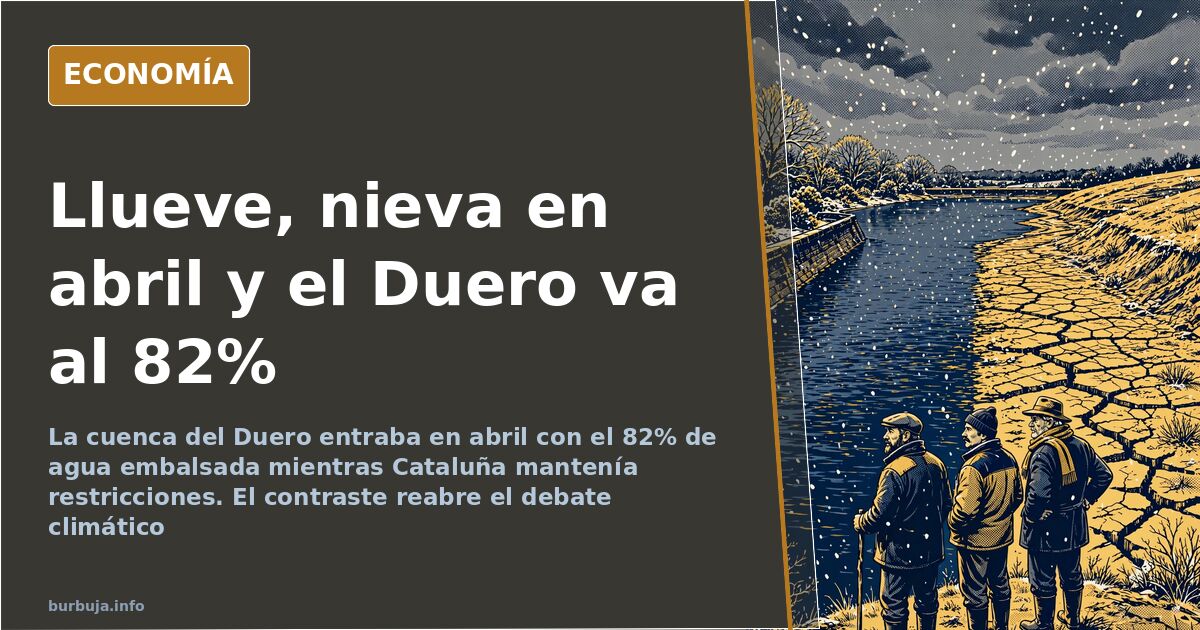
Record drought year ends with reservoirs at 82% and snow
The calendar predicted drought, but reality showed otherwise. While Catalonia remained under water restrictions, forum users claimed the Duero basin entered April with 82% of its reservoir capacity filled, exceeding its last decade's average. Some recalled April snow in Somosierra and a rain-soaked Easter in Seville. A user noted that Murcia, en route to Cabo de Gata—a region theoretically receiving Europe’s lowest precipitation—also saw rain. The gap between climate narratives and observed weather is exactly what sparked recent debate, with no consensus emerging.
How much water do reservoirs actually hold?
The most cited yet uncomfortable data point: the Duero basin at 82% capacity and rising, above the ten-year average according to shared messages. February and March were reportedly exceptionally rainy in many areas, with viral posts claiming El Grado reservoir in Huesca was full. Conversely, another message ironically referenced Torcón reservoir releasing excess water via spillways. Thread calculations suggest Extremadura and Andalucía combined hold three to four times more water than Catalonia’s internal basins. Drought measured in cubic hectometers isn’t uniform; it depends on rainfall location and storage infrastructure, not just precipitation levels.
Greener cities but less forest than perceived
Drivers across Spain report noticeably greener landscapes compared to a decade ago: grass in cracks, corners, and around tree pits, automated irrigation, and increased wildlife. However, impressions don’t equate to data. Forest cover is different, with conflicting claims: some assert Navarra leads with 54% of its forest area managed and Catalonia second, while others place Castilla y León as having the most forest. Cited aerial photos indicate significantly more trees in Spain and Europe than in 1900, a fact leveraged by all sides.
Climate has always changed: the skeptical argument
The recurring thesis emphasizes natural cycles. Messages defending this view note Earth has regulated itself for billions of years, with solar activity driving temperature fluctuations. They cite the Triassic period, antiestéticaturing seas at 40 ºC and continents at 60 ºC, as evidence extreme climates existed pre-industry. This foundation critiques official frameworks: if it rains, it’s attributed to climate change; if it doesn’t, likewise, making the argument unfalsifiable. Another thread blames lack of rain on alleged aerial spraying, unsupported by data. The core accusation is political, not meteorological: some claim climate serves as a tool for social control.
Greenland, the Arctic, and melting ice
On March 15, 2024, European Commission President Ursula von der Leyen peine the EU representation office in Greenland and signed two cooperation agreements with the Danish autonomous territory’s government, emphasizing the Arctic must remain peaceful and secure. Parallel discussions mention pogre Arctic ice melt, interpreted by some as alarming and by others as natural cycling. Historical counterarguments reference Greenland’s coasts, where farming occurred for two centuries starting in the 11th century until cooling halted it. The fundamental debate centers on whether current changes are natural or human-driven.
Catalonia, internal basins, and National Water Plan
The most highlighted contrast is regional: Catalonia’s restrictions versus El Grado reservoir overflowing in Huesca, per shared reports. This sparks disputes over management—transferred internal basins, spending priorities, and perceptions of delayed hydraulic policy. Politically, calls emerge for a National Water Plan ending described regional confrontation policies, timed ahead of May 12 Catalan elections.
The open question isn’t meteorological. If reservoirs rise, February and March break rainfall records, and April brings snow to Somosierra, why does water policy still assume imminent desertification? Perhaps the issue isn’t climate, but who allocates water when available.
The calendar predicted drought, but reality showed otherwise. While Catalonia remained under water restrictions, forum users claimed the Duero basin entered April with 82% of its reservoir capacity filled, exceeding its last decade's average. Some recalled April snow in Somosierra and a rain-soaked Easter in Seville. A user noted that Murcia, en route to Cabo de Gata—a region theoretically receiving Europe’s lowest precipitation—also saw rain. The gap between climate narratives and observed weather is exactly what sparked recent debate, with no consensus emerging.
How much water do reservoirs actually hold?
The most cited yet uncomfortable data point: the Duero basin at 82% capacity and rising, above the ten-year average according to shared messages. February and March were reportedly exceptionally rainy in many areas, with viral posts claiming El Grado reservoir in Huesca was full. Conversely, another message ironically referenced Torcón reservoir releasing excess water via spillways. Thread calculations suggest Extremadura and Andalucía combined hold three to four times more water than Catalonia’s internal basins. Drought measured in cubic hectometers isn’t uniform; it depends on rainfall location and storage infrastructure, not just precipitation levels.
Greener cities but less forest than perceived
Drivers across Spain report noticeably greener landscapes compared to a decade ago: grass in cracks, corners, and around tree pits, automated irrigation, and increased wildlife. However, impressions don’t equate to data. Forest cover is different, with conflicting claims: some assert Navarra leads with 54% of its forest area managed and Catalonia second, while others place Castilla y León as having the most forest. Cited aerial photos indicate significantly more trees in Spain and Europe than in 1900, a fact leveraged by all sides.
Climate has always changed: the skeptical argument
The recurring thesis emphasizes natural cycles. Messages defending this view note Earth has regulated itself for billions of years, with solar activity driving temperature fluctuations. They cite the Triassic period, antiestéticaturing seas at 40 ºC and continents at 60 ºC, as evidence extreme climates existed pre-industry. This foundation critiques official frameworks: if it rains, it’s attributed to climate change; if it doesn’t, likewise, making the argument unfalsifiable. Another thread blames lack of rain on alleged aerial spraying, unsupported by data. The core accusation is political, not meteorological: some claim climate serves as a tool for social control.
Greenland, the Arctic, and melting ice
On March 15, 2024, European Commission President Ursula von der Leyen peine the EU representation office in Greenland and signed two cooperation agreements with the Danish autonomous territory’s government, emphasizing the Arctic must remain peaceful and secure. Parallel discussions mention pogre Arctic ice melt, interpreted by some as alarming and by others as natural cycling. Historical counterarguments reference Greenland’s coasts, where farming occurred for two centuries starting in the 11th century until cooling halted it. The fundamental debate centers on whether current changes are natural or human-driven.
Catalonia, internal basins, and National Water Plan
The most highlighted contrast is regional: Catalonia’s restrictions versus El Grado reservoir overflowing in Huesca, per shared reports. This sparks disputes over management—transferred internal basins, spending priorities, and perceptions of delayed hydraulic policy. Politically, calls emerge for a National Water Plan ending described regional confrontation policies, timed ahead of May 12 Catalan elections.
The open question isn’t meteorological. If reservoirs rise, February and March break rainfall records, and April brings snow to Somosierra, why does water policy still assume imminent desertification? Perhaps the issue isn’t climate, but who allocates water when available.
Also available in: Deutsch
Summary of a discussion on Burbuja.info - Foro de economía, actualidad y política., translated from Spanish and reviewed before publication. Read the full discussion (136 replies).
More summaries
-
Von der Leyen: "The cheapest energy is the one you don't use"
Ursula von der Leyen preaches energy savings as the Economics forum debates whether this signals an era of imposed scarcity and degrowth.
-
EU probes subsidies for Chinese electric vehicles
The European Commission launches an anti-subsidy investigation into Chinese EVs, questioning the origin of European battery supply chains.
-
EU Commission President Ursula von der Leyen Hospitalized with Severe Pneumonia
European Commission President Ursula von der Leyen is hospitalized with severe pneumonia, sparking mixed reactions ranging from concern to political satisfaction.
-
Euribor rises to 3.374% while September average nears 3.2%
Euribor rises by 0.048% to 3.374%, while the September average hits 3.166% versus last year's 2.172%. The variables are under scrutiny.
-
Useless vs useful degrees: salary and regret chart
A chart links expected salaries with graduate regret. Dentistry pays less than Music, while Teaching outperforms Engineering.
-
Spain's Congress bans 'MENA' term as stigmatizing
Spain's Congressional Bureau approved text to avoid the term 'MENA' for being stigmatizing. The euphemism debate leaves language options scarce.