
Spain’s Drought Narrative Monetized on YouTube
Reservoirs at 56.7%, above average, while rural content creators monetize drought complaints. The crisis exists, but so does the business of storytelling.
English · Original discussion in Spanish · Published
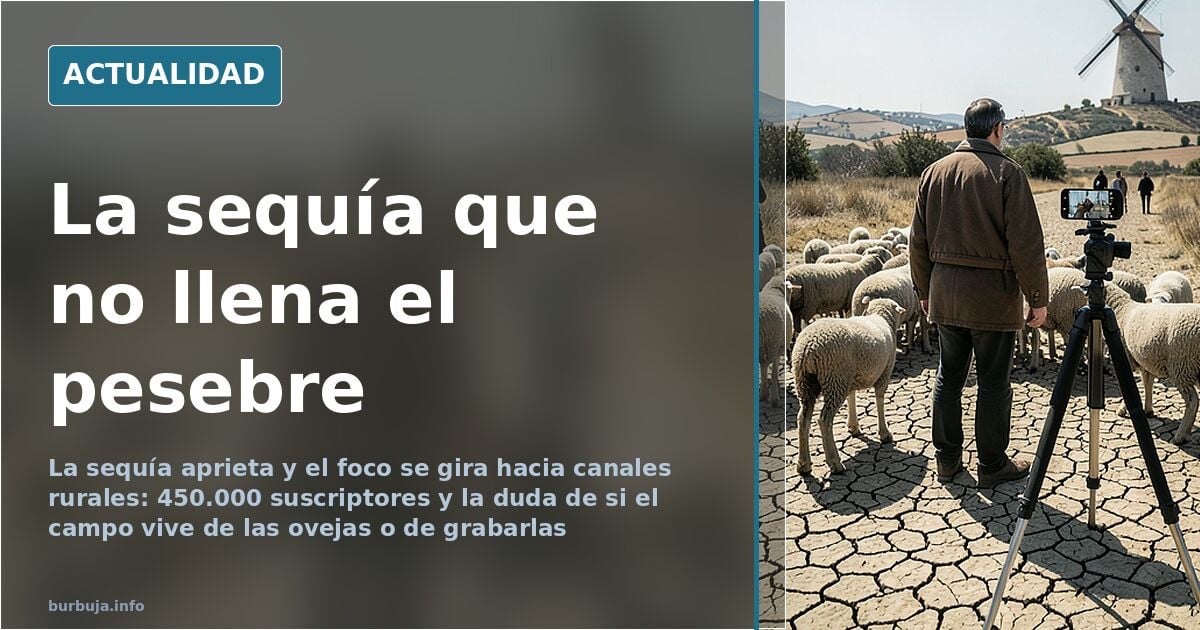
No rain and this is no longer just a drought: it’s a business model
Spanish agriculture has been looking to the sky for months, finding only weeds where grass once grew. Lack of rainfall has become the new backdrop for part of the rural YouTube ecosystem, where climate grievances coexist with daily monetization. A video about drought generates views; a lesson on livestock margins does not. That is the problem.
The public debate on farming has shifted from agronomic data to audiovisual narrative. According to figures circulating in the discussion, Iberian reservoirs are at 56.7% capacity, compared to 51.8% last year and well above the decade’s average of 43.28%. In other words: the water drama is real, but its temporal and geographic scope is more nuanced than the apocalyptic tone adopted by certain channels suggests.
The business isn’t in the sheep: it’s in the camera
The Nazaret Martín phenomenon, with nearly 450,000 subscribers, has moved from showing life on a family farm to building an audiovisual product around the figure of a shepherdess who, according to circulating estimates, could be generating several thousand euros monthly solely from YouTube ads. The underlying question isn’t whether one can make a living creating content, but whether that content responds to those seeking to learn the trade or to those consuming the character.
After hundreds of videos, there remains no public breakdown of operating costs, income per lamb, veterinary expenses, or net margin per head. Some argue this opacity is deliberate: if the actual balance sheet of livestock farming were worse than that of a video with 300,000 views, the narrative of hardship would collapse. Counterarguments state that no farmer is obliged to publish their numbers and that dissemination is not equivalent to an audit.
Drought as excuse and the data that nuances it
The climatic context is real, but it coexists with a statistical anomaly that unsettles the most catastrophic narratives. The cited reservoirs exceed historical averages, and the olive campaign is presented, based on available data, as one of the best in years thanks to October rains. Drought is not homogeneous: it hits northern Seville hard, where fields appear yellow and barren, while other areas breathe easier.
In this context, permanent grievance functions as a narrative formula. Farming becomes a stage, meteorology a script, and indignation a hook. This is not exclusive to the primary sector: it is the logic of the attention economy applied to any niche, including depopulated Spain.
Why isn’t there a profitable livestock manual on YouTube?
Because profitable manuals don’t go viral. A video explaining how many heads are needed to live decently, what initial investment a farm requires, and how much remains after paying everything doesn’t compete with an anecdote about a bored goat. The algorithm rewards conflict, personality, and recurrence; it penalizes cold pedagogy. Those who live off this know it.
The paradox is that the same audience consuming the character receives no tools to replicate it. The lingering question is whether this is a flaw, a choice, or a model. The honest answer, given published evidence, is that the system better rewards the narrative of scarcity than technical solutions to it.
With reservoirs above average and fields turned into studios, drought will remain a serious problem. But the water issue faces unexpected competition: the problem of who tells the story of water and why.
Also available in: Deutsch
Summary of a discussion on Burbuja.info - Foro de economía, actualidad y política., translated from Spanish and reviewed before publication. Read the full discussion (62 replies).
More summaries
-
Ayuso Criticizes La Sexta Over Grandfather's Past
La Sexta Columna report on Ayuso's grandfather as Falange leader sparks controversy over politicians' family histories.
-
Agenda 2030: From Theory to Real Restrictions
Agenda 2030: Analysis of restrictions on consumption, mobility, and food proposed by global frameworks
-
Birth rate debate exposes anti-woke hypocrisy over childlessness
A viral tweet highlights the contradiction of some anti-woke figures who demand children from others while approaching 40 without any of their own, according to a tally that…
-
La bola negra: $4.7M opening, polarized audience in Spain
Spain's 'La bola negra' earned $4.7 million on opening weekend, becoming the year's top-grossing film despite accusations of propaganda.
-
Spain's High Treason Laws: Penalties and Misuse Explained
Spain's Penal Code punishes high treason with up to 20 years in peacetime. This video explains the legal definition and why the term is often misused.
-
Poland Attack Conspiracy Claims Lack Evidence
Viral claims link Krakow attack figures to Norway and Madrid via numerology. The alleged pattern is flawed, citing a future date for the incident.