
Spain's Double Kiss Fades: Zero Contact and Bowing Replace the Gesture
The double kiss is no longer automatic in Spain following the Rubiales case. Zero-contact greetings and bows are gaining ground in social and professional settings.
English · Original discussion in Spanish · Published
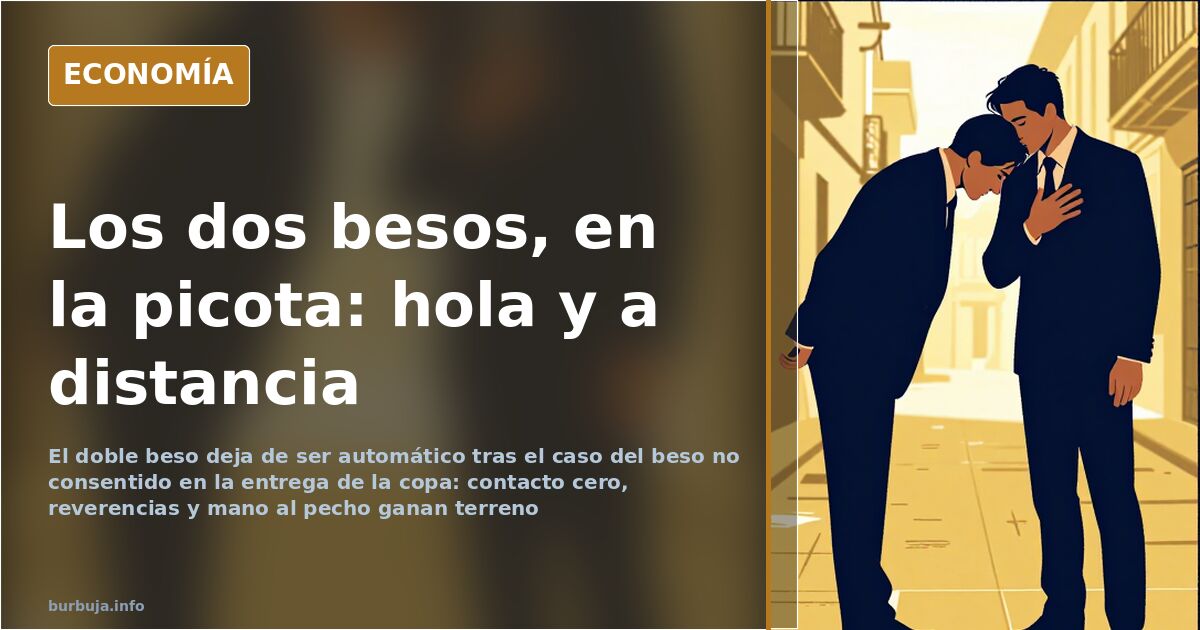
Spain's Double Kiss Fades: Zero Contact, Bowing, and Hand to Chest
Does the traditional double kiss still make sense when meeting someone new? This doubt, seemingly resolved for decades, has returned strongly trinc the non-consensual kiss incident during the Women's World Cup final. With Luis Rubiales in the stands, the most common greeting in Spain has ceased to be automatic for many. Now, justification is required, and many prefer to avoid it entirely.
The Catalyst: A Kiss on Camera
Consent laws are not new, nor is this unique to Spain. What was unprecedented was the global spotlight: world champions receiving the trophy with cameras rolling. No such case had ever occurred, as noted in the thread. It shifted from a private anecdote to a national conversation.
The result is a slippery slope. Some joke that if consent is recorded on your phone, behavior doesn't matter; but when presenting someone, giving two kisses is seen as collaborating with certain narratives. This contradiction circulates naturally, dragging along a collateral victim: the lifelong greeting.
Bows, Hand to Chest, and the Thai Wai
With physical contact closed off, imagination runs wild. The Japanese bow leads the list: elegant, discreet, and hard to misinterpret—unless one is bald and the reading is ambiguous. A simple nod, with hugs reserved for friends, is another formula defended as the new standard.
The Thai wai, with hands together at face level, is touted as a proven solution from the pandemic, when elbows served as a sanitary border. Some revive the old-fashioned hand kiss, the Roman salute, or a manly "Hail Caesar", while others simply place their palm on their chest. This is what snooker player Rory McLeod did, refusing to shake hands with the referee. He placed his hand on his chest, sparking controversy.
The Workplace: Where the Double Kiss Was Always Suspicious
In professional settings, the rules change. A firm handshake with eye contact has always been the norm; attempting two kisses in the office is considered unprofessional. One participant points to an exception: environments with balanced or majority-female staff—public administration, consulting, teaching, legal advice, advertising, commerce—where kisses are deemed inevitable. Among men, the handshake remains hegemonic, according to this narrative.
One participant notes that his company legislated distrust years ago. An internal rule prohibits men and women from meeting alone; a third person must always be present. Two men can meet; two women can meet. A man and a woman cannot.
The Inverse Case: When Harassment Comes from the Other Side
The conversation breaks when someone raises the opposite direction. One participant recounts that two female employees, whom he managed, grabbed his buttocks, one with an attempted kiss and lick, and he executed a "cobra" move to escape. The episode, according to his account, occurred nearly ten years ago. Responses range from "report it" to pure mockery.
Thus emerges a double standard discussed openly: the same act—touching someone's buttocks—carries vastly different social gravity depending on who commits it. It is not a proven thesis, but a repeated perception, which must be acknowledged.
The Overton Window and the Language of Greetings
Nostalgia has its own thesis. In the 1980s and 90s, giving two kisses to any woman introduced to you was normal, and refusing was frowned upon. The Overton window has shifted in the last twenty years, turning a trivial greeting into a matter of public scrutiny. Those who hold this view ask for a time machine.
Parallel to this is a minor war over words. "Encantado" is labeled as French modernity, "good morning" is cut for brevity, and the recommendation is to speak with a grave voice, circumspect expression, and distance marked by oneself. A dry "hello," nothing more. Some go further, insisting on zero contact, verbal greeting, and moving on.
In the end, there remains the handshake, the bow, and the palm on the chest. And above all, staying still and saying a simple hello.lest, at the next introduction, the only one with written consent be the other.
Does the traditional double kiss still make sense when meeting someone new? This doubt, seemingly resolved for decades, has returned strongly trinc the non-consensual kiss incident during the Women's World Cup final. With Luis Rubiales in the stands, the most common greeting in Spain has ceased to be automatic for many. Now, justification is required, and many prefer to avoid it entirely.
The Catalyst: A Kiss on Camera
Consent laws are not new, nor is this unique to Spain. What was unprecedented was the global spotlight: world champions receiving the trophy with cameras rolling. No such case had ever occurred, as noted in the thread. It shifted from a private anecdote to a national conversation.
The result is a slippery slope. Some joke that if consent is recorded on your phone, behavior doesn't matter; but when presenting someone, giving two kisses is seen as collaborating with certain narratives. This contradiction circulates naturally, dragging along a collateral victim: the lifelong greeting.
Bows, Hand to Chest, and the Thai Wai
With physical contact closed off, imagination runs wild. The Japanese bow leads the list: elegant, discreet, and hard to misinterpret—unless one is bald and the reading is ambiguous. A simple nod, with hugs reserved for friends, is another formula defended as the new standard.
The Thai wai, with hands together at face level, is touted as a proven solution from the pandemic, when elbows served as a sanitary border. Some revive the old-fashioned hand kiss, the Roman salute, or a manly "Hail Caesar", while others simply place their palm on their chest. This is what snooker player Rory McLeod did, refusing to shake hands with the referee. He placed his hand on his chest, sparking controversy.
The Workplace: Where the Double Kiss Was Always Suspicious
In professional settings, the rules change. A firm handshake with eye contact has always been the norm; attempting two kisses in the office is considered unprofessional. One participant points to an exception: environments with balanced or majority-female staff—public administration, consulting, teaching, legal advice, advertising, commerce—where kisses are deemed inevitable. Among men, the handshake remains hegemonic, according to this narrative.
One participant notes that his company legislated distrust years ago. An internal rule prohibits men and women from meeting alone; a third person must always be present. Two men can meet; two women can meet. A man and a woman cannot.
The Inverse Case: When Harassment Comes from the Other Side
The conversation breaks when someone raises the opposite direction. One participant recounts that two female employees, whom he managed, grabbed his buttocks, one with an attempted kiss and lick, and he executed a "cobra" move to escape. The episode, according to his account, occurred nearly ten years ago. Responses range from "report it" to pure mockery.
Thus emerges a double standard discussed openly: the same act—touching someone's buttocks—carries vastly different social gravity depending on who commits it. It is not a proven thesis, but a repeated perception, which must be acknowledged.
The Overton Window and the Language of Greetings
Nostalgia has its own thesis. In the 1980s and 90s, giving two kisses to any woman introduced to you was normal, and refusing was frowned upon. The Overton window has shifted in the last twenty years, turning a trivial greeting into a matter of public scrutiny. Those who hold this view ask for a time machine.
Parallel to this is a minor war over words. "Encantado" is labeled as French modernity, "good morning" is cut for brevity, and the recommendation is to speak with a grave voice, circumspect expression, and distance marked by oneself. A dry "hello," nothing more. Some go further, insisting on zero contact, verbal greeting, and moving on.
In the end, there remains the handshake, the bow, and the palm on the chest. And above all, staying still and saying a simple hello.lest, at the next introduction, the only one with written consent be the other.
Also available in: Deutsch
Summary of a discussion on Burbuja.info - Foro de economía, actualidad y política., translated from Spanish and reviewed before publication. Read the full discussion (219 replies).
More summaries
-
Jenni Hermoso Testifies to Prosecutor Over Rubiales Kiss
Jenni Hermoso formalizes her complaint with the Prosecutor's Office over Rubiales' kiss, in a case with jurisdictional doubts and a possible coercion front.
-
Irene Montero’s Tarot Habits Spark Debate on Spain’s Equality Ministry
Equality Minister Irene Montero’s reported reliance on horoscopes and tarot raises questions about esoteric influences on public policy and institutional credibility.
-
Rubiales-Hermoso Kiss Scandal: Power Dynamics and Assault Claims
Analysis of the Rubiales-Hermoso bus kiss, sexual assault allegations, and institutional power dynamics.
-
Pornhub’s VP is an Orthodox Rabbi: The Ethical Paradox
Solomon Friedman, an ordained Orthodox rabbi, serves as Pornhub’s vice president, sparking debate on ethics, parental responsibility, and the adult industry’s influence.
-
Watching Marc Vidal's Videos Leaves Me Massively Depressed
An analysis of Marc Vidal's impact: informative value or economic alarmism? Discover forum opinions on his style, credibility and business model.
-
BREAKING: Serious stabbing in Barcelona's Plaça de Catalunya
Stabbing in Plaça de Catalunya, Barcelona: a minor arrested, victim seriously injured, and a Burbuja.info thread that breaks stereotypes about insecurity in the city.