
Spain's dominant forecast: nothing will change
The prevailing view holds that amnesty, protests, and monarchy debates won't alter the status quo; citizens are expected to accept the current situation.
English · Original discussion in Spanish · Published
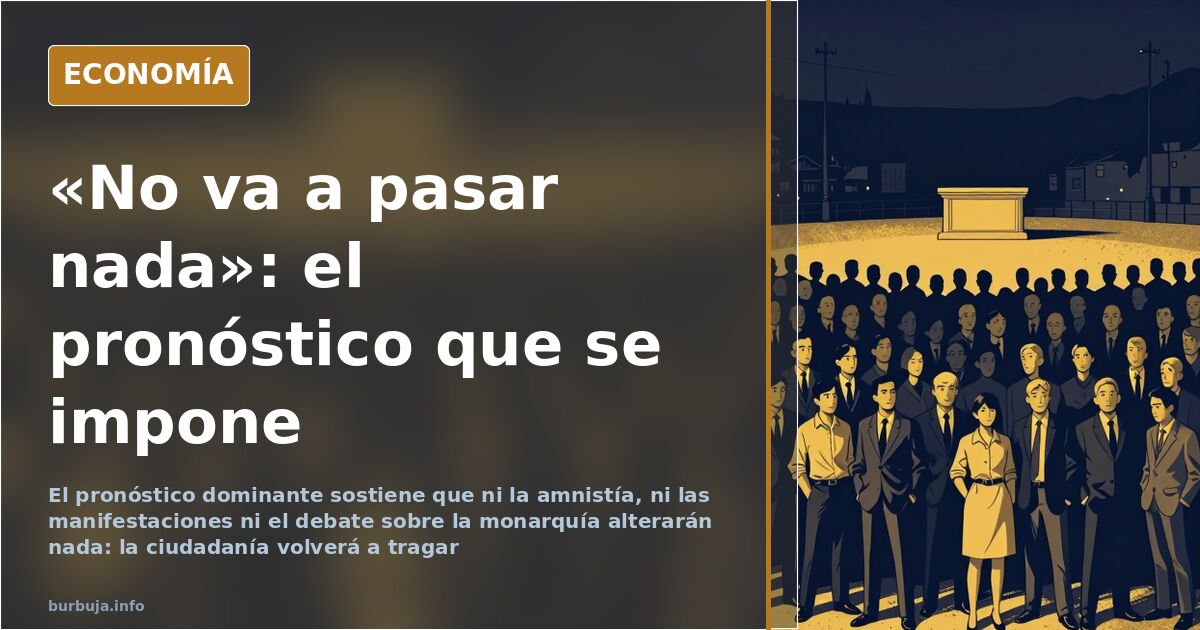
Spain faces a forecast of political stagnation: nothing is going to change
Nothing is going to happen. That is the conclusion dominating analyses of Spain's immediate future: neither the amnesty, nor the agreement with separatists, nor the protests, nor the debate on the monarchy will move the status quo by a millimeter. The prevailing diagnosis is that citizens will simply swallow it again, public officials will keep getting paid, and in a year no one will remember anything. The thesis isn't new, but the consensus with which it is repeated is striking.
The central forecast: entertainment for the masses and money for the usual suspects
The most repeated argument is that major public issues function as "peanuts for voters": periodic distractions that do not alter the power structure. Those holding significant positions, this current holds, will end up placed elsewhere with salaries many won't see in half a lifetime. The cycle repeats regardless of who is in government.
To this is added the demographic factor. It is argued that an aging population, with a large part living on public transfers—pensions, public employment, subsidies—has few incentives to mobilize. Add a migrant population focused on surviving and paying rent, and the demobilizing cocktail is served. The conclusion is that the critical mass needed no longer exists.
Why is it taken for granted there will be no general strike or cycle change?
The most repeated answer is that unions are part of the system and won't bite the hand that feeds them. To this is added the antiestéticar of losing privileges: those receiving aid, pensions, or public posts don't take risks. According to this analysis, protests will fizzle out within weeks.
Some go further, arguing that the pandemic itself left the population more apathetic and sheep-like, willing to accept restrictions and forget quickly. The episode of evening applause and the subsequent lack of demands for accountability is cited as proof that collective memory is short.
Loss of purchasing power: the change that is actually happening
Against the "nothing will happen" narrative, another current responds with an uncomfortable nuance: something is happening, and it is sustained impoverishment. The jump in oil prices from just over one euro to six euros per bottle is mentioned as an example of life becoming more expensive without anyone resigning or anything falling apart. Tax hikes to fund public spending are taken for granted.
Added to this are specific forecasts: shortages of nitrates, fertilizers, pesticides, paper, expensive diesel, and a cold winter. The thesis is that material deterioration advances even if spectacle politics doesn't change.
The underlying diagnosis: a society without a homeland or common project
One of the most cited reflections argues that Spaniards lack a real homeland: except for the nobility and those with political perks, everyone else pays taxes, fines, and lives without justice or effective rights. The conclusion is that there is no collective project to defend, and without a project, there is no mobilization.
Attention is also drawn to the division among voters who treat politics like a football team, lacking critical thinking about their party's actions. And to a disorienting detail: part of the population that feels discriminated against in their own country openly says they won't lift a finger for it. This rootlessness, they argue, is the perfect fuel for nothing changing.
The discarded scenario: civil conflict and historical shifts
The hypothesis of civil conflict is dismissed as an exaggeration by those needing professional help. It is recalled that the world order was decided in 1945, not 1939: what trinc was domestic management with no possible continuity once the leader disappeared.
As a closing remark, the most repeated prediction: the current president will only leave when the country is in absolute misery and there is no money left for subsidies. As long as the party lasts, he stays. And if he ever appears in court, it will be read as theater. The only certainty repeated is the money already pocketed, the money being pocketed, and the money to be pocketed.
Nothing is going to happen. That is the conclusion dominating analyses of Spain's immediate future: neither the amnesty, nor the agreement with separatists, nor the protests, nor the debate on the monarchy will move the status quo by a millimeter. The prevailing diagnosis is that citizens will simply swallow it again, public officials will keep getting paid, and in a year no one will remember anything. The thesis isn't new, but the consensus with which it is repeated is striking.
The central forecast: entertainment for the masses and money for the usual suspects
The most repeated argument is that major public issues function as "peanuts for voters": periodic distractions that do not alter the power structure. Those holding significant positions, this current holds, will end up placed elsewhere with salaries many won't see in half a lifetime. The cycle repeats regardless of who is in government.
To this is added the demographic factor. It is argued that an aging population, with a large part living on public transfers—pensions, public employment, subsidies—has few incentives to mobilize. Add a migrant population focused on surviving and paying rent, and the demobilizing cocktail is served. The conclusion is that the critical mass needed no longer exists.
Why is it taken for granted there will be no general strike or cycle change?
The most repeated answer is that unions are part of the system and won't bite the hand that feeds them. To this is added the antiestéticar of losing privileges: those receiving aid, pensions, or public posts don't take risks. According to this analysis, protests will fizzle out within weeks.
Some go further, arguing that the pandemic itself left the population more apathetic and sheep-like, willing to accept restrictions and forget quickly. The episode of evening applause and the subsequent lack of demands for accountability is cited as proof that collective memory is short.
Loss of purchasing power: the change that is actually happening
Against the "nothing will happen" narrative, another current responds with an uncomfortable nuance: something is happening, and it is sustained impoverishment. The jump in oil prices from just over one euro to six euros per bottle is mentioned as an example of life becoming more expensive without anyone resigning or anything falling apart. Tax hikes to fund public spending are taken for granted.
Added to this are specific forecasts: shortages of nitrates, fertilizers, pesticides, paper, expensive diesel, and a cold winter. The thesis is that material deterioration advances even if spectacle politics doesn't change.
The underlying diagnosis: a society without a homeland or common project
One of the most cited reflections argues that Spaniards lack a real homeland: except for the nobility and those with political perks, everyone else pays taxes, fines, and lives without justice or effective rights. The conclusion is that there is no collective project to defend, and without a project, there is no mobilization.
Attention is also drawn to the division among voters who treat politics like a football team, lacking critical thinking about their party's actions. And to a disorienting detail: part of the population that feels discriminated against in their own country openly says they won't lift a finger for it. This rootlessness, they argue, is the perfect fuel for nothing changing.
The discarded scenario: civil conflict and historical shifts
The hypothesis of civil conflict is dismissed as an exaggeration by those needing professional help. It is recalled that the world order was decided in 1945, not 1939: what trinc was domestic management with no possible continuity once the leader disappeared.
As a closing remark, the most repeated prediction: the current president will only leave when the country is in absolute misery and there is no money left for subsidies. As long as the party lasts, he stays. And if he ever appears in court, it will be read as theater. The only certainty repeated is the money already pocketed, the money being pocketed, and the money to be pocketed.
Also available in: Deutsch
Summary of a discussion on Burbuja.info - Foro de economía, actualidad y política., translated from Spanish and reviewed before publication. Read the full discussion (106 replies).
More summaries
-
Inda links Inquilinas spokesman in Sol to €80 million
Eduardo Inda attributes €80 million in real estate companies to the spokesman of the Tenants Union in Sol, amid allegations of pressure on Urbagestión.
-
Hazte Oír Fails to Serve Sarah Santaolalla in Spain
Spanish Catholic group Hazte Oír seeks €30,000 from commentator Sarah Santaolalla; a Salamanca court suspends the hearing for the third time as she remains unlocatable.
-
French Sociologist Studied Machismo as Dominatrix for Five Years
A French sociologist worked five years as a dominatrix to study machismo, claiming it reduced her anger toward men.
-
Spain Blackout Cause Still Unconfirmed Amid Silence
The cause of Spain's blackout remains officially unconfirmed. Hypotheses point to France and Morocco without public evidence, amid government silence.
-
Single Women Over 30: The Gender Gap in Modern Dating
Nearly 80 women explain why they remain single after 30: not a lack of love, but men failing to meet basic cohabitation standards.
-
EU Plans Ban on Wood Boilers from 2027
Brussels prepares rules to phase out wood stoves by 2027, requiring automatic controls that prevent use without electricity.