
Spain's demographic gap: Who will pay for pensions without immigration?
The Spanish pension system faces a demographic crisis that immigration alone may not solve. An analysis of the complex debate surrounding social security.
English · Original discussion in Spanish · Published
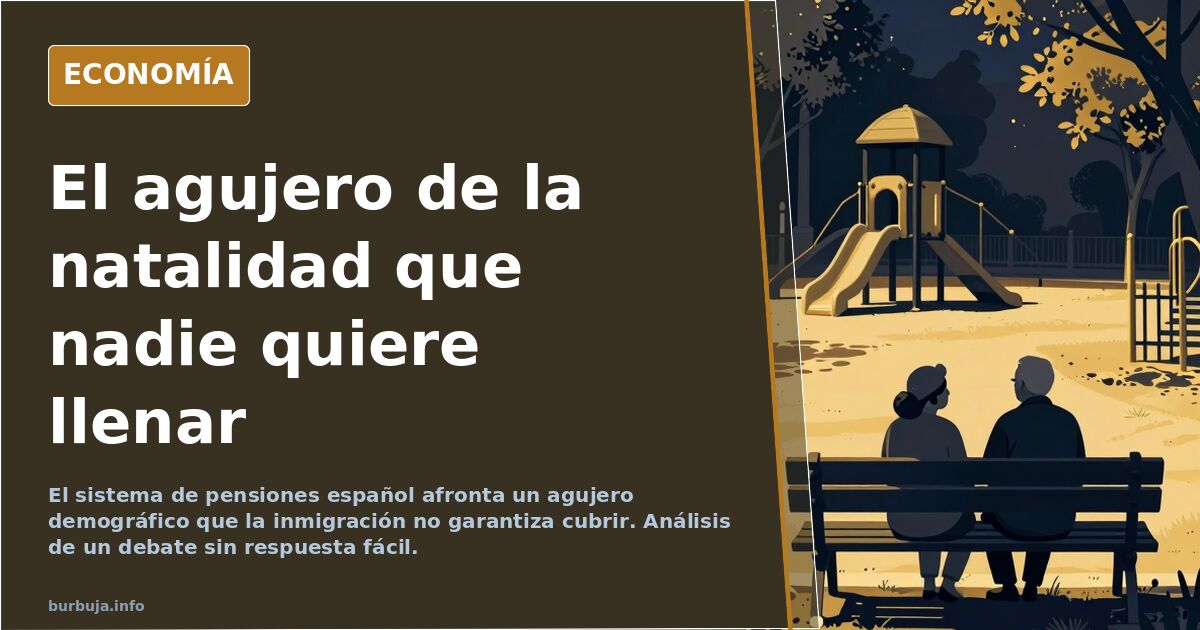
Without immigration, who will sustain the pension system?
The Spanish pension system faces a contradiction that cannot be ignored: birth rates are failing to provide generational replacement, and immigration is being presented as the only possible fix, though no one can guarantee its effectiveness. This fundamental debate runs through economic analyses: without young people, there are no contributors; without contributors, there are no pensions. The question is not rhetorical; it is arithmetic.
The initial premise summarizes it bluntly: "We do not want immigrants, but we also do not want to have children. Something is failing here." This dilemma is uncomfortable because it pits two simultaneous rejections against each other: demographic and migratory. Those supporting this thesis add an important nuance: it is not about "ethnic replacement," but about a birth rate gap that someone will have to fill. They also warn that relying on unskilled immigration will impoverish the country.
The system trap: Is it a pyramid scheme?
The first line of criticism does not dispute the diagnosis, but rather the design. It is argued that the pay-as-you-go system (sistema de reparto) functions like a pyramid structure where "the last one in" pays for the party. This is a recurring accusation: current pensions would not be sustainable with or without immigration because the problem is structural. Private savings appear as the only real way out for those who do not want to depend on a political promise.
Some go further, flatly declaring that pensions are "a scam." This is not a marginal stance; it connects with the distrust toward a system that, according to several analyses, is currently being maintained through public debt. In other words, it is not the contributors who pay, but the State's indebtedness. If this is true, the debate over immigration becomes secondary: the hole is already open and is being plugged with debt.
The real cost of immigration: Does it contribute or drain?
Here, the consensus breaks. One side maintains that the immigration arriving in Spain is a net cost to the public coffers. The argument rests on three pillars: an unemployment rate higher than that of nationals, low wages that contribute little to the Social Security, and intensive consumption of public services (healthcare, education, aid). A fourth element is added: the remittances that migrants send to their home countries drain money that, in theory, should remain in the system.
The conclusion of this school of thought is clear: migrants are not paying for pensions, but are part of the problem. It openly asks whether someone who does not work can contribute, and the answer is no. According to this analysis, the equation does not balance: if they do not work, they do not contribute; if they work for the minimum wage, they contribute very little.
The alternative that no one wants to discuss
In response, another current proposes selective immigration: bringing in the most qualified and wealthiest individuals. The problem, as is noted sarcastically, is that these profiles do not choose Spain; they go to other countries with better conditions. The country is neither a tax haven nor a technological hub, so highly skilled immigration does not arrive in mass. Selective migration sounds good in theory, but it clashes with the reality of global flows.
The other side of the alternative is the birth rate. It is argued that there should be incentives for nationals to have children, instead of spending money on bringing in a population that, according to this view, neither integrates nor contributes. The problem is that birth rate policies do not yield short-term results: it takes twenty years for a child to become a contributor. And the system does not have twenty years.
The adjustment already underway: lower pensions, more years of work
While the ideological debate continues, reality imposes its own logic. An inevitable adjustment is pointed to: more years of work, lower pensions, and more taxes. The result, year after year, will be worse for those coming next. The example of Russia, with pensions of 150 euros per month, is mentioned as an uncomfortable mirror. It is warned that the system will be cut back through the facts on the ground, without the need for an explicit political decision.
Demographics rule. If the population ages and the birth rate does not recover, the pressure on public spending becomes unsustainable. There is talk of a future with two groups: retirees and everyone else. It is pointed out that current retirees, many of whom own property, are those who benefit most from the system while the youth carry the bill. Intergenerational tension is the elephant in the room.
The initial question remains unanswered. There is no consensus on whether immigration is the solution, the problem, or a temporary patch. The only thing that is clear is that the system, as it stands, cannot be sustained without profound changes. And profound changes, in politics, are the ones that no one wants to make.
The Spanish pension system faces a contradiction that cannot be ignored: birth rates are failing to provide generational replacement, and immigration is being presented as the only possible fix, though no one can guarantee its effectiveness. This fundamental debate runs through economic analyses: without young people, there are no contributors; without contributors, there are no pensions. The question is not rhetorical; it is arithmetic.
The initial premise summarizes it bluntly: "We do not want immigrants, but we also do not want to have children. Something is failing here." This dilemma is uncomfortable because it pits two simultaneous rejections against each other: demographic and migratory. Those supporting this thesis add an important nuance: it is not about "ethnic replacement," but about a birth rate gap that someone will have to fill. They also warn that relying on unskilled immigration will impoverish the country.
The system trap: Is it a pyramid scheme?
The first line of criticism does not dispute the diagnosis, but rather the design. It is argued that the pay-as-you-go system (sistema de reparto) functions like a pyramid structure where "the last one in" pays for the party. This is a recurring accusation: current pensions would not be sustainable with or without immigration because the problem is structural. Private savings appear as the only real way out for those who do not want to depend on a political promise.
Some go further, flatly declaring that pensions are "a scam." This is not a marginal stance; it connects with the distrust toward a system that, according to several analyses, is currently being maintained through public debt. In other words, it is not the contributors who pay, but the State's indebtedness. If this is true, the debate over immigration becomes secondary: the hole is already open and is being plugged with debt.
The real cost of immigration: Does it contribute or drain?
Here, the consensus breaks. One side maintains that the immigration arriving in Spain is a net cost to the public coffers. The argument rests on three pillars: an unemployment rate higher than that of nationals, low wages that contribute little to the Social Security, and intensive consumption of public services (healthcare, education, aid). A fourth element is added: the remittances that migrants send to their home countries drain money that, in theory, should remain in the system.
The conclusion of this school of thought is clear: migrants are not paying for pensions, but are part of the problem. It openly asks whether someone who does not work can contribute, and the answer is no. According to this analysis, the equation does not balance: if they do not work, they do not contribute; if they work for the minimum wage, they contribute very little.
The alternative that no one wants to discuss
In response, another current proposes selective immigration: bringing in the most qualified and wealthiest individuals. The problem, as is noted sarcastically, is that these profiles do not choose Spain; they go to other countries with better conditions. The country is neither a tax haven nor a technological hub, so highly skilled immigration does not arrive in mass. Selective migration sounds good in theory, but it clashes with the reality of global flows.
The other side of the alternative is the birth rate. It is argued that there should be incentives for nationals to have children, instead of spending money on bringing in a population that, according to this view, neither integrates nor contributes. The problem is that birth rate policies do not yield short-term results: it takes twenty years for a child to become a contributor. And the system does not have twenty years.
The adjustment already underway: lower pensions, more years of work
While the ideological debate continues, reality imposes its own logic. An inevitable adjustment is pointed to: more years of work, lower pensions, and more taxes. The result, year after year, will be worse for those coming next. The example of Russia, with pensions of 150 euros per month, is mentioned as an uncomfortable mirror. It is warned that the system will be cut back through the facts on the ground, without the need for an explicit political decision.
Demographics rule. If the population ages and the birth rate does not recover, the pressure on public spending becomes unsustainable. There is talk of a future with two groups: retirees and everyone else. It is pointed out that current retirees, many of whom own property, are those who benefit most from the system while the youth carry the bill. Intergenerational tension is the elephant in the room.
The initial question remains unanswered. There is no consensus on whether immigration is the solution, the problem, or a temporary patch. The only thing that is clear is that the system, as it stands, cannot be sustained without profound changes. And profound changes, in politics, are the ones that no one wants to make.
Also available in: Deutsch
Summary of a discussion on Burbuja.info - Foro de economía, actualidad y política., translated from Spanish and reviewed before publication. Read the full discussion (102 replies).
More summaries
-
Forum Debates Spain's Pension Fund Warning: No Cash for December
Online discussion questions the Bank of Spain's liquidity for December pensions, covering solvency, demographics, and the Pay-As-You-Go system.
-
Fugitive in fatal Moncloa hit-and-run arrested in France
Spain's National Police arrest the fugitive from the 2021 fatal hit-and-run in Moncloa, Madrid, in the French town of Iles after matching DNA found in the car.
-
Ayuso parade video sparks debate over misinformation and footwear
A video of Madrid President Ayuso walking during the Hispanidad parade has triggered intense online debate involving claims of manipulation and misinformation.
-
Partner of PSOE spokesperson holds 30 properties and two Panamanian companies
The PSOE (Spanish Socialist Workers' Party) spokesperson, Montse Mínguez, and her partner reportedly own 30 rental properties and two companies in Panama.
-
Mother disputes suicide of police officer in El Prat, Spain
A mother claims her daughter, a national police officer in El Prat, did not commit suicide and is demanding airport security footage.
-
César Vidal's listeners flag inconsistent shifts in his rhetoric
Followers of Spanish commentator César Vidal question his changing stance on geopolitics and the crowdfunding model supporting his online program.