
Spain's debate on stripping voting rights from public aid recipients
A proposal to ban state beneficiaries and civil servants from voting faces a hurdle: nearly everyone receives some form of public support.
English · Original discussion in Spanish · Published
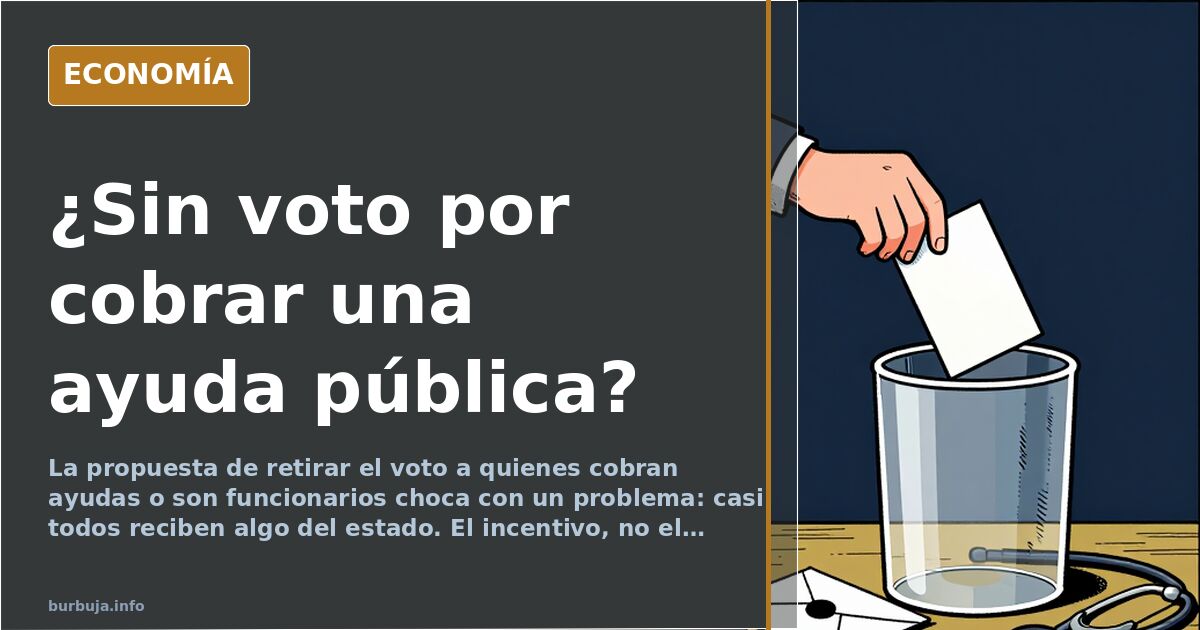
Public funds and voting rights: the proposed limit
Those receiving public money should not be allowed to vote. This thesis, stated bluntly at the outset, argues that any grant, scholarship, or public salary turns the recipient into an interested party, thereby contaminating their vote. The underlying argument is older than the anger itself: every state expenditure is taken from some to give to others. According to this view, it erodes the effort of taxpayers and disincentivizes those who could otherwise escape poverty independently. The proposal extends beyond aid to include civil servants, whom the author sees as part of the apparatus and thus judge and party in every election.
The response was swift and far from mild. A recurring counterpoint: if the criterion is being an interested party, the circle expands until the electoral roll is nearly empty. Those using public healthcare, sending children to public schools, passing through police controls at airports, collecting pensions, or enjoying tax deductions all receive something. The lingering question is simple: who is left out?
Calculating fiscal effort: the weight of each paycheck
In numerical terms, the debate gets tangled with international comparisons. It is argued that a Swedish worker finds it easier to pay taxes than a Spanish one, a claim based on fiscal effort rather than nominal rates. The nuance matters: a high rate on high income differs from a medium rate on a wage barely covering basic needs. The discussion shifted to which country is ideal for starting a business and the real impact of VAT, which sellers pass on to customers before remitting it, meaning businesses do not bear it in their profit and loss accounts.
The deeper hook is another idea: working for free until June summarizes the tax burden on the average employee. The exact breakdown depends on individual salaries and regional differences.
Civil servants, aid, and the incentive problem
The most interesting aspect concerns perverse incentives. It is argued that losing aid upon accepting a low wage leaves the beneficiary worse off, and benefits may not be recoverable after employment ends. This step, known as the poverty trap, turns a safety net into a burden. The counterargument is direct: those truly in need require tools, not handouts; training, a flexible labor market, and opportunities, not just enough to eat.
Regarding civil servants, job stability is debated. Some defend that protection against dismissal exists precisely so public employees do not depend on the government of the day, dismantling the claim that they always vote according to their payer. The alternative proposed by critics is outsourcing these activities and keeping data open and public to measure efficiency.
Captive voting and the census paradox
The most uncomfortable point is captive voting. If someone receives a subsidy and believes the opposition will remove it, their vote responds to survival, not national projects. This is the core argument. The objection that partially disarms it is that interest does not disappear with a public salary: executives billing millions to the public sector also vote thinking about contracts, yet no one strips them of rights. The line between aid recipients and state providers is blurrier than it seems.
The most awkward derivative appears when criteria are pushed to extremes: tax breaks, subsidies, and public prices affect almost everyone, including high-income earners benefiting from deductions. Applied rigorously, the electorate would shrink to a handful of people with no connection to the public sphere. There, the proposal loses force: a system excluding the majority is not electoral reform, but a coffee-shop hypothesis.
The crux is not who votes, but how many live off the budget and under what incentives. With available data, excluding aid recipients from the census has no practical translation: the perimeter is unmanageable. What holds water is the quieter part of the diagnosis: the poverty trap punishing job acceptance. If corrected, the voting rights debate runs out of fuel. If not, it returns seasonally with new headlines and the same frustration.
Also available in: Deutsch
Summary of a discussion on Burbuja.info - Foro de economía, actualidad y política., translated from Spanish and reviewed before publication. Read the full discussion (115 replies).
More summaries
-
Senegalese man arrested in Canada after collecting €1.09m in Basque public aid
A Senegalese man has been arrested in Canada for defrauding CAD 180,000 in social benefits, after collecting €1.09 million in Spain's Basque Country.
-
Vox demands national priority in housing in Spain's Congress
Vox has brought an initiative to the Spanish Congress to prioritise Spaniards in housing aid and expel those living off benefits. The debate reveals deep divisions.
-
Man sentenced to 4.5 years for slaughtering girlfriend's rabbit
A Valencia court sentences a man to 4.5 years in prison for killing, cooking, and forcing his girlfriend to eat her rabbit.
-
Spain's PSOE faces mounting sexual harassment complaints, forum user says right has none
A PSOE member reports sexual harassment to the prosecutor's office after her case stalled at the party's Ferraz headquarters. A forum user claims the right has no cases in ten…
-
Spain's baby boom won't break pensions: the debt will be perpetual
The baby-boom peak is temporary and public debt will be refinanced forever: the 1% and the 3.5 points of GDP that reopen the generational war over pensions in Spain.
-
Expensive wine and tasting: selling a story more than a flavour
Paying 180 euros for a wine that is no better than a five-euro bottle. A 2.50-euro supermarket wine won a blind tasting organised by a Belgian TV show.