
Spain's Constitutional Court approves Bassa amnesty by 7-5 vote
Spain's high court approves Dolors Bassa's amnesty in a 7-5 split, setting a precedent for future pardons and challenging the Supreme Court's stance on illicit enrichment.
English · Original discussion in Spanish · Published
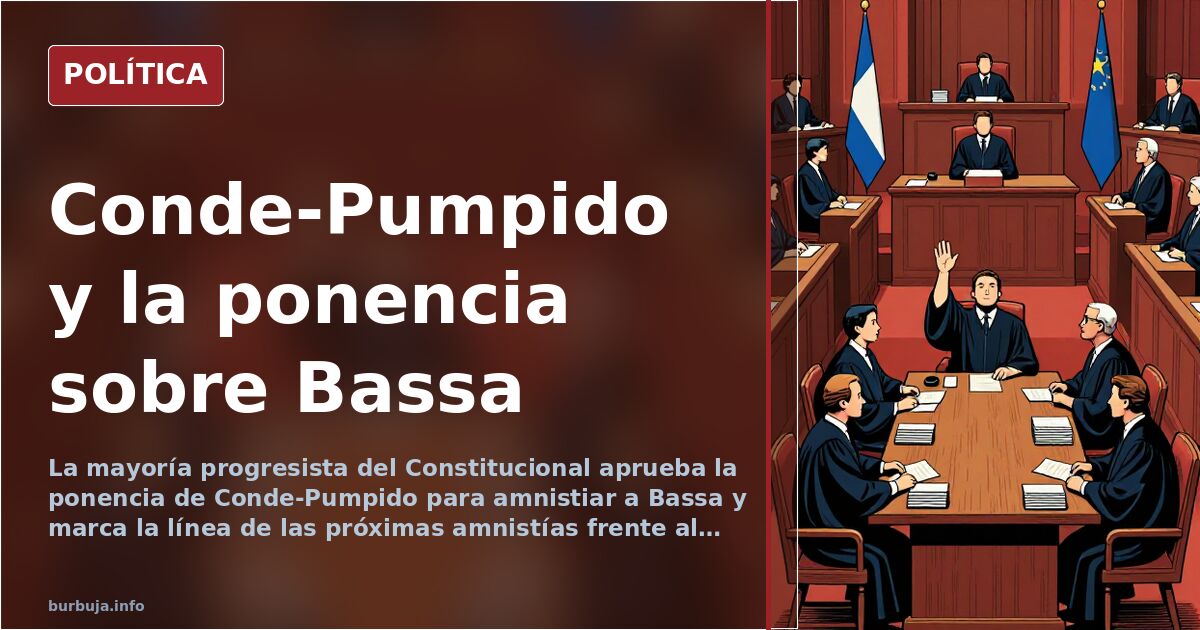
Spain's Constitutional Court approves Bassa amnesty by seven votes to five
Spain's Constitutional Court has approved President Cándido Conde-Pumpido's motion to grant amnesty to former ERC minister Dolors Bassa. The ruling passes seven votes to five, with the pogre bloc prevailing over the conservative minority. According to the material, this decision establishes the line for future amnesties trinc the rejection of an earlier motion by magistrate José María Macías, which aligned with the Supreme Court's criteria. The outcome creates doctrine contrary to the Supreme Court and sets the precedent for upcoming amnesties to separatist leaders.
What the rejected Constitutional Court motion stated
Magistrate Macías had prepared a motion denying amnesty to Jordi Turull, arguing the Supreme Court's position: there was illicit enrichment because the separatist leader did not use his own funds to organize the illegal October 1 referendum. This chain of reasoning would have blocked amnesty for much of the separatist leadership.
According to legal sources, Macías intended to draft a separate motion favoring Turull to avoid a direct clash with the Supreme Court, seeking institutional balance. However, Conde-Pumpido preempted this by scheduling his own motion on Bassa to set the precedent before the opposing view took hold.
Conde-Pumpido's move: establishing doctrine before resolving a case
The sequence matters more than the result. This is not merely about amnestying one former minister, but about setting the line for all subsequent amnesties. By choosing Bassa's case and signing it himself, the President of the Constitutional Court transforms an individual resolution into doctrine applicable to other separatist leaders. The pogre majority had already shown it could reject an uncomfortable motion; now it proves it can write its own.
The clash with the Supreme Court is explicit. The high court maintains there was illicit enrichment in financing the referendum; the Constitutional Court responds that this criterion does not block amnesty. Two incompatible legal readings on the same fact, with the final word going to whoever drafts the prevailing motion.
The reaction: from irony to "it was about time"
The ruling has fallen as an expected wink to some and a provocation to others. Some summarize the verdict with a "surprise in the Gaunas," while others directly refer to political courts. The most repeated accusation is that the Constitutional Court is intervening in matters unrelated to the Constitution, doing so by only seven votes to five, with no wide margin.
On the other hand, the reading is that amnesty avoids subsequent pardons and returns the ball to the political arena. The circulating argument: if the Constitutional Court approves the measure, the separatist movement obtains through the judiciary what it had sought for years at the negotiation table. The looming question is what happens with Puigdemont, who until now had no clear path to return.
The disorienting video: Sánchez denying amnesty
The archive has become the sharpest weapon in the debate. Statements from Pedro Sánchez denying amnesty two days before the last general elections circulate, when he needed Puigdemont's seven votes. In the same batch appears Salvador Illa, then a candidate, saying: "No amnesty, or anything like it. I repeat it to make it clear." The temporal coincidence between these statements and the parliamentary arithmetic is the most repeated data point.
The contradiction is not legal, but political. And it explains why the Constitutional Court's vote is read less as a technical resolution and more as the final act of a negotiation that began at the polls.
It remains to be seen whether the Supreme Court accepts the Constitutional Court's criteria or opens a new front. The Bassa motion establishes doctrine, but does not resolve the tug-of-war between courts. And that tug-of-war is, exactly, where the analysis gets stuck.
Summary of a discussion on Burbuja.info - Foro de economía, actualidad y política., translated from Spanish and reviewed before publication. Read the full discussion (18 replies).
More summaries
-
Spain's Constitutional Court voided amnesty clause in 1986
Ruling 147/1986 struck down an amendment to Spain's 1977 Amnesty Law. Article 164 grants it res judicata status.
-
Constitutional Court paves way for Puigdemont's return amidst clash with Supreme Court
The Constitutional Court clears the path for applying amnesty to misappropriation, potentially allowing Carles Puigdemont’s return.
-
Spain's Constitutional Court Voids Chaves' ERE Verdict
The Constitutional Court overturned Manuel Chaves' prevarication conviction in the ERE scandal by a 7-4 vote.
-
Tweet Places Pablo Fernández in Luxury Housing Development
A tweet places Pablo Fernández living in a luxury development from the Mahou-Calderón operation, the same one Podemos tried to halt.
-
Spain's PP launches Latin anthem but the new voters fail to show up
Spain's conservative PP releases a Latin version of its anthem to attract votes while its base argues over immigration, unemployment and Feijóo's leadership
-
Spain 2026 election poll: right edges toward 195 seats as PSOE slips
A poll gives PP and Vox 195 seats and the PSOE bloc a twelve-seat loss, but memories of 2023 and tactical voting keep the election betting wide open.