
Spain's civil service prep academies charge up to €15,000
Preparing for Spanish civil service exams costs between €1,000 and over €15,000, while private jobs pay just €1,500 net.
English · Original discussion in Spanish · Published
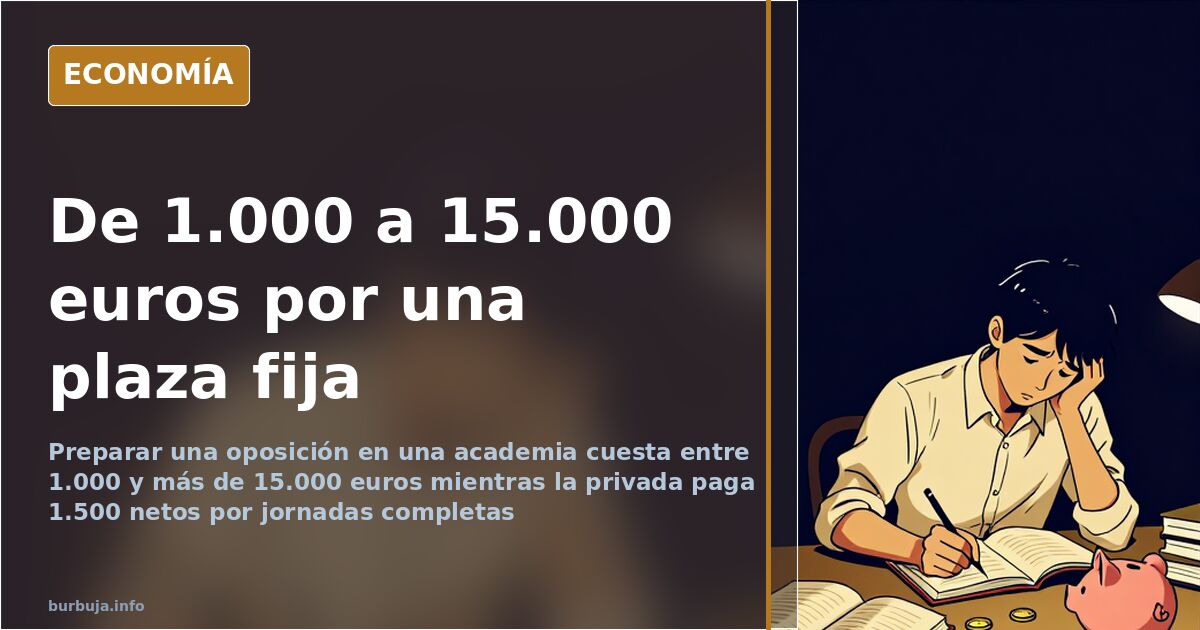
Up to €15,000 to become a civil servant: the academy business
How much does it cost to stop worrying about making ends meet? The industry itself says prices start at €1,000 and have no comfortable ceiling: preparing for a civil service exam (oposición) in an academy requires investments ranging from that figure to more than €15,000. This data appears in a report by Raquel Pascual Cortés dated September 24, 2023. What it depicts is not a commercial brochure, but a booming market: packed classrooms, students chaining years of study, and an uncomfortable question about what exactly one buys with that money.
The cost of preparing for a civil service exam
Since the pandemic, preparation centers have extended their success throughout Spain and abroad, according to the enthusiastic account given by Puri Marín, head of studies at the Jesús Ayala academy in Málaga. In that narrative, the model case is Giacomo Arroyo, a firefighter who recently passed the exam for the Community of Madrid. Behind every position is a bill. Long packages, including materials, mock exams, and years of support, go well above €10,000; some courses are charged at €150 per month even for positions requiring no degree, such as hospital orderlies in the public health system. Paying to prepare for exams has ceased to be an exception and has become the norm.
The private sector driving exam preparation
The engine of this fever is not vocation, but salary. Indefinite eight-hour contracts paying between €1,500 and €1,600 net per month are rare, except for highly technical profiles; below that lies part-time temporary work, which rarely exceeds €700 or €800. With this landscape, a permanent public post ceases to be a calling and becomes a forward escape. Missing is the other side: candidates who have spent several thousand euros, are around 40, and still lack a position, living with parents or chaining odd jobs while waiting for the next call.
Why the fever arrives now
The calendar explains much of the phenomenon. After years of zero replacement rate, with public staff aging and accumulated retirements, calls for applications have multiplied, and academies that survived the tough years are now reaping the rewards. However, some warn that the party has an expiration date: with public debt soaring and state accounts strained, maintaining the supply pace depends on someone continuing to foot the bill. Those preparing for an exam do not just buy a syllabus. They bet that the State will sustain them for three decades.
Rigged exams: what is claimed and what is proven
There is a suspicion running through the conversation that should be handled with care: that the real filter is not the syllabus. It is claimed that up to eight out of ten positions would be pre-arranged among family and acquaintances, especially in labor personnel and regional calls, through consolidations or nearly closed processes, while open access is reserved for national posts: fewer spots and more competitors. None of this comes with proof, so it functions as widespread suspicion, not fact. What does appear in circulating calculations is hard arithmetic: a national call with 137 positions, presented as loot for a few chosen ones.
Too many civil servants or too many counters?
Here the big rift opens. Doctors, firefighters, teachers, and police generate consensus; the rest, no. One current argues that half of administrative, counter, and public company jobs are superfluous, and that bureaucracy justifies itself through "come back tomorrow" responses and duplicating staff. The response is that this civil service is what makes the country function, that in percentage Estonia has more public employees than Spain, and that many procedures can already be done online if the citizen does not insist on seeing the employee's face. Automation adds more noise: some anticipate that much of these administrative tasks will become obsolete, in both public and private sectors, and that guaranteed salaries will not last forever.
Lifetime civil servants and their alleged Francoist heritage
The label of "Francoist figure" attached to un-fireable civil servants also does not withstand scrutiny. It is argued that during Francoism there was significantly less public employment than after, and a book written before the Civil War, El reñidero español, is recalled, which already placed public officials among the country's castes and considered creating jobs by placing people in the public sector as common practice. Endogamy, it is said, predates the regime to which many attribute it. And some add that a graduate at a counter is not wasted talent: it is the predictable result of a system where the most reasonable exit for someone with a degree is to pay for a job that already exists.
With these figures, spending €15,000 for a lifetime salary seems like a good financial operation. One only needs to trust that the position will be called, published in the official bulletin, and not awarded to anyone before the application period opens.
How much does it cost to stop worrying about making ends meet? The industry itself says prices start at €1,000 and have no comfortable ceiling: preparing for a civil service exam (oposición) in an academy requires investments ranging from that figure to more than €15,000. This data appears in a report by Raquel Pascual Cortés dated September 24, 2023. What it depicts is not a commercial brochure, but a booming market: packed classrooms, students chaining years of study, and an uncomfortable question about what exactly one buys with that money.
The cost of preparing for a civil service exam
Since the pandemic, preparation centers have extended their success throughout Spain and abroad, according to the enthusiastic account given by Puri Marín, head of studies at the Jesús Ayala academy in Málaga. In that narrative, the model case is Giacomo Arroyo, a firefighter who recently passed the exam for the Community of Madrid. Behind every position is a bill. Long packages, including materials, mock exams, and years of support, go well above €10,000; some courses are charged at €150 per month even for positions requiring no degree, such as hospital orderlies in the public health system. Paying to prepare for exams has ceased to be an exception and has become the norm.
The private sector driving exam preparation
The engine of this fever is not vocation, but salary. Indefinite eight-hour contracts paying between €1,500 and €1,600 net per month are rare, except for highly technical profiles; below that lies part-time temporary work, which rarely exceeds €700 or €800. With this landscape, a permanent public post ceases to be a calling and becomes a forward escape. Missing is the other side: candidates who have spent several thousand euros, are around 40, and still lack a position, living with parents or chaining odd jobs while waiting for the next call.
Why the fever arrives now
The calendar explains much of the phenomenon. After years of zero replacement rate, with public staff aging and accumulated retirements, calls for applications have multiplied, and academies that survived the tough years are now reaping the rewards. However, some warn that the party has an expiration date: with public debt soaring and state accounts strained, maintaining the supply pace depends on someone continuing to foot the bill. Those preparing for an exam do not just buy a syllabus. They bet that the State will sustain them for three decades.
Rigged exams: what is claimed and what is proven
There is a suspicion running through the conversation that should be handled with care: that the real filter is not the syllabus. It is claimed that up to eight out of ten positions would be pre-arranged among family and acquaintances, especially in labor personnel and regional calls, through consolidations or nearly closed processes, while open access is reserved for national posts: fewer spots and more competitors. None of this comes with proof, so it functions as widespread suspicion, not fact. What does appear in circulating calculations is hard arithmetic: a national call with 137 positions, presented as loot for a few chosen ones.
Too many civil servants or too many counters?
Here the big rift opens. Doctors, firefighters, teachers, and police generate consensus; the rest, no. One current argues that half of administrative, counter, and public company jobs are superfluous, and that bureaucracy justifies itself through "come back tomorrow" responses and duplicating staff. The response is that this civil service is what makes the country function, that in percentage Estonia has more public employees than Spain, and that many procedures can already be done online if the citizen does not insist on seeing the employee's face. Automation adds more noise: some anticipate that much of these administrative tasks will become obsolete, in both public and private sectors, and that guaranteed salaries will not last forever.
Lifetime civil servants and their alleged Francoist heritage
The label of "Francoist figure" attached to un-fireable civil servants also does not withstand scrutiny. It is argued that during Francoism there was significantly less public employment than after, and a book written before the Civil War, El reñidero español, is recalled, which already placed public officials among the country's castes and considered creating jobs by placing people in the public sector as common practice. Endogamy, it is said, predates the regime to which many attribute it. And some add that a graduate at a counter is not wasted talent: it is the predictable result of a system where the most reasonable exit for someone with a degree is to pay for a job that already exists.
With these figures, spending €15,000 for a lifetime salary seems like a good financial operation. One only needs to trust that the position will be called, published in the official bulletin, and not awarded to anyone before the application period opens.
Summary of a discussion on Burbuja.info - Foro de economía, actualidad y política., translated from Spanish and reviewed before publication. Read the full discussion (171 replies).
More summaries
-
Madrid's 'Soy un Mandao' Campaign Sparks Gender and Spending Debate
Madrid's 'Soy un Mandao' campaign faces backlash for allegedly humiliating men and wasting public funds. An analysis of the social and economic controversy.
-
Tenant Union of Sol: a network with €3.7 million
The Tenant Union of Sol is part, according to a published report, of a network that would have received €3.7 million from Socialist administrations.
-
La Sirena owner calls Saturday refusers 'rats'
José Elías, owner of La Sirena, labels those refusing Saturday work as 'rats', sparking debate on wages and labor conditions in Spain.
-
Work Value Collapsing: Capital May Be All That Remains
Burbuja.info debate on labor's future amid a 30% wage drop, AI automation, and the rise of universal basic income concepts.
-
Spain's Women's Soccer League Hits Record Low Attendance
Only 64 fans attended a top-tier match. Liga F attendance drops 9%, intensifying debates on its economic viability.
-
Oil Prices Surge Amid Strait of Hormuz Tensions
Crude oil spikes following attacks in the Strait of Hormuz. We analyze WTI gains and risks to global food supply chains.