
Spain's Civil Guard AI Hate Crime Campaign Sparks Backlash
The Guardia Civil promoted an anti-hate campaign using AI-generated images, triggering debates on hate crime definitions and police overreach.
English · Original discussion in Spanish · Published
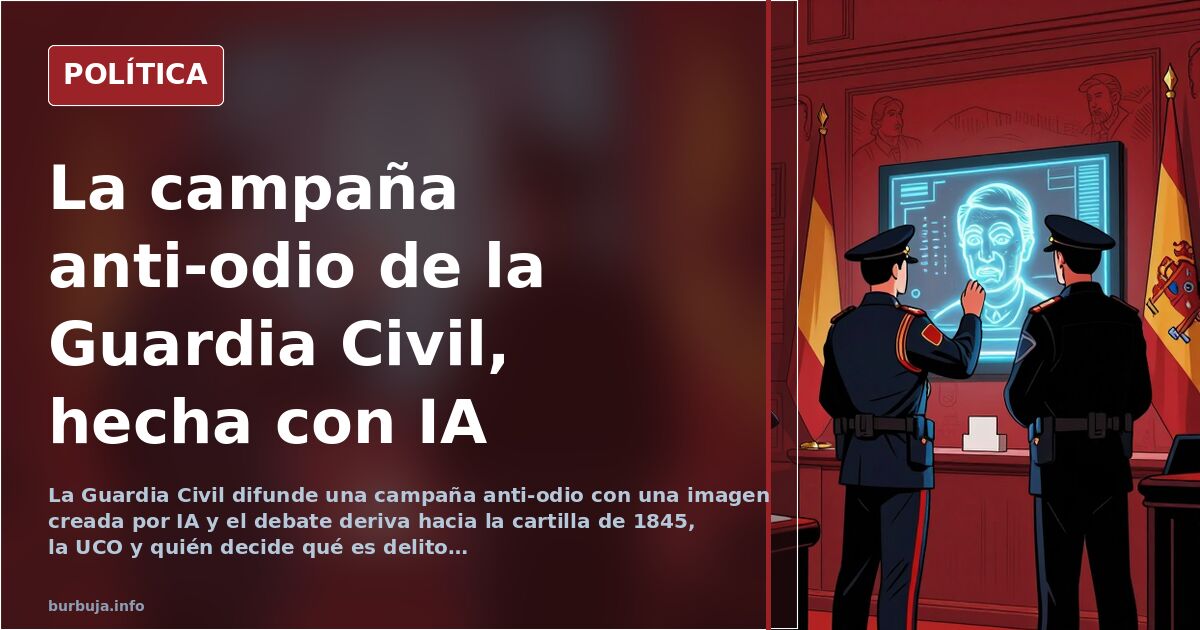
Spain's Civil Guard Promotes Anti-Hate Campaign With AI-Generated Image
The Guardia Civil posted a social media message explaining that hate crimes harm not only direct victims but also those sharing their characteristics, creating collective antiestéticar. The controversy began when the accompanying image was revealed to be artificial intelligence-generated. This sparked a broader debate about the role of the armed institute, legal definitions of hate, and who decides what constitutes a crime.
Official Message Content and Criticism
The original tweet used #StopOdio and #StopDiscriminación tags, stating these crimes target victims and similar individuals. Initial reactions were sharp: the image isn't real; it was made with AI. Critics argued that a police force illustrating campaigns with synthetic imagery reflects a dystopian reality. This perception suggests an irreversible shift in institutional communication.
Verification confirmed the tweet existed, dated the 11th. It wasn't a fabrication but an official campaign, opening discussions on the entire framework.
Debate on Civil Guard History
The conversation shifted to the corps' past. Historical debates in Spain have questioned abolishing the Guardia Civil, comparing it to institutions ended in 1931. Some argue Francoism revived it, and now its presence is endured. Others counter that Spain's only real army then was in Africa, crossing the strait against all odds.
Tensions rose. Some called the situation da repelús. Others ironically asked if non-Spaniards attacking guards should be discriminated against. Critics linked degradation to specific governments, mentioning Felipe González and Luis Roldán, as usual.
1845 Manual and Removed Article
A key point was normative comparison. The 1845 manual by Duke of Ahumada, Chapter I, Article 26, forbade eavesdropping on conversations in public or private spaces, deeming it espionage. This rule lasted 177 years until 2022, when updates removed it entirely. The doctrinal change, not just the AI image, marks the true turning point.
Hate Crimes, Free Speech, and Authority
Core discontent lies in definitions. Many claim nothing can be said because they decide what is hate. They describe a dictatorship where dissent leads to imprisonment. Comparisons were drawn to the UK, where police allegedly kneel before some groups while arresting others for protesting.
Anecdotes included a colleague raided for complaining about immigration, arrested in Almería for spreading hate messages online. Meanwhile, immigrants mentioned in complaints appear in other news. The underlying argument is inconsistent enforcement standards.
Institutional Response and Image Erosion
Comments noted National Police posts about men carrying bags or unpiloted women under #CuálEsElProblema, and Civil Guard tweets on diversity. For many, this confirms police entering inappropriate territory.
Recurring criticism states they know it’s not about hate. Logic suggests the Guardia Civil would react strongly to released Finnish prisoners or Swiss abuse cases. The issue is political use of 'hate' to limit free speech, not security.
UCO, Drug Trafficking, and Counterpoints
Not all analysis was negative. Defenders highlighted the UCO (Central Operational Unit), noting politicians sweat coldly when it intervenes. It remains Spain's most trusted police body. However, critics argued the UCO differs from the rest, claiming guards monitor forums illegally without probable cause.
One comment noted the Guadalquivir river becoming a drug trafficking route while the Benemérita suppresses feelings. Berlanga would have loved such a script.
Future Expectations
Expectations are that the campaign won't be withdrawn, and hate crime definition debates will escalate. Hypotheses suggest the goal is keeping people home, as online or street activity increases perceived crime risk. If so, erosion affects both the Guardia Civil and the concept of security itself.
The Guardia Civil posted a social media message explaining that hate crimes harm not only direct victims but also those sharing their characteristics, creating collective antiestéticar. The controversy began when the accompanying image was revealed to be artificial intelligence-generated. This sparked a broader debate about the role of the armed institute, legal definitions of hate, and who decides what constitutes a crime.
Official Message Content and Criticism
The original tweet used #StopOdio and #StopDiscriminación tags, stating these crimes target victims and similar individuals. Initial reactions were sharp: the image isn't real; it was made with AI. Critics argued that a police force illustrating campaigns with synthetic imagery reflects a dystopian reality. This perception suggests an irreversible shift in institutional communication.
Verification confirmed the tweet existed, dated the 11th. It wasn't a fabrication but an official campaign, opening discussions on the entire framework.
Debate on Civil Guard History
The conversation shifted to the corps' past. Historical debates in Spain have questioned abolishing the Guardia Civil, comparing it to institutions ended in 1931. Some argue Francoism revived it, and now its presence is endured. Others counter that Spain's only real army then was in Africa, crossing the strait against all odds.
Tensions rose. Some called the situation da repelús. Others ironically asked if non-Spaniards attacking guards should be discriminated against. Critics linked degradation to specific governments, mentioning Felipe González and Luis Roldán, as usual.
1845 Manual and Removed Article
A key point was normative comparison. The 1845 manual by Duke of Ahumada, Chapter I, Article 26, forbade eavesdropping on conversations in public or private spaces, deeming it espionage. This rule lasted 177 years until 2022, when updates removed it entirely. The doctrinal change, not just the AI image, marks the true turning point.
Hate Crimes, Free Speech, and Authority
Core discontent lies in definitions. Many claim nothing can be said because they decide what is hate. They describe a dictatorship where dissent leads to imprisonment. Comparisons were drawn to the UK, where police allegedly kneel before some groups while arresting others for protesting.
Anecdotes included a colleague raided for complaining about immigration, arrested in Almería for spreading hate messages online. Meanwhile, immigrants mentioned in complaints appear in other news. The underlying argument is inconsistent enforcement standards.
Institutional Response and Image Erosion
Comments noted National Police posts about men carrying bags or unpiloted women under #CuálEsElProblema, and Civil Guard tweets on diversity. For many, this confirms police entering inappropriate territory.
Recurring criticism states they know it’s not about hate. Logic suggests the Guardia Civil would react strongly to released Finnish prisoners or Swiss abuse cases. The issue is political use of 'hate' to limit free speech, not security.
UCO, Drug Trafficking, and Counterpoints
Not all analysis was negative. Defenders highlighted the UCO (Central Operational Unit), noting politicians sweat coldly when it intervenes. It remains Spain's most trusted police body. However, critics argued the UCO differs from the rest, claiming guards monitor forums illegally without probable cause.
One comment noted the Guadalquivir river becoming a drug trafficking route while the Benemérita suppresses feelings. Berlanga would have loved such a script.
Future Expectations
Expectations are that the campaign won't be withdrawn, and hate crime definition debates will escalate. Hypotheses suggest the goal is keeping people home, as online or street activity increases perceived crime risk. If so, erosion affects both the Guardia Civil and the concept of security itself.
Also available in: Deutsch
Summary of a discussion on Burbuja.info - Foro de economía, actualidad y política., translated from Spanish and reviewed before publication. Read the full discussion (125 replies).
More summaries
-
Judge in Koldo case moves to indict Ábalos
The judge moves to indict Ábalos after UCO report; PP summons Marlaska and Globalia CEO to Senate committee
-
Satire Claims Ayuso Hears 7,291 Ghost Voices, Seeks Iker Jiménez
A satirical story attributes 7,291 paranormal voices and six years of insomnia to Madrid's Isabel Díaz Ayuso, leading her to consult TV presenter Iker Jiménez.
-
Spanish TV Pundits Who Irritate Viewers Most
Afra Blanco, Antonio Maestre, El Gran Wyoming: online threads highlight the most disliked Spanish TV commentators and reasons for viewer fatigue.
-
Orriols: Speech That Unsettles All Sides
Silvia Orriols, leader of Aliança Catalana, challenges Catalan independence with an anti-immigration speech that divides supporters and critics alike.
-
Pope Leo XIV challenges Europe to overcome fear of Islam
Pope Leo XIV urges Europe to shed its fear of Islam, sparking backlash from conservatives who accuse him of naivety and financial compromise.
-
Irene Montero: Political Erosion Damages Public Image
Spanish MEP Irene Montero faces political wear from the 'Yes Means Yes' law, real estate holdings, and migration strategy.