
Spain's CIS Poll Gives PSOE Best Result Since 2019
Spanish forum users claim the latest CIS poll shows PSOE with its best result since 2019, sparking widespread suspicions of electoral fraud before the vote.
English · Original discussion in Spanish · Published
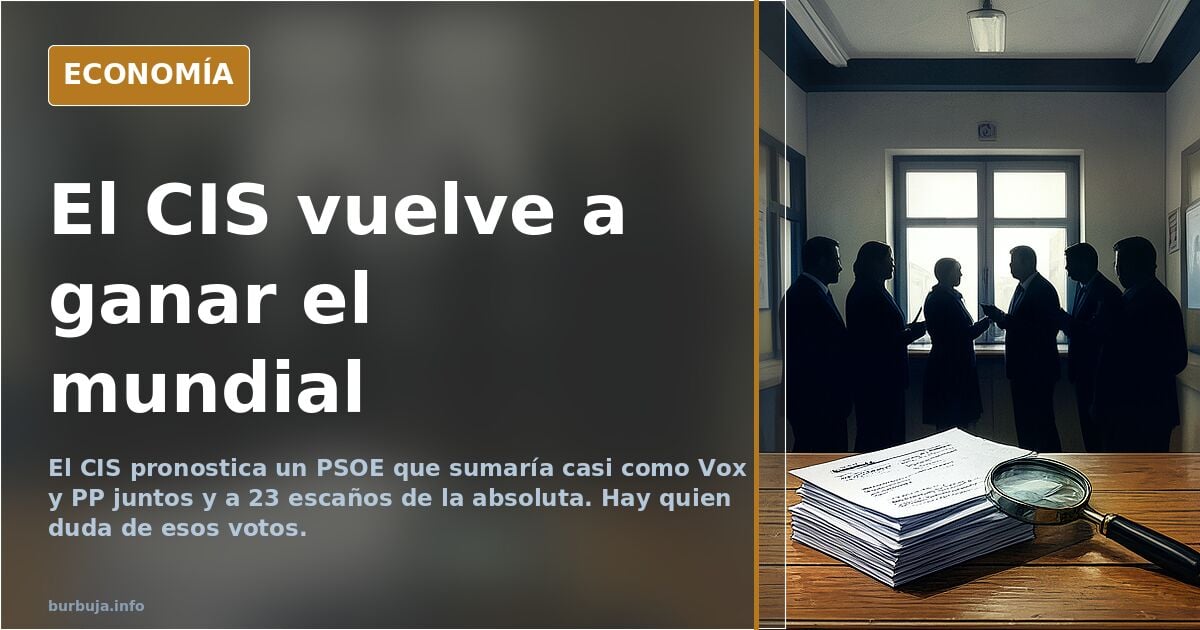
CIS Poll Boosts PSOE to Best Result, Fueling Fraud Suspicions
According to calculations circulating in online debates, the latest barometer from Spain's Center for Sociological Research (CIS) would place the PSOE just 23 seats short of an absolute majority, marking their best performance since 2019. Released during the pre-campaign period, this data has triggered alarm bells: no other poll aligns with the arithmetic used by the opposition. The reaction was immediate. From sarcastic remarks to technical analysis, the consensus remains clear: the numbers do not add up.
Where Do the Votes for a 30-Seat Surge Come From?
This question dominates every conversation. The PSOE would need to gain nearly as many votes as Vox and PP combined, a shift unsupported by any historical voting series. The CIS places the party at its highest level since 2019, but no one explains where this electorate originates. The most common explanation points to a report finalized in March with these exact results: correcting it after publication would miccionan admitting an error. The agency could face charges for electoral fraud, a detail that has become central to the argument rather than being dismissed. "The CIS is trapped by its own report," summarizes one of the most cited comments.
No official defense has emerged, nor any technical explanation to dispel the suspicion. Instead, there is silence and repeated claims that polls are merely snapshots of the moment. Critics argue this snapshot was taken through a distorting lens.
Electoral Fraud Prepared Before Voting Begins
The term is used without hesitation. Many sectors assume electoral fraud is already underway before any ballot is cast. The 'grandchildren law', postal voting, and reserves held by Indra and Correos: each piece fits into a theory that feeds on itself, no longer requiring proof. "I antiestéticar the fraud these incivil must be preparing," reads one comment capturing the general mood. This is not an exception; it is the prevailing tone.
Some go further, arguing the outcome is already decided. They claim the CIS does not predict anything but justifies what will happen. The poll serves as an alibi: if final results match the published figures, no one can speak of fraud. If they differ, the blame falls on the opposition. This circular logic leaves voters feeling their ballot is decorative.
A Poll No One Believes
Skepticism spans all political lines. Neither PP, Vox, nor even PSOE voters believe the data. Distrust is cross-party. "PSOE will get 130% of the vote while you hold Viruelo's drink," another message mocks. References to the Minister of Transport, a frequent target, illustrate the low credibility attributed to the agency.
Comparisons with defunct regimes have become commonplace. "We are one step away from North Korea," one user states. Another compares it to Bulgarian elections won with 99% of the vote. In this view, the CIS does not measure voting intention but the government's ability to fabricate reality.
The Same Party and Abstention as an Exit
Beyond the noise, a colder analysis repeats itself. Whoever wins, the PPSOE coalition will govern. Blue or red, but the same bloc. Alternation changes faces, not policies. "In the end, either the blue PPSOE or the red PPSOE will govern, but the same party will win again and Spain will continue functioning poorly as always," summarizes a widely supported comment.
For some, the practical conclusion is emigration. "If this happens, I EMIGRATE; I can't take anymore," writes one user. It is not rhetorical threat but recognition that confirmed results would exhaust the patience of voters who no longer feel represented by any option.
The CIS publishes, the government stays silent, and the opposition shouts. The poll, intended as an analytical tool, has become the debate's subject. Meanwhile, the unanswered question remains: where do the votes come from?
Also available in: Deutsch
Summary of a discussion on Burbuja.info - Foro de economía, actualidad y política., translated from Spanish and reviewed before publication. Read the full discussion (188 replies).
More summaries
-
The right and the pensions elephant: promises without numbers
An analysis argues that Spain's pension system is already being propped up by debt and that the right promises to pay pensions without saying how. The electoral dilemma nobody wants to face.
-
Abascal puts Spain's minimum income benefit at the centre of viral economic debate
Vox's proposal to cut the IMV (Spain's minimum living income) has gone viral, sparking a debate over who should receive the benefit and whether the system is well designed.
-
Another Zapatero mess: how Spain's renewables boom went wrong
The renewables disaster in Spain: how the 2010 regulatory change ruined 65,000 families who trusted the state's promises.
-
Spain's PM publishes Financial Times piece urging social media ban for young people
Pedro Sánchez publishes an article in the Financial Times to protect children from social media, sparking debate over the 13% depression figure.
-
Spain's right splits over Israel: who opposes it and why
Spain's right is divided over Israel: patriotic incompatibility or a smokescreen? An analysis of an informal poll with 36 signatories, plus historical and geopolitical arguments.
-
AI is only a problem for programmers and office workers... oh, wait!
Think AI only threatens office workers? The annual labor cost of a minimum-wage worker in Spain (€22,590) already exceeds that of a robot. Data, videos and skepticism.