
Spain's cash debate reignites over a 12-cent card payment
Paying 12 cents by card divides Spanish retailers and customers: with ATMs lacking small notes, cash loses the logistical battle.
English · Original discussion in Spanish · Published
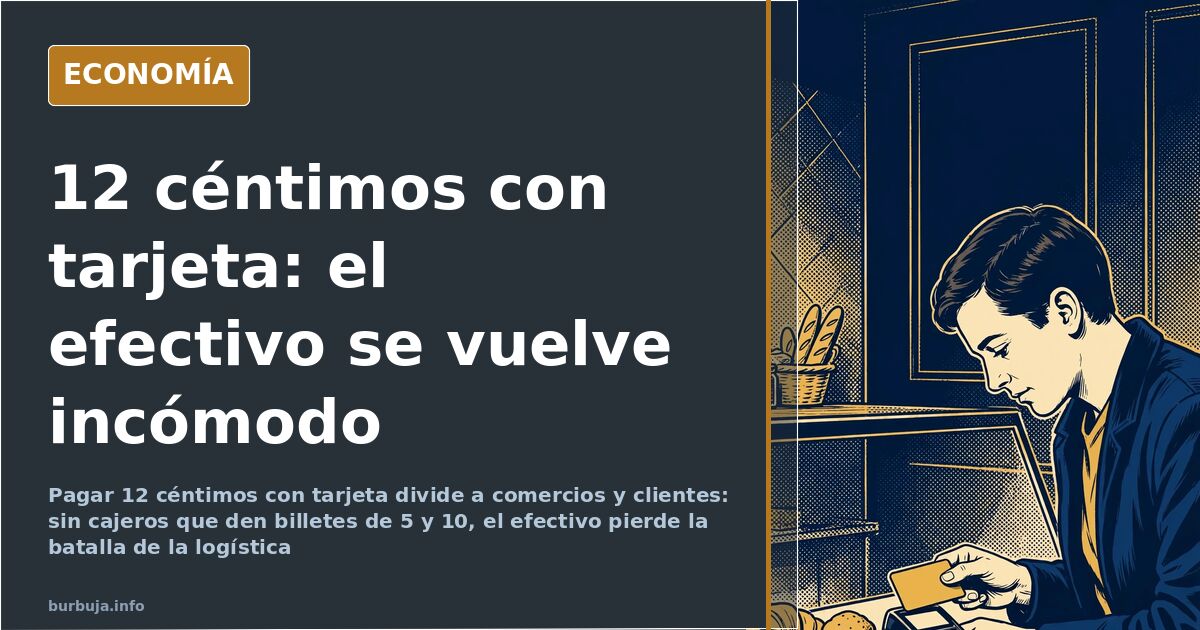
Paying 12 cents by card: the boundary between two views of money
A forgotten plastic bag at an Alcampo self-service machine, a 12-cent receipt, and a card tapped without anyone batting an eye. The scene is real; the protagonist even apologized for it ("I berated myself later that night"). Around this tiny gesture lies a debate touching distinct nerves: the freedom to leave no trace, antiestéticar of losing alternatives, the hassle of counting coins, and the unproven suspicion that refusing cards means refusing tax authorities.
The starting question is simple, though some ask it aggressively: Is someone paying for coffee, bread, or an 80-cent water bottle by card irresponsible for not carrying €20? The short answer is no single response exists. The long one spans dozens of messages and multiple fronts.
Why pay for an 80-cent water bottle by card?
For convenience, habit, and often because there’s simply no cash on hand. Two incompatible narratives emerge from this. One argues that paying trivial amounts by plastic stems from laziness or poor management, warning that cloned cards will cause regret. The other counters that wallets are heavy, easily lost, and bulky; it’s odd to carry coins just to buy a €1.50 fridge magnet.
In the middle lies a detail few dispute: some haven’t withdrawn cash from an ATM in over a year, while others withdraw in batches of €1,000–€2,000 and keep at least €3,000 at home. Both strategies coexist in the same economy.
What is true is that cash acceptance depends on the retailer today. No business is forced to have a POS terminal, and many don’t. Here begins the real problem: a customer who only carries a phone arrives in certain towns and discovers they can’t pay for a fridge magnet any other way.
Businesses without POS terminals: fraud or just an elderly butcher?
Here the conversation heats up. One school claims businesses rejecting cards do so to avoid declaring income, treating every missing terminal as an unrecorded invoice. The opposing view cites a specific case: an elderly butcher refusing the device "to avoid trouble with gadgets," intending only to serve customers as always. He adds that suspicion falls more enthusiastically on neighborhood freelancers than on other pockets, institutional or otherwise.
This argument intertwines with a classic critique: those billing under €11,000 annually, receiving public aid, then complaining about meager pensions. This accusation lacks names and should be read as generic suspicion, not diagnosis. It’s worth remembering that paying in cash isn’t illegal; suspicion targets businesses failing to declare such income.
The ATM problem: no dispensing of €5 and €10 notes
This is arguably the most technical point in the discussion and the least addressed. ATMs don’t dispense coins, don’t exchange coins for notes, and rarely offer €5 or €10 bills. Typical cash payments are low—coffee, bread, bus tickets—and become problematic when your wallet holds only a fresh €20 note. This forces sellers to accumulate change and buyers to carry it.
Recurring scenes trinc: someone withdrawing €50 for daily coffees finds nowhere to break them, ending up buying three packs of gum for about €4 to spare the barista from struggling with change. The uncomfortable conclusion: the system pushes electronic payment not for comfort, but because it has ceased facilitating basic cash logistics.
Anonymity, fees, and programmable money scenarios
Part of the debate goes beyond convenience. Arguments state that cash is the only way to leave no trace and avoid handing financial institutions a percentage of spending, suggesting it’s best reserved for high amounts while cards handle small ones. Opponents point out the obvious: fees exist, and those paying 17 cents for Teflon tape knowing it costs the shopkeeper money sometimes do so intentionally.
The underlying scenario involves programmable money with consumption limits, where retailers might eventually be unable to refuse digital payments, mirroring today’s inability to reject cash. No firm dates exist for this. Speculation abounds, and those denying a plan argue that convenience has already done the work without decrees.
Does paying by card make you worse at math?
One cited side effect is mental calculation. Some confess they prepare exact amounts while queuing and estimate change, using purchases to let their children practice arithmetic. Criticism targets those needing phones to divide 80 by 9 or add up a meal, beer, and coffee.
Nevertheless, the discussion closes with its lowest cited amount: 12 cents. A system making it viable to charge that sum via plastic yet burdensome to withdraw a €10 note needs no prohibitions to impose its logic. It only needs to make cash inconvenient.
A forgotten plastic bag at an Alcampo self-service machine, a 12-cent receipt, and a card tapped without anyone batting an eye. The scene is real; the protagonist even apologized for it ("I berated myself later that night"). Around this tiny gesture lies a debate touching distinct nerves: the freedom to leave no trace, antiestéticar of losing alternatives, the hassle of counting coins, and the unproven suspicion that refusing cards means refusing tax authorities.
The starting question is simple, though some ask it aggressively: Is someone paying for coffee, bread, or an 80-cent water bottle by card irresponsible for not carrying €20? The short answer is no single response exists. The long one spans dozens of messages and multiple fronts.
Why pay for an 80-cent water bottle by card?
For convenience, habit, and often because there’s simply no cash on hand. Two incompatible narratives emerge from this. One argues that paying trivial amounts by plastic stems from laziness or poor management, warning that cloned cards will cause regret. The other counters that wallets are heavy, easily lost, and bulky; it’s odd to carry coins just to buy a €1.50 fridge magnet.
In the middle lies a detail few dispute: some haven’t withdrawn cash from an ATM in over a year, while others withdraw in batches of €1,000–€2,000 and keep at least €3,000 at home. Both strategies coexist in the same economy.
What is true is that cash acceptance depends on the retailer today. No business is forced to have a POS terminal, and many don’t. Here begins the real problem: a customer who only carries a phone arrives in certain towns and discovers they can’t pay for a fridge magnet any other way.
Businesses without POS terminals: fraud or just an elderly butcher?
Here the conversation heats up. One school claims businesses rejecting cards do so to avoid declaring income, treating every missing terminal as an unrecorded invoice. The opposing view cites a specific case: an elderly butcher refusing the device "to avoid trouble with gadgets," intending only to serve customers as always. He adds that suspicion falls more enthusiastically on neighborhood freelancers than on other pockets, institutional or otherwise.
This argument intertwines with a classic critique: those billing under €11,000 annually, receiving public aid, then complaining about meager pensions. This accusation lacks names and should be read as generic suspicion, not diagnosis. It’s worth remembering that paying in cash isn’t illegal; suspicion targets businesses failing to declare such income.
The ATM problem: no dispensing of €5 and €10 notes
This is arguably the most technical point in the discussion and the least addressed. ATMs don’t dispense coins, don’t exchange coins for notes, and rarely offer €5 or €10 bills. Typical cash payments are low—coffee, bread, bus tickets—and become problematic when your wallet holds only a fresh €20 note. This forces sellers to accumulate change and buyers to carry it.
Recurring scenes trinc: someone withdrawing €50 for daily coffees finds nowhere to break them, ending up buying three packs of gum for about €4 to spare the barista from struggling with change. The uncomfortable conclusion: the system pushes electronic payment not for comfort, but because it has ceased facilitating basic cash logistics.
Anonymity, fees, and programmable money scenarios
Part of the debate goes beyond convenience. Arguments state that cash is the only way to leave no trace and avoid handing financial institutions a percentage of spending, suggesting it’s best reserved for high amounts while cards handle small ones. Opponents point out the obvious: fees exist, and those paying 17 cents for Teflon tape knowing it costs the shopkeeper money sometimes do so intentionally.
The underlying scenario involves programmable money with consumption limits, where retailers might eventually be unable to refuse digital payments, mirroring today’s inability to reject cash. No firm dates exist for this. Speculation abounds, and those denying a plan argue that convenience has already done the work without decrees.
Does paying by card make you worse at math?
One cited side effect is mental calculation. Some confess they prepare exact amounts while queuing and estimate change, using purchases to let their children practice arithmetic. Criticism targets those needing phones to divide 80 by 9 or add up a meal, beer, and coffee.
Nevertheless, the discussion closes with its lowest cited amount: 12 cents. A system making it viable to charge that sum via plastic yet burdensome to withdraw a €10 note needs no prohibitions to impose its logic. It only needs to make cash inconvenient.
Summary of a discussion on Burbuja.info - Foro de economía, actualidad y política., translated from Spanish and reviewed before publication. Read the full discussion (207 replies).
More summaries
-
Network outages, ATMs, and card machines down in Malaga, user reports
A user describes network failures in Malaga causing outages for ATMs, card machines, and internet. The issue affected essential services across the province.
-
Card Payment Failures: Transactions Declined at Multiple Retailers
Retailers and taxis were unable to accept card payments due to point-of-sale terminal failures, according to user reports. The link to ISO 20022 has not been confirmed.
-
Spain to mint €1.50 Mortadelo and Filemón coins in late 2026
Controversy over €1.50 Mortadelo and Filemón coins. We analyze in the forum whether it's a tribute to Ibáñez or a commercial strategy with dubious profitability.
-
Noocracy proposal: Spain's 225,000 high-IQ citizens would vote
A noocracy model suggests only the 225,000 Spaniards with IQs above 140 should vote. It features rotation and claims to prevent corruption.
-
Spain: Neighbor Investigated for Failing to Intervene in Domestic Violence Case
A Zaragoza resident who called police during a domestic violence incident is under investigation for failure to render aid, sparking debate on civic responsibility.
-
Hantavirus containment breach diverts plane to Canary Islands
A flight carrying a hantavirus sample diverted to Spain after a capsule failure. The Andes strain outbreak reignites health safety debates.