
Spain's Beaches: Overcrowding, Noise and Class Divides
Overcrowded Spanish beaches drive locals to expensive coves, weekday visits or Croatia, turning the calendar into a class filter.
English · Original discussion in Spanish · Published
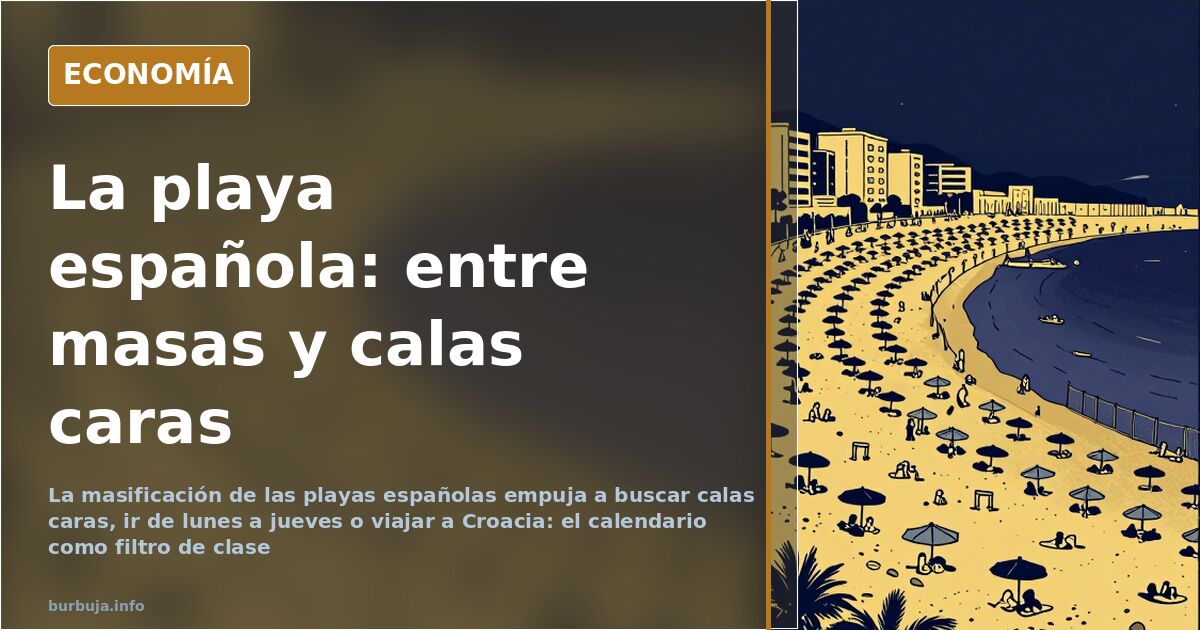
September and Expensive Coves: The New Map of Spain’s Beaches
In peak season, the conversation about Spain’s beaches has shifted from sunscreen to logistics. The scene repeats itself: people visit "mandatory" sandy spots amidst screaming children, shouting families, and crowds that turn the shoreline into a market. The dominant diagnosis is simple and brutal: it is not the sea, it is the people. The circulating recipe is less lament than roadmap: change the date, change the time, and above all, change the access price. Underlying this, the issue becomes everyday: summer bonuses and holiday plans creep into the same chat.
Summer overcrowding is the starting point. The same ingredients return: overflowing urban beaches, packed beach bars, and visitor drips concentrated in the same three weeks. Some argue that high volume in shared spaces —shouts, loud conversations, music— feels more intense after returning from a season away. Opposing this is the classic defense. Blue cooler, huge umbrella, cheap beer and meat-cheese sandwiches: that would be authentic, and the rest, pose by misfits trying to look cool. It is not a minor dispute: the beach is the country’s cheapest public space, hosting leisure models that rarely share schedules.
The Calendar as Filter: Who Can Go in September
The first line of defense is temporal, not geographic. September and October appear as the ideal window, with empty beaches and quiet walks. Going very early, when staff are still sleeping, or late, when they have left, is another variant of the same trick. At the hardest edge of the argument, weekends are labeled for those who cannot choose, recommending visits on weekdays "when people work hard." Overcrowding stops being a space problem and becomes a working hours problem. Those with flexibility during the week get clean beaches; those without it are stuck with rush hour.
The Alternative Map: From Costa Blanca to the Algarve
For those who can travel, the map of Spain’s beaches is reordered. In the Levante, coves in Costa Blanca —Altea, Finestrat, Racó del Conill in La Vila, Jávea— are presented as refuges with foreign visitors and barely any civil servants. In the north, Comillas, "a town with pedigree," and Suances are cited, with different summer profiles depending on origin. The Cantabrian coast, Cádiz, Huelva, Girona, the Cíes Islands, or Oleiros complete a repeated list. Outside Spain, Portugal’s Algarve is recommended for covered parking and beach bar service; further away, Croatia, Greek islands, or Southeast Asia.
The problem is that the map itself brings its bill. Hidden coves fill up by six in the morning, fishing towns have more cars than inhabitants, and some trendy beaches —Altea and its pebble sand— leave feet wrecked. Paradise fills up too.
Guadalajara and the Artificial Beach of Nearly 25,000 Square Meters
Facing coastal saturation, some use irony and look inland. Europe’s largest artificial beach project would be in Guadalajara: a water sheet of nearly 25,000 square meters surrounded by an urban beach, expected to finish in 2023. The joke accompanying the data is immediate: ten square meters per person to act silly. Moving the sea inland does not solve the space equation; it only disguises it.
What Gets Into the Water and Atlantic Currents
A less pleasant layer appears when discussing the water. Some claim beaches have become the dirtiest place of summer, between shared baths at impossible densities and dubious hygiene. Beyond exaggerations, serious warnings come from the Atlantic: in Cádiz capital, the beach is large with uncrowded zones, but currents are strong and sometimes form a double shore separated quite far from the first. Knowing how to swim is no longer a detail.
Alternatives Also Get Crowded
And here everything stalls. Each proposed exit —September, hidden cove, neighboring country, foreign coast— works only while few use it. When the refuge goes viral, it ceases to be a refuge. Summer lacks no beaches: it lacks empty beaches. It remains to be seen how long any newly discovered corner takes to resemble the beach one fled. The answer, for now, is not on any map.
In peak season, the conversation about Spain’s beaches has shifted from sunscreen to logistics. The scene repeats itself: people visit "mandatory" sandy spots amidst screaming children, shouting families, and crowds that turn the shoreline into a market. The dominant diagnosis is simple and brutal: it is not the sea, it is the people. The circulating recipe is less lament than roadmap: change the date, change the time, and above all, change the access price. Underlying this, the issue becomes everyday: summer bonuses and holiday plans creep into the same chat.
Summer overcrowding is the starting point. The same ingredients return: overflowing urban beaches, packed beach bars, and visitor drips concentrated in the same three weeks. Some argue that high volume in shared spaces —shouts, loud conversations, music— feels more intense after returning from a season away. Opposing this is the classic defense. Blue cooler, huge umbrella, cheap beer and meat-cheese sandwiches: that would be authentic, and the rest, pose by misfits trying to look cool. It is not a minor dispute: the beach is the country’s cheapest public space, hosting leisure models that rarely share schedules.
The Calendar as Filter: Who Can Go in September
The first line of defense is temporal, not geographic. September and October appear as the ideal window, with empty beaches and quiet walks. Going very early, when staff are still sleeping, or late, when they have left, is another variant of the same trick. At the hardest edge of the argument, weekends are labeled for those who cannot choose, recommending visits on weekdays "when people work hard." Overcrowding stops being a space problem and becomes a working hours problem. Those with flexibility during the week get clean beaches; those without it are stuck with rush hour.
The Alternative Map: From Costa Blanca to the Algarve
For those who can travel, the map of Spain’s beaches is reordered. In the Levante, coves in Costa Blanca —Altea, Finestrat, Racó del Conill in La Vila, Jávea— are presented as refuges with foreign visitors and barely any civil servants. In the north, Comillas, "a town with pedigree," and Suances are cited, with different summer profiles depending on origin. The Cantabrian coast, Cádiz, Huelva, Girona, the Cíes Islands, or Oleiros complete a repeated list. Outside Spain, Portugal’s Algarve is recommended for covered parking and beach bar service; further away, Croatia, Greek islands, or Southeast Asia.
The problem is that the map itself brings its bill. Hidden coves fill up by six in the morning, fishing towns have more cars than inhabitants, and some trendy beaches —Altea and its pebble sand— leave feet wrecked. Paradise fills up too.
Guadalajara and the Artificial Beach of Nearly 25,000 Square Meters
Facing coastal saturation, some use irony and look inland. Europe’s largest artificial beach project would be in Guadalajara: a water sheet of nearly 25,000 square meters surrounded by an urban beach, expected to finish in 2023. The joke accompanying the data is immediate: ten square meters per person to act silly. Moving the sea inland does not solve the space equation; it only disguises it.
What Gets Into the Water and Atlantic Currents
A less pleasant layer appears when discussing the water. Some claim beaches have become the dirtiest place of summer, between shared baths at impossible densities and dubious hygiene. Beyond exaggerations, serious warnings come from the Atlantic: in Cádiz capital, the beach is large with uncrowded zones, but currents are strong and sometimes form a double shore separated quite far from the first. Knowing how to swim is no longer a detail.
Alternatives Also Get Crowded
And here everything stalls. Each proposed exit —September, hidden cove, neighboring country, foreign coast— works only while few use it. When the refuge goes viral, it ceases to be a refuge. Summer lacks no beaches: it lacks empty beaches. It remains to be seen how long any newly discovered corner takes to resemble the beach one fled. The answer, for now, is not on any map.
Also available in: Deutsch
Summary of a discussion on Burbuja.info - Foro de economía, actualidad y política., translated from Spanish and reviewed before publication. Read the full discussion (124 replies).
More summaries
-
Three Arrested in India for Gang Rape of Spanish Couple
Three suspects detained in Dumka, India, for the gang rape of a Spanish woman. The consulate is over 1,300 km away, amid statistics of one rape every 15 minutes.
-
UNIR Responds to Those Claiming They Are Its Professor: No Evidence Found
UNIR responds to those claiming they are its professor after insults were hurled at a user on X: there is no record that they are an employee.
-
Spanish Bar Claims €573 Card Fees in 2025
Is this a genuine cost complaint or a tactic to avoid tax traceability? We analyze the debate.
-
Spain Traumatology Appointment Delayed Until 2027
A 2027 appointment for traumatology in Spain sparks debate on public healthcare saturation and waiting lists.
-
Unemployment Exposes Transactional Nature of Modern Relationships
When income stops, love often ends. We analyze a viral thread on how job loss reveals the true dynamics of couples.
-
Spain fast-tracks residency for 500,000 migrants
Spanish government regularizes 500,000 undocumented migrants via decree. Analysis of legal impact and potential voting rights within two years.