
Spain's average pension exceeds Germany's and Austria's despite lower salaries
Spain's average pension (€1,445.75) beats Germany (€900) and Austria (€1,400), despite average annual salaries being roughly half those in neighboring EU countries.
English · Original discussion in Spanish · Published
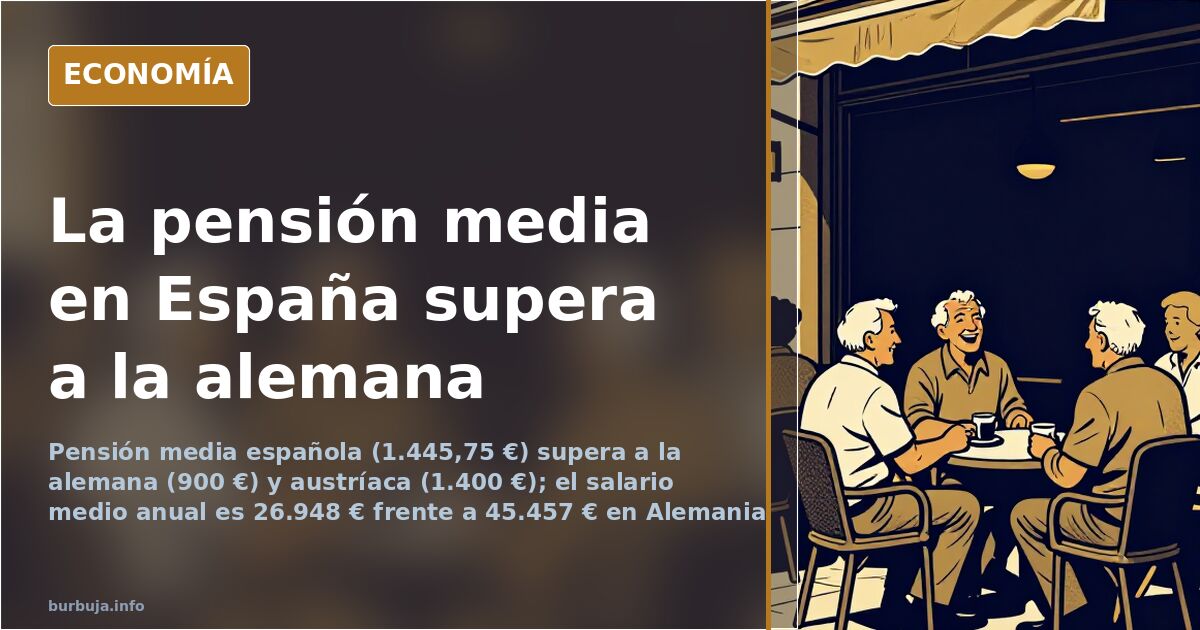
Average pension in Spain €1,445, compared to €900 in Germany
A key figure in the debate places the average pension in Spain at €1,445.75 per month, compared to €900 in Germany and €1,400 in Austria. With these figures, the Spanish retiree earns more than the German and slightly more than the Austrian, despite living in a country where the average annual gross salary is around €26,948—half that of Germany’s €45,457 or the Netherlands’ €57,513. The cross-reference between working pay and retirement pay drives a discussion peine with every fiscal update.
The premise is simple and painful. If goods circulate without friction in the single market, the shopping basket costs similarly in Madrid as in Munich. What does not equalize is household income. With uniform prices and half the salaries, the conclusion is clear: working here is cheaper, and earning here leaves you poorer.
Spain's average salary, half that of Germany or the Netherlands
The data in circulation draws an unsurprising map. Spain: €26,948 annual gross; Sweden: €44,581; Germany: €45,457; Austria: €50,460; Netherlands: €57,513. With free movement of workers in the European Union, the gap between staying and crossing a border often means doubling your salary.
From there, each side emphasizes what suits them. Some argue the only rational response is to pack your bags, while those who stay must accept they will be poorer. The immediate rebuttal: emigration is not a button you press; it requires money, language skills, support networks, and often extreme necessity.
How much more does a Spanish retiree earn compared to a German one?
The gap reverses upon retirement. Against €900 monthly average in Germany and €1,400 in Austria, Spain stands at €1,445.75. The Spanish pension exceeds Austria’s and exceeds Germany’s by over €500, according to these calculations.
Here lies the core of intergenerational anger. The most repeated argument is that the system pays generous pensions funded by contributions that do not sustain them, and the bill will eventually fall on those not yet retired. Those on the other side counter: these pensions were financed with mandatory contributions over decades, and those questioning them often ignore how much was contributed.
The actuarial mismatch: extra payments, widowhood, and single fund
Here the discussion becomes technical, and thus revealing. The idea that two extra payments create a shortfall is countered with an accounting argument: these payments are part of ordinary salary and are contributed to, with their base spread over twelve months. According to this participant, cutting them would be like applying a 16.67% scissors to the benefit.
The real problem, it is argued, lies in assistance and non-contributory benefits, which should not come from the Social Security fund. The underlying diagnosis repeats: those who contributed at the maximum base their entire working life will receive something very different from those who accumulated minimum bases and unemployment periods, and high pensions are subject to IRPF, so their net amount falls below the gross figure. The points targeted for future adjustment are always the same: widowhood, non-contributory benefits, and the formula transferring bases to pensions.
Emigrating to Austria or the Netherlands: solution or mirage?
The mantra that a three-hour flight doubles your salary clashes with an objection gaining weight as the conversation pogre. A migration project depends not only on will: family, language, finances, and contact networks matter. Without a cushion, the chance of succeeding in another country narrows, and many who leave end up returning within months.
History plays both ways. One participant recalls a generation that emigrated to France, Switzerland, and Germany in the 1960s, made money, and invested in bricks. Those citing this precedent reproach young people for not moving; those listening recall that leaving the country with nothing was then, as now, more an escape than a choice.
Who pays taxes in Spain
The final turn shifts focus from pensions to taxation. It is claimed that the burden falls on payrolls, evasion is high, and inspectors are insufficient and hamstrung by politics. In contrast, it is nuanced: the Corporate Tax collects at the European average, though with these profits, a modern state is unsustainable, and the remaining margin lies in VAT, where part of family spending is taxed at reduced rates that other countries apply more heavily.
And the same underlying suspicion always appears: public spending that does not return: administrative structure, appointed positions, and organizations growing without anyone knowing exactly why. This is where analysis stalls. With these salary and pension differentials, youth emigration should be massive. It is not. And the exact point where the calculation breaks—whether the fault lies in salaries, pensions, spending, or fiscal design—remains unanswered.
A key figure in the debate places the average pension in Spain at €1,445.75 per month, compared to €900 in Germany and €1,400 in Austria. With these figures, the Spanish retiree earns more than the German and slightly more than the Austrian, despite living in a country where the average annual gross salary is around €26,948—half that of Germany’s €45,457 or the Netherlands’ €57,513. The cross-reference between working pay and retirement pay drives a discussion peine with every fiscal update.
The premise is simple and painful. If goods circulate without friction in the single market, the shopping basket costs similarly in Madrid as in Munich. What does not equalize is household income. With uniform prices and half the salaries, the conclusion is clear: working here is cheaper, and earning here leaves you poorer.
Spain's average salary, half that of Germany or the Netherlands
The data in circulation draws an unsurprising map. Spain: €26,948 annual gross; Sweden: €44,581; Germany: €45,457; Austria: €50,460; Netherlands: €57,513. With free movement of workers in the European Union, the gap between staying and crossing a border often means doubling your salary.
- Spain: €26,948
- Sweden: €44,581
- Germany: €45,457
- Austria: €50,460
- Netherlands: €57,513
From there, each side emphasizes what suits them. Some argue the only rational response is to pack your bags, while those who stay must accept they will be poorer. The immediate rebuttal: emigration is not a button you press; it requires money, language skills, support networks, and often extreme necessity.
How much more does a Spanish retiree earn compared to a German one?
The gap reverses upon retirement. Against €900 monthly average in Germany and €1,400 in Austria, Spain stands at €1,445.75. The Spanish pension exceeds Austria’s and exceeds Germany’s by over €500, according to these calculations.
Here lies the core of intergenerational anger. The most repeated argument is that the system pays generous pensions funded by contributions that do not sustain them, and the bill will eventually fall on those not yet retired. Those on the other side counter: these pensions were financed with mandatory contributions over decades, and those questioning them often ignore how much was contributed.
The actuarial mismatch: extra payments, widowhood, and single fund
Here the discussion becomes technical, and thus revealing. The idea that two extra payments create a shortfall is countered with an accounting argument: these payments are part of ordinary salary and are contributed to, with their base spread over twelve months. According to this participant, cutting them would be like applying a 16.67% scissors to the benefit.
The real problem, it is argued, lies in assistance and non-contributory benefits, which should not come from the Social Security fund. The underlying diagnosis repeats: those who contributed at the maximum base their entire working life will receive something very different from those who accumulated minimum bases and unemployment periods, and high pensions are subject to IRPF, so their net amount falls below the gross figure. The points targeted for future adjustment are always the same: widowhood, non-contributory benefits, and the formula transferring bases to pensions.
Emigrating to Austria or the Netherlands: solution or mirage?
The mantra that a three-hour flight doubles your salary clashes with an objection gaining weight as the conversation pogre. A migration project depends not only on will: family, language, finances, and contact networks matter. Without a cushion, the chance of succeeding in another country narrows, and many who leave end up returning within months.
History plays both ways. One participant recalls a generation that emigrated to France, Switzerland, and Germany in the 1960s, made money, and invested in bricks. Those citing this precedent reproach young people for not moving; those listening recall that leaving the country with nothing was then, as now, more an escape than a choice.
Who pays taxes in Spain
The final turn shifts focus from pensions to taxation. It is claimed that the burden falls on payrolls, evasion is high, and inspectors are insufficient and hamstrung by politics. In contrast, it is nuanced: the Corporate Tax collects at the European average, though with these profits, a modern state is unsustainable, and the remaining margin lies in VAT, where part of family spending is taxed at reduced rates that other countries apply more heavily.
And the same underlying suspicion always appears: public spending that does not return: administrative structure, appointed positions, and organizations growing without anyone knowing exactly why. This is where analysis stalls. With these salary and pension differentials, youth emigration should be massive. It is not. And the exact point where the calculation breaks—whether the fault lies in salaries, pensions, spending, or fiscal design—remains unanswered.
Summary of a discussion on Burbuja.info - Foro de economía, actualidad y política., translated from Spanish and reviewed before publication. Read the full discussion (208 replies).
More summaries
-
Bullfighter Enrique Ponce, 54, and His 27-Year-Old Partner: The Age Gap
Enrique Ponce, 54, and his 27-year-old partner spark debate on relationships with large age gaps, involving money, status, and lifestyle differences.
-
Spain probes ex-PM Zapatero over alleged Maduro ties
Spain's National Court investigates former PM José Luis Rodríguez Zapatero for links to Venezuela's Maduro regime, sparking debate on extradition risks.
-
Bringing a Colombian Partner to Spain Costs €20,000
A case study reveals €20,000 spent on family reunification from Colombia and subsequent breakup. No official data measures the real cost.
-
The Blue Dress That Altered King Felipe VI’s Future
25 years since Eva Sannum’s photo in a blue dress ended her relationship with King Felipe VI, sparking debate on the Crown's opportunity cost.
-
Lloret de Mar: Viral photo sparks debate on tourist saturation
A count of 470 people in a Lloret de Mar photo fuels tourism debate, though telephoto lenses and beach slopes skew the perception of overcrowding.
-
Viral Sign in Spanish Restaurant Demands Boss Approval for Sick Leave
A sign in a Spanish restaurant requires staff to seek manager approval before visiting a doctor, sparking debate on precarious working conditions.