
Spain's 2030 Scenario: No Cheap Oil, EU Collapse, Pension Cuts
A 2030 scenario predicts the EU's disintegration, €3 diesel prices, and a return to rural subsistence living in Spain.
English · Original discussion in Spanish · Published
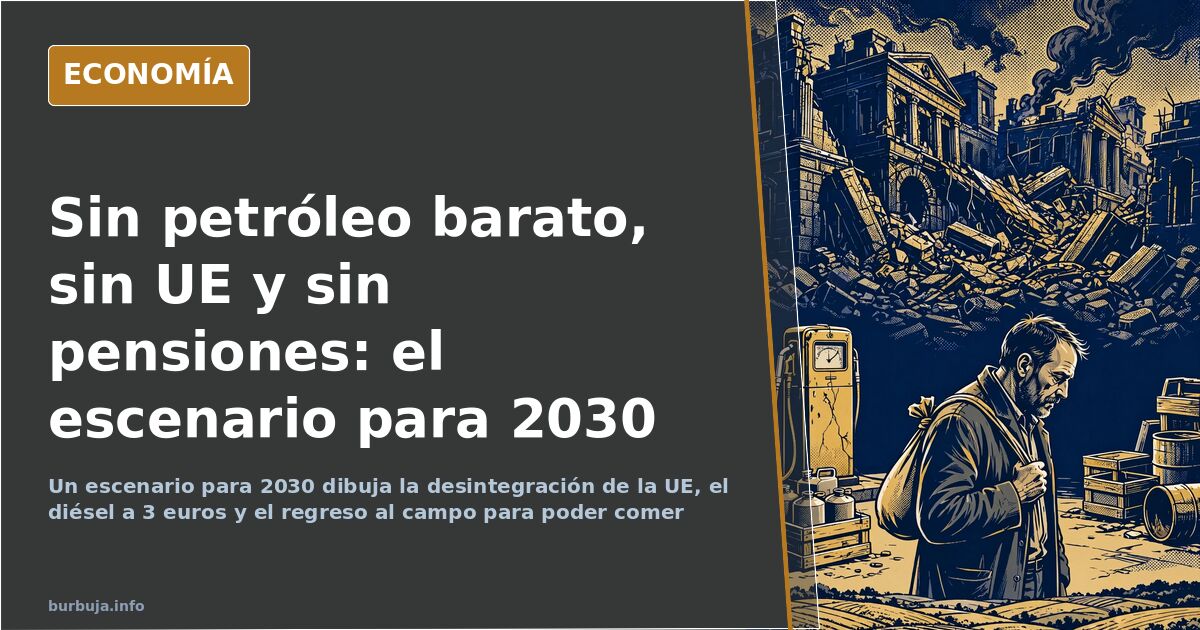
Oil, EU, and Pensions: Mapping a Spain Without Cheap Energy
Obesity vanishes. Not due to public health campaigns, but because meat, milk, and fish become unaffordable for most. This is one consequence of the detailed scenario dissected here: the EU disintegrates in the 2030s, oil stops reaching Europe, fuel rationing becomes daily reality, and only the wealthy access energy. The depicted standard of living resembles that of the 1940s and 50s.
What Happens If Oil Stops Reaching Europe?
The starting logic is linear: without cheap energy, moving goods and people costs a fortune, and a political union sustained by such transport loses its purpose. Meat, milk, and fish production plummets; animal protein consumption collapses, and consequently, obesity disappears for the majority. Some add a migration effect: if living standards collapse, the country stops attracting anyone.
The most common objection doesn't dispute the substance but the timeline. It argues these prophecies never materialize and doubts such brutal deterioration can occur in six or seven years. The metric used is crude oil prices, which hover around $80 per barrel during the discussion. From there, scarcity hasn't yet hit prices. Within the narrative itself, calculations place diesel at €3 when shortages become apparent.
The Welfare State Fades: Healthcare, Pensions, and Medicines
With energy costs soaring, tax revenue evaporates. VAT, income tax (IRPF), hydrocarbon taxes, vehicle inspections (ITV): the taxes supporting public structures lose their base. Without money, autonomous communities unravel, reverting to territorial organization similar to 1975. Pensions vanish or remain negligible, forcing children to care for parents as nursing homes and resources disappear.
Healthcare regresses. Medicines become luxury items, many being petroleum-derived, so care reverts to herbal remedies and folk healers. Life expectancy drops, while general and infant mortality rise due to reduced medical access. This is the harshest part of the narrative, delivered with minimal embellishment.
From Plastic to Glass: Remaking Material Life
Nylon and polyester, petroleum derivatives, become inaccessible, driving clothing prices up. Linen, hemp, and cotton cultivation returns. Chemical detergents, softeners, and cleaning products disappear similarly. Plastic vanishes, replaced by glass bottles that are washed and reused. Nothing is wasted: organic waste goes to animals or compost.
Agriculture suffers from input shortages. Fertilizers and pesticides came from fossil fuels, so farming reverts to manure, causing agricultural output to fall. Some recount this from personal memory, not theory: "My grandparents made everything from esparto grass, from baskets to bags to horse harnesses. Brooms were homemade, toilet paper was magazines and newspapers, no plastic existed, nor washing machines." The traditional grocery store with paper cones and counter-balanced scales isn't archaeology: it's what returns.
Return to the Countryside: Donkeys, Pigs, and Barter
Cities empty out. People move to villages and farmhouses to eat, cultivating land as done a century ago and raising pigs, chickens, and goats. Mules, donkeys, and horses regain roles lost to combustion engines. Tourism collapses: with air travel expensive, German and Swedish summer visitors stay home. Modern professions and much of the public sector disappear, as no taxes means no salaries.
Cash loses prominence, barter gains ground. Unexpectedly, birth rates rise: when everything is handmade, labor matters, and families reclaim their role as productive units. Large party structures, reliant on patronage networks and public budgets, suffocate when funds run dry. Regarding debt, the proposed sequence is explicit: "We revert to the peseta, the gold standard applies again, Spain's debt becomes unpayable, a haircut is imposed, but living standards resemble those of the 40s and 50s."
Resource Wars: Ukraine and Niger as Warnings
US, Russian, and Chinese nuclear arsenals prevent direct great-power conflict, shifting battles to secondary theaters where allies fight each other. Ukraine is the current example; Niger the next candidate. Scarcity drives this: "These wars will be over diminishing resources like gas, oil, uranium." By 2030, as shortages peak, states will likely fight for deposits at minimal cost. In this geopolitical board, Europe risks becoming the terrain where others settle scores.
No one disputes oil price trends. The question remains how much of this scenario is prophecy versus simply the present day stretched ten years forward with less energy.
Obesity vanishes. Not due to public health campaigns, but because meat, milk, and fish become unaffordable for most. This is one consequence of the detailed scenario dissected here: the EU disintegrates in the 2030s, oil stops reaching Europe, fuel rationing becomes daily reality, and only the wealthy access energy. The depicted standard of living resembles that of the 1940s and 50s.
What Happens If Oil Stops Reaching Europe?
The starting logic is linear: without cheap energy, moving goods and people costs a fortune, and a political union sustained by such transport loses its purpose. Meat, milk, and fish production plummets; animal protein consumption collapses, and consequently, obesity disappears for the majority. Some add a migration effect: if living standards collapse, the country stops attracting anyone.
The most common objection doesn't dispute the substance but the timeline. It argues these prophecies never materialize and doubts such brutal deterioration can occur in six or seven years. The metric used is crude oil prices, which hover around $80 per barrel during the discussion. From there, scarcity hasn't yet hit prices. Within the narrative itself, calculations place diesel at €3 when shortages become apparent.
The Welfare State Fades: Healthcare, Pensions, and Medicines
With energy costs soaring, tax revenue evaporates. VAT, income tax (IRPF), hydrocarbon taxes, vehicle inspections (ITV): the taxes supporting public structures lose their base. Without money, autonomous communities unravel, reverting to territorial organization similar to 1975. Pensions vanish or remain negligible, forcing children to care for parents as nursing homes and resources disappear.
Healthcare regresses. Medicines become luxury items, many being petroleum-derived, so care reverts to herbal remedies and folk healers. Life expectancy drops, while general and infant mortality rise due to reduced medical access. This is the harshest part of the narrative, delivered with minimal embellishment.
From Plastic to Glass: Remaking Material Life
Nylon and polyester, petroleum derivatives, become inaccessible, driving clothing prices up. Linen, hemp, and cotton cultivation returns. Chemical detergents, softeners, and cleaning products disappear similarly. Plastic vanishes, replaced by glass bottles that are washed and reused. Nothing is wasted: organic waste goes to animals or compost.
Agriculture suffers from input shortages. Fertilizers and pesticides came from fossil fuels, so farming reverts to manure, causing agricultural output to fall. Some recount this from personal memory, not theory: "My grandparents made everything from esparto grass, from baskets to bags to horse harnesses. Brooms were homemade, toilet paper was magazines and newspapers, no plastic existed, nor washing machines." The traditional grocery store with paper cones and counter-balanced scales isn't archaeology: it's what returns.
Return to the Countryside: Donkeys, Pigs, and Barter
Cities empty out. People move to villages and farmhouses to eat, cultivating land as done a century ago and raising pigs, chickens, and goats. Mules, donkeys, and horses regain roles lost to combustion engines. Tourism collapses: with air travel expensive, German and Swedish summer visitors stay home. Modern professions and much of the public sector disappear, as no taxes means no salaries.
Cash loses prominence, barter gains ground. Unexpectedly, birth rates rise: when everything is handmade, labor matters, and families reclaim their role as productive units. Large party structures, reliant on patronage networks and public budgets, suffocate when funds run dry. Regarding debt, the proposed sequence is explicit: "We revert to the peseta, the gold standard applies again, Spain's debt becomes unpayable, a haircut is imposed, but living standards resemble those of the 40s and 50s."
Resource Wars: Ukraine and Niger as Warnings
US, Russian, and Chinese nuclear arsenals prevent direct great-power conflict, shifting battles to secondary theaters where allies fight each other. Ukraine is the current example; Niger the next candidate. Scarcity drives this: "These wars will be over diminishing resources like gas, oil, uranium." By 2030, as shortages peak, states will likely fight for deposits at minimal cost. In this geopolitical board, Europe risks becoming the terrain where others settle scores.
No one disputes oil price trends. The question remains how much of this scenario is prophecy versus simply the present day stretched ten years forward with less energy.
Summary of a discussion on Burbuja.info - Foro de economía, actualidad y política., translated from Spanish and reviewed before publication. Read the full discussion (181 replies).
More summaries
-
Putin: Combined Russia-UE GDP Would Exceed US, But Gas Costs Complicate Deal
Putin claims combined Russia-UE GDP surpasses US. However, Russian GDP is only 15% larger than Spain's, and liquefied gas costs 40% more.
-
Sol Campout: Elite Spokespeople and Suspicions of Manipulation
Spokespeople for the Sol campout against the housing crisis reportedly attended United World College and Comillas, according to disseminated data.
-
Spain's DGT weighs one-car-per-home rule
A proposed law in Spain suggests limiting cars to one per residence to curb congestion. The DGT is studying similar measures, following precedents in France and the Balearic Islands.
-
Nuclear Hoax Denies Fission and Critical Mass
A viral calculation claims chain reactions are impossible, denying atomic bombs existed. The theory contradicts physics and its own cited sources.
-
Vox Leader Attends Trump Inauguration as Spain PM Snubbed
Abascal attends Trump's inauguration while Sánchez is excluded, sparking debate on costs and Spain's international role.
-
AI Fails Basic Tasks, Sparking Debate on Utility
Users report AI errors in simple tasks while others defend its value; one claims to have fired staff due to automation.