
Spain's 15% Stated Unemployment vs. 37% Real Rate
Spain cites 15% unemployment, but real estimates reach 37%. Nearly 1,200 applicants compete for minimum wage warehouse jobs, highlighting the gap between vacancies and living costs.
English · Original discussion in Spanish · Published
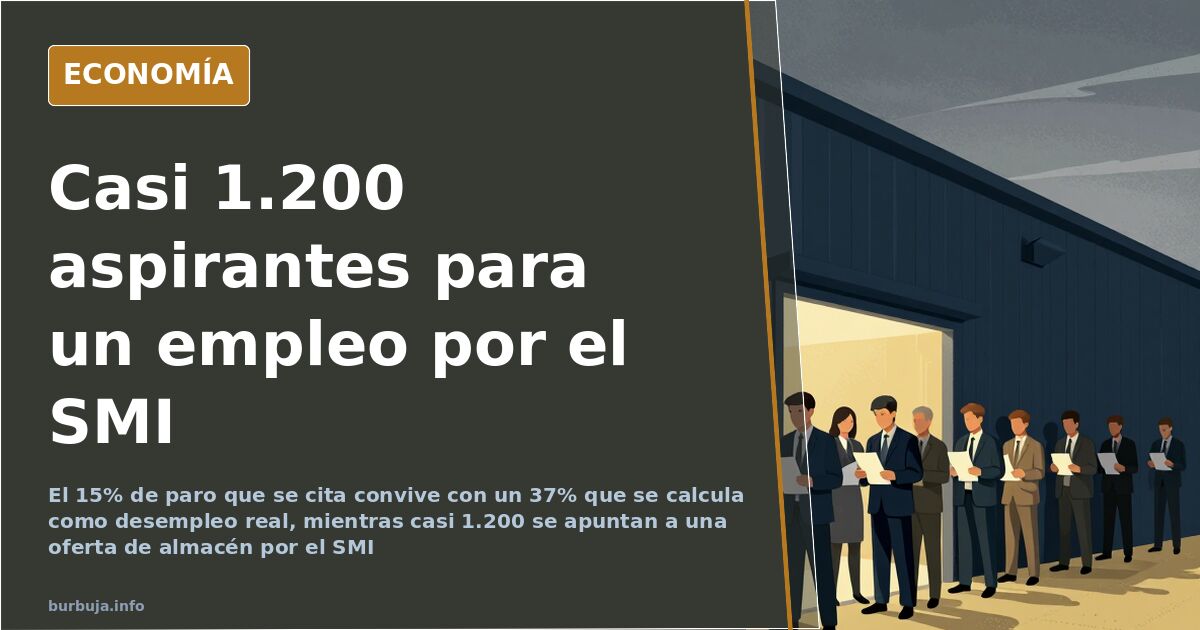
Spain's 15% stated unemployment vs. 37% real rate
Spain does not lack job offers; it lacks offers that cover living costs. The starting figure is a 15% unemployment rate. From there, the breakdown becomes complex. Against this cited 15%, a 37% real unemployment rate is calculated, a figure circulated on social media without official statistical backing. In between, testimonies converge on the same point: there are thousands of vacancies, but salaries do not cover commuting costs.
Why a 1,100 euro salary nets 800
Twenty kilometers round alucinación means 40 kilometers daily. Add fuel, vehicle wear, insurance, maintenance, and, if no packed lunch, the midday meal. The crude calculation is: 1,100 euros gross for eight hours ends up as 800 net. If you subtract 500 euros for rent or mortgage, you have 300 left for food, utilities, phone, and transport. The conclusion imposed by this part of the analysis is that the problem is not the existence of jobs, but their profitability for those who accept them.
The price context completes the argument. Rents of 1,200 euros, small flats for 400,000, an electric car for 45,000, and a kilo of green beans at 9.99 euros are cited. Each figure, separately, allows discussion; together they outline the framework where the minimum wage stops being a base and becomes a ceiling. When that happens, the math does not work, even when squeezed.
Nearly 1,200 candidates for a minimum wage warehouse job
If anyone doubts there are candidates, here is the ad. Order picking in a warehouse, full-time, minimum salary, Alicante province: nearly 1,200 registered applicants. The offer exists. The queue does too. The argument that there is plenty of work holds; the argument that this work solves life's problems does not.
The bottleneck appears before the interview. It is alleged that any position requires two to three years of experience, that higher qualifications are placed in assistant roles with duties exceeding their classification, split shifts, and Saturdays included. For those seeking their first job, the prior experience requirement acts as an impossible toll: without a car, license, or years of contributions, the barrier is even higher.
Finding work without connections?
Here the analysis splits into two. One current holds that without a sponsor there is no position, that the real path is inheriting the job, taking civil service exams, or knocking on the right door, and that access is reserved for those who already have contacts. Opposite, experiences contradict this: sector changes after age 45 with no leverage other than resumes sent daily and interviews.
The disagreement extends to the distribution of low-skilled jobs. Some point to competition for these jobs and the arrival of migrant workers; others reject this framework and point to the type of productive fabric and salaries. The background pointed to by some voices is the same: the private sector generates much low value-added employment, and conditions stem from there.
Technical training, exams in interviews, and remote work
Against total blockage, a concrete exit is described: the technology sector. Specialized platforms exist, processes include knowledge tests, and recruiters distinguish real training from gifted certifications. The person telling this does not speak fluent English and yet changed jobs after age 45. They add a detail that alters the commuting cost equation: remote work eliminates commuting costs.
Sectors with declared shortages, such as passenger transport, are also mentioned, with the usual obstacle: the license costs money and not everyone can afford it. In some regions, public employment service courses allow you to get it; in Andalusia, according to those asking, it is not free. Training thus appears as the most repeated lever and, at the same time, the hardest to activate without prior resources.
With these numbers, the provisional conclusion is uncomfortable: available employment and the cost of accessing it grow at different speeds. Search channels — general portals, sectoral platforms, spontaneous applications, courses with internships, and seasonal campaigns — are shared as remedies, not solutions. If the diagnosis is confirmed, pressure will not come from a lack of vacancies, but from the fact that fewer and fewer of them make ends meet by month-end. And that admits few firm predictions.
Spain does not lack job offers; it lacks offers that cover living costs. The starting figure is a 15% unemployment rate. From there, the breakdown becomes complex. Against this cited 15%, a 37% real unemployment rate is calculated, a figure circulated on social media without official statistical backing. In between, testimonies converge on the same point: there are thousands of vacancies, but salaries do not cover commuting costs.
Why a 1,100 euro salary nets 800
Twenty kilometers round alucinación means 40 kilometers daily. Add fuel, vehicle wear, insurance, maintenance, and, if no packed lunch, the midday meal. The crude calculation is: 1,100 euros gross for eight hours ends up as 800 net. If you subtract 500 euros for rent or mortgage, you have 300 left for food, utilities, phone, and transport. The conclusion imposed by this part of the analysis is that the problem is not the existence of jobs, but their profitability for those who accept them.
The price context completes the argument. Rents of 1,200 euros, small flats for 400,000, an electric car for 45,000, and a kilo of green beans at 9.99 euros are cited. Each figure, separately, allows discussion; together they outline the framework where the minimum wage stops being a base and becomes a ceiling. When that happens, the math does not work, even when squeezed.
Nearly 1,200 candidates for a minimum wage warehouse job
If anyone doubts there are candidates, here is the ad. Order picking in a warehouse, full-time, minimum salary, Alicante province: nearly 1,200 registered applicants. The offer exists. The queue does too. The argument that there is plenty of work holds; the argument that this work solves life's problems does not.
The bottleneck appears before the interview. It is alleged that any position requires two to three years of experience, that higher qualifications are placed in assistant roles with duties exceeding their classification, split shifts, and Saturdays included. For those seeking their first job, the prior experience requirement acts as an impossible toll: without a car, license, or years of contributions, the barrier is even higher.
Finding work without connections?
Here the analysis splits into two. One current holds that without a sponsor there is no position, that the real path is inheriting the job, taking civil service exams, or knocking on the right door, and that access is reserved for those who already have contacts. Opposite, experiences contradict this: sector changes after age 45 with no leverage other than resumes sent daily and interviews.
The disagreement extends to the distribution of low-skilled jobs. Some point to competition for these jobs and the arrival of migrant workers; others reject this framework and point to the type of productive fabric and salaries. The background pointed to by some voices is the same: the private sector generates much low value-added employment, and conditions stem from there.
Technical training, exams in interviews, and remote work
Against total blockage, a concrete exit is described: the technology sector. Specialized platforms exist, processes include knowledge tests, and recruiters distinguish real training from gifted certifications. The person telling this does not speak fluent English and yet changed jobs after age 45. They add a detail that alters the commuting cost equation: remote work eliminates commuting costs.
Sectors with declared shortages, such as passenger transport, are also mentioned, with the usual obstacle: the license costs money and not everyone can afford it. In some regions, public employment service courses allow you to get it; in Andalusia, according to those asking, it is not free. Training thus appears as the most repeated lever and, at the same time, the hardest to activate without prior resources.
With these numbers, the provisional conclusion is uncomfortable: available employment and the cost of accessing it grow at different speeds. Search channels — general portals, sectoral platforms, spontaneous applications, courses with internships, and seasonal campaigns — are shared as remedies, not solutions. If the diagnosis is confirmed, pressure will not come from a lack of vacancies, but from the fact that fewer and fewer of them make ends meet by month-end. And that admits few firm predictions.
Also available in: Deutsch
Summary of a discussion on Burbuja.info - Foro de economía, actualidad y política., translated from Spanish and reviewed before publication. Read the full discussion (473 replies).
More summaries
-
Spain's Silent Work Death Epidemic
Spain recorded over 1,200 annual work fatalities during the property boom. Subcontracting, media silence, and lack of inspections explain the tragedy.
-
Málaga, Alicante, Valencia Top Expats Ranking; Madrid, Barcelona Lag
InterNations ranks Málaga, Alicante, and Valencia as top cities for expats, with Madrid seventh and Barcelona 21st, amid high housing costs.
-
Clash at Sol protest camp over Spanish flag bracelet
A woman wearing a Spanish flag bracelet was confronted at the Sol camp for backing Abascal, as the Comunidad de Madrid deadline looms
-
Mutiny at Spain's Cadena Ser: staff weigh strikes over editorial shift and Barceló's exit
The crisis at Spain's Cadena Ser over its editorial shift and Àngels Barceló's departure reveals a fight for the survival of Prisa's business model.
-
Viral video of woman attacking Virgin Mary reignites Spain's immigration debate
A viral video of a woman striking a Virgin Mary image has reignited the debate over evangelical immigration in Spain. What lies behind the phenomenon?
-
I just picked up my pill organizer, ask me anything
A user confesses to a massive overdose and the forum responds with a mix of skepticism and concern. An analysis of a thread that pushes the limits of the internet.