
Spain: World's Third Fentanyl Consumer at 11.8%
Data places Spain as the world's third-largest fentanyl consumer, with healthcare workers among the first affected.
English · Original discussion in Spanish · Published
From Industrial Restructuring Heroin to Global Fentanyl Crisis
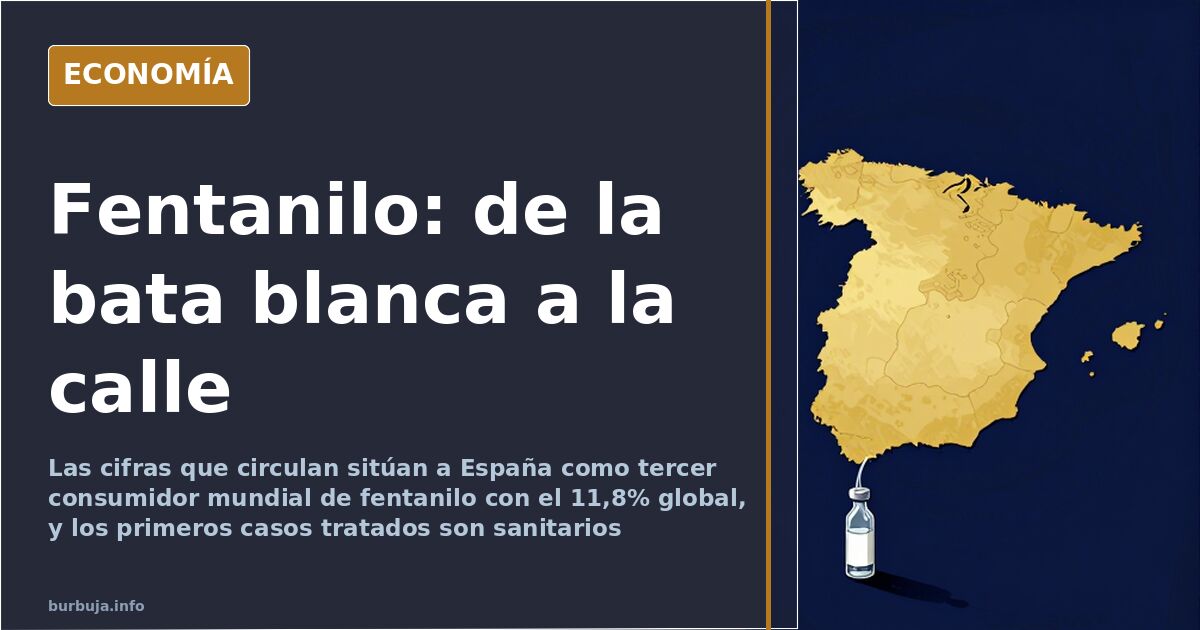
Press reports position Spain as the world's third-largest fentanyl consumer, accounting for 11.8% of global usage and leading in per capita consumption. The alarm stems not from street markets but operating rooms. Therapists treating early detox cases note that initial addicts were healthcare professionals hooked on so-called legal fentanyl used in hospitals. One case involves a nurse arriving for treatment with an IV line already inserted, ready to administer the opioid and its antidote.
Why Are Spain's First Fentanyl Addicts Healthcare Workers?
The profile is no accident. Fentanyl is described as cheap and highly potent, and hospital staff have direct access without needing dealers. This differs from the black market: the first wave requires no distribution network, only privileged access and growing tolerance. Experts say the threshold is crossed when moving from pills to intravenous use; thereafter, consumption becomes relentless.
This detail disrupts the usual narrative. When discussing opioids, the mental image is marginal users, not those sustaining the healthcare system. The described sequence is reversed: prescribed medication first, then escalation, and finally street involvement. The lingering question is whether this is a labor issue—shifts, chronic pain, easy access—disguised as a drug problem.
The Ghost of the Eighties: Heroin, Unemployment, and Deindustrialization
Comparisons with the 1980s pervade the discussion. Then, heroin entered working-class neighborhoods just as industrial restructuring dismantled jobs, with Bilbao as the epicenter. Testimonies are stark: in one Bilbao working-class district, over a hundred deaths annually among under-thirty individuals occurred due to overdoses, AIDS, pneumonia, hepatitis, or violent disputes. A participant recalls organizing bets with schoolmates on how many would die that winter; they underestimated the toll.
The thesis linking both episodes is simple and long-standing: when the labor market expels a population segment, cheap substances emerge as anesthesia. The initial message links consumption directly to prolonged unemployment and high interest rates stifling activity. The pattern repeats; only the molecule changes. Geography matters: the same neighborhoods hit by deindustrialization now view the new opioid with suspicion.
Depopulation Theories Not Supported by Data
Analysis then veers into slippery territory. Some argue drugs are a deliberate tool for population reduction, driven by elites preferring less wealth redistribution. Another variant claims chemical dependency aims to create docile youth, alleging institutional backing. These theories circulate without evidence, confusing lack of regulation with conspiracy. Mentioning them reflects the climate, not credibility.
The debateable ground lies elsewhere. The mix of public health, unemployment, and politics turns every data point into ammunition, yet none of the cited figures close the case.
From Eighties Addicts to Today's Consumers
The conversation also examines the market. Some claim addiction starts with recreation before targeting the vulnerable; others insist origin lies in physical or economic pain. Amidst this, suspicion arises that media hype acts as covert advertising to normalize the product's arrival in Europe. Some imagine entrepreneurs mixing milligrams of fentanyl with other mass-consumed narcotics to quickly build loyal customer bases.
While some debate economics, others drift toward nutrition: saturated fats versus carbs, ketogenic diets, ancestral recipes. Threads unravel because no definitive figure settles arguments. Only solid are opening data: consumption numbers, the healthcare profile of early cases, and the scar of a decade this country never fully closed.
With 11.8% of global consumption on the table and such an unexpected origin, diagnosis remains incomplete. We know how it starts, what it resembles, but not if the next phase will be a neighborhood or hospital crisis. There, exactly, analysis stalls.
Also available in: Deutsch
Summary of a discussion on Burbuja.info - Foro de economía, actualidad y política., translated from Spanish and reviewed before publication. Read the full discussion (109 replies).
More summaries
-
Madrid High Court Orders Probe into Sexual Assault Claim Against Socialist MP
The TSJM returns the sexual assault complaint against Madrid socialist deputy Javier Guardiola to lower court, demanding investigation amid claims of internal party conspiracy.
-
Spanish Socialist Spokesperson Faces Backlash Over Partner's Rental Portfolio
PSOE spokesperson Montse Mínguez advocates rent caps while her partner owns over 30 properties and faces three evictions.
-
The Palencia hacker: Russian sabotage or amateur hoax?
A hacker arrested in Palencia, Spain, for sabotaging a crematorium oven and water networks sparks disbelief: Russian threat or cheap farce? The analysis reveals a...
-
Birth crisis and immigration: plan or economic inertia?
Why does Europe encourage mass immigration while birth rates fall? Two schools of thought explain it: an elite conspiracy or pure economic incentives.
-
Anthropic's 'Panama' project: destroying books or urban legend?
Anthropic's 'Panama' project sparks controversy: destruction of old books or a debunked hoax? We look at the facts and the implications for…
-
Waymo lands in Spain: robotaxis or mirage?
Waymo announces its expansion into Spain and Portugal. The San Francisco blackout exposed the vulnerabilities of robotaxis. Is Europe ready for autonomous driving?