
Spain wildfires: 6,000 evacuated as state stays on the sidelines
Over 6,000 evacuated and 73,000 hectares burned in Galicia as Spain's central government remains in pre-emergency mode, reigniting the dispute over who should manage wildfires.
English · Original discussion in Spanish · Published
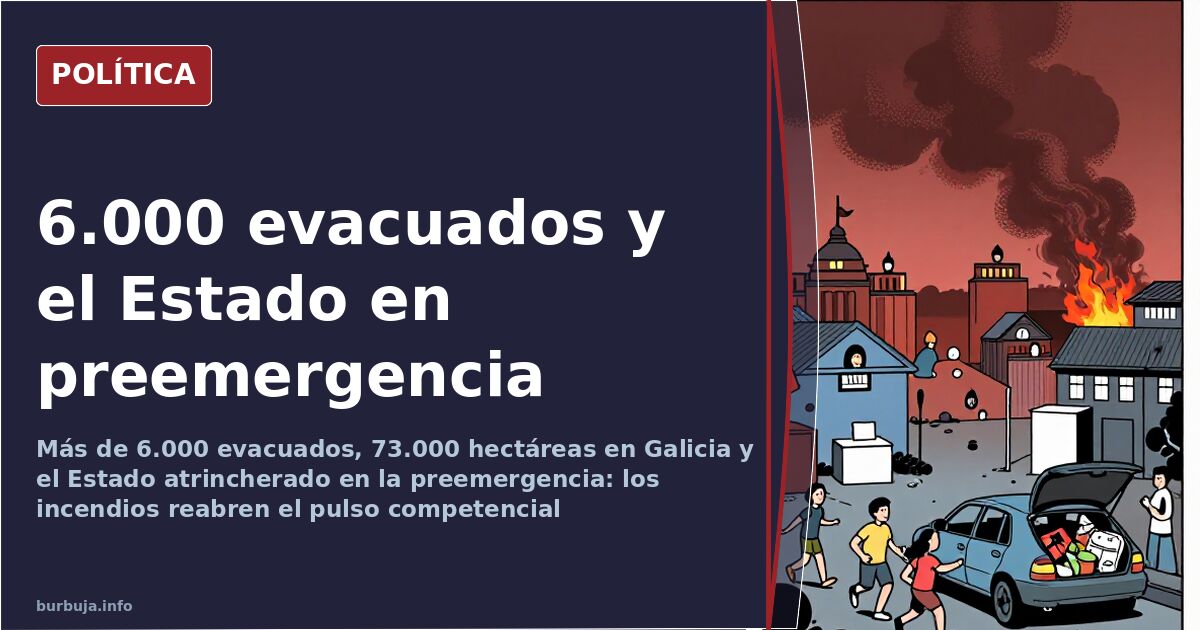
Spain burns and the state stays in pre-emergency mode
August 2025. Half of Spain is on fire and the official response fits in one word: pre-emergency. The Interior Ministry activated that level, which on paper does not oblige state agencies to take over firefighting, while the fires leave more than 6,000 evacuated, one dead in Tres Cantos and a wave in Galicia approaching 73,000 hectares. This is not a fire: it is a pattern. The question is no longer how to put out the fire, but who signs the report when the fire reaches the garden.
The numbers of a wave that only looks back to 2006
Galicia faces the second worst fire season in its history, surpassed only by 2006, with the burned area approaching 73,000 hectares. The outbreaks are no longer spread by province: they overlap. On 11 August, the fire that started in Tarifa advanced between Bolonia and Zahara de los Atunes driven by the easterly wind and forced the evacuation of more than 2,000 people. That same day, in Tres Cantos, a fire declared at around 19:45 forced the evacuation of the Soto de Viñuelas and Fuente El Fresno housing developments.
The human toll does not lend itself to graphics. Two seriously injured. One resident who died with burns over 98% of his body. Writing the percentage is simple; understanding it, impossible. The figure, stark, at least serves to remind us that behind every hectare there is a house that is no longer there.
The state that does not take over firefighting
The Interior Ministry's decision to remain at the pre-emergency level is the most uncomfortable point. It is a level that activates alerts, not one that deploys the state machinery against the fire. With more than 6,000 evacuated across Spain, the question arises on its own: if the central government reserves coordination, why does it not exercise it when the forest burns? Some argue that the competence is regional and that Madrid bursting in uninvited would be an encroachment on regional powers. Against that weighs a more down-to-earth argument: when fire jumps from one region to another, the phone that rings is always the same.
It is worth not losing sight of the obvious. An emergency is not measured by who appears in the photo, but by how many resources arrive in time. And here the official narrative and the reality on the ground have not matched up for months.
The "You fix it?" that sums up two decades
The phrase that gives the political standoff its title was not born at a rally. It was said by someone affected by the Sierra de la Culebra fires in 2022, responding to Pedro Sánchez after the announcement of aid: "Fix it? You... fix it?" Three years later, the retort still works as a caption for the cycle. Meanwhile, according to published reports, Transport Minister Óscar Puente deleted a message in which he joked about the Tarifa fire: the joke disappeared from the network; the fire did not. There were even those who reproached chef José Andrés, now a regular at catastrophes, for not being on the ground.
Those who do put out the fire, in precarious conditions
While politics argues over who should be in charge, those fighting the fire denounce conditions that cannot last a season. Emergency helicopter pilots and technicians speak of exhausting shifts and demand solutions to the precariousness of their contracts. It is the least visible link in the system and, probably, the first to feel any cut. A system that depends on people burned out from fatigue has a design problem, not a run of bad luck.
37 arrested and 113 investigated since 1 June
Since 1 June, 37 people have been arrested and 113 investigated in connection with the fires. The figure breaks the narrative of fate: part of the fire does not fall from the sky, someone lights it. That shifts the focus from the climate to the hand holding the lighter and complicates any simplistic response. VOX, for its part, denounced that Spain is burning because of a "pyromaniac bipartisanship" that would have passed laws and regulations harmful to the territory. The accusation, launched in the middle of the emergency, mixes regulatory criticism with opportunism.
Where the analysis gets stuck
That is where consensus stops. No one disputes the hectares, but as soon as you ask who pays, who is in charge and how much of this is an accident, versions diverge. Some point to the abandonment of the forest and cuts in prevention; others, to intent. And an uncomfortable suspicion hangs over everything: that money not spent on prevention ends up costing far more in reconstruction. The season is still open. The fire, too.
August 2025. Half of Spain is on fire and the official response fits in one word: pre-emergency. The Interior Ministry activated that level, which on paper does not oblige state agencies to take over firefighting, while the fires leave more than 6,000 evacuated, one dead in Tres Cantos and a wave in Galicia approaching 73,000 hectares. This is not a fire: it is a pattern. The question is no longer how to put out the fire, but who signs the report when the fire reaches the garden.
The numbers of a wave that only looks back to 2006
Galicia faces the second worst fire season in its history, surpassed only by 2006, with the burned area approaching 73,000 hectares. The outbreaks are no longer spread by province: they overlap. On 11 August, the fire that started in Tarifa advanced between Bolonia and Zahara de los Atunes driven by the easterly wind and forced the evacuation of more than 2,000 people. That same day, in Tres Cantos, a fire declared at around 19:45 forced the evacuation of the Soto de Viñuelas and Fuente El Fresno housing developments.
The human toll does not lend itself to graphics. Two seriously injured. One resident who died with burns over 98% of his body. Writing the percentage is simple; understanding it, impossible. The figure, stark, at least serves to remind us that behind every hectare there is a house that is no longer there.
The state that does not take over firefighting
The Interior Ministry's decision to remain at the pre-emergency level is the most uncomfortable point. It is a level that activates alerts, not one that deploys the state machinery against the fire. With more than 6,000 evacuated across Spain, the question arises on its own: if the central government reserves coordination, why does it not exercise it when the forest burns? Some argue that the competence is regional and that Madrid bursting in uninvited would be an encroachment on regional powers. Against that weighs a more down-to-earth argument: when fire jumps from one region to another, the phone that rings is always the same.
It is worth not losing sight of the obvious. An emergency is not measured by who appears in the photo, but by how many resources arrive in time. And here the official narrative and the reality on the ground have not matched up for months.
The "You fix it?" that sums up two decades
The phrase that gives the political standoff its title was not born at a rally. It was said by someone affected by the Sierra de la Culebra fires in 2022, responding to Pedro Sánchez after the announcement of aid: "Fix it? You... fix it?" Three years later, the retort still works as a caption for the cycle. Meanwhile, according to published reports, Transport Minister Óscar Puente deleted a message in which he joked about the Tarifa fire: the joke disappeared from the network; the fire did not. There were even those who reproached chef José Andrés, now a regular at catastrophes, for not being on the ground.
Those who do put out the fire, in precarious conditions
While politics argues over who should be in charge, those fighting the fire denounce conditions that cannot last a season. Emergency helicopter pilots and technicians speak of exhausting shifts and demand solutions to the precariousness of their contracts. It is the least visible link in the system and, probably, the first to feel any cut. A system that depends on people burned out from fatigue has a design problem, not a run of bad luck.
37 arrested and 113 investigated since 1 June
Since 1 June, 37 people have been arrested and 113 investigated in connection with the fires. The figure breaks the narrative of fate: part of the fire does not fall from the sky, someone lights it. That shifts the focus from the climate to the hand holding the lighter and complicates any simplistic response. VOX, for its part, denounced that Spain is burning because of a "pyromaniac bipartisanship" that would have passed laws and regulations harmful to the territory. The accusation, launched in the middle of the emergency, mixes regulatory criticism with opportunism.
Where the analysis gets stuck
That is where consensus stops. No one disputes the hectares, but as soon as you ask who pays, who is in charge and how much of this is an accident, versions diverge. Some point to the abandonment of the forest and cuts in prevention; others, to intent. And an uncomfortable suspicion hangs over everything: that money not spent on prevention ends up costing far more in reconstruction. The season is still open. The fire, too.
Summary of a discussion on Burbuja.info - Foro de economía, actualidad y política., translated from Spanish and reviewed before publication. Read the full discussion (541 replies).
More summaries
-
Sánchez and the Archive: 376 Responses to the Lie
376 responses and 298 days of debate: whether Pedro Sánchez lies or simply changes his mind when it suits him.
-
Spain's Congress Demands Sánchez Resignation in Non-Binding Vote
Spain's Congress, backed by PP, Vox, Junts, and UPN, demands Pedro Sánchez's resignation. The vote is non-binding, leaving the Prime Minister free to stay.
-
Tweet Places Pablo Fernández in Luxury Housing Development
A tweet places Pablo Fernández living in a luxury development from the Mahou-Calderón operation, the same one Podemos tried to halt.
-
Ignacio Garriga launches Catalonia campaign by criticizing media bias
VOX leader Ignacio Garriga denounces media bias in Spain following the announcement of regional elections in Catalonia. Analysis of the party's strategy.
-
Germany faces electoral uncertainty and looming economic crisis
An analysis of Germany's political tension as the far-right rises and forecasts suggest a severe economic recession.
-
Spain's Attorney General convicted and refuses to resign
The Attorney General of Spain, García Ortiz, has been convicted of leaking secrets, while the Government considers legal appeals and a potential pardon.