
Spain tops OECD rankings while wages stagnate
The Economist names Spain the best-performing OECD economy in 2024, but purchasing power parity wages fall and public debt surges.
English · Original discussion in Spanish · Published
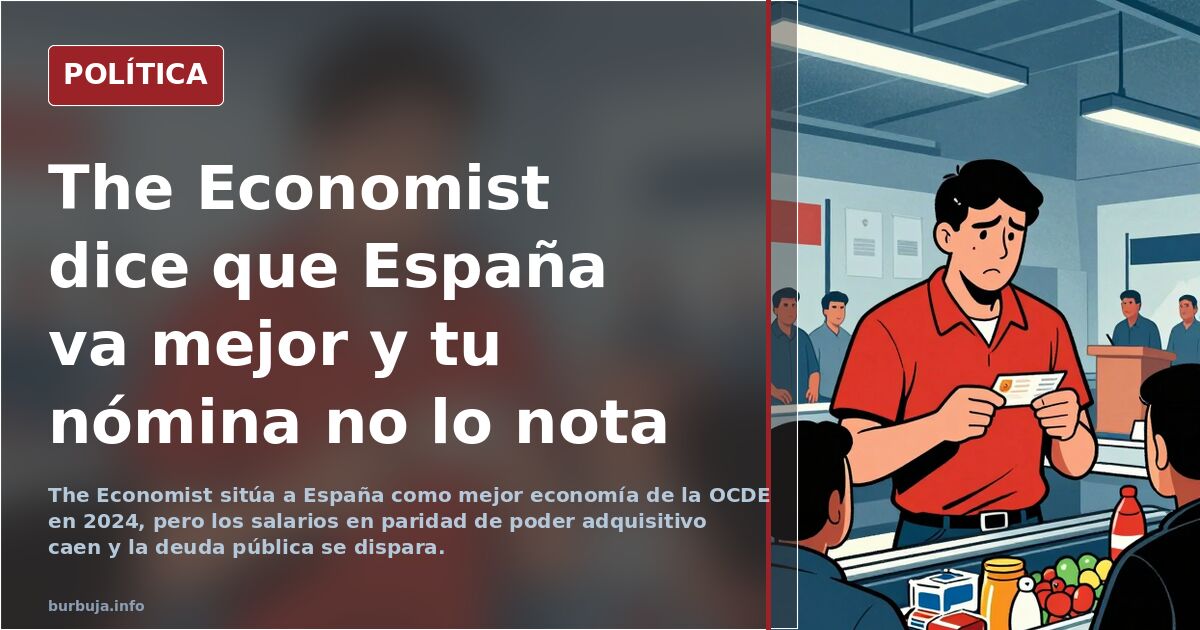
Spain crowned by The Economist, but pockets don't feel it
How can the magazine that best gauges the global economic pulse rank Spain at the top of the OECD in 2024, while the shopper pushing their cart feels cheated? The short answer: they measure different things. GDP grows, employment holds steady, foreign investment arrives. But when you look at the details—wages in purchasing power parity terms, cost of living baskets, rents—the shine fades. The Economist's headline is real; so are the fine print caveats.
What exactly does The Economist's ranking say?
The British weekly places Spain as the best-performing OECD economy in 2024, a recognition the Government has adopted as a banner. The indicators supporting this medal include GDP growth, employment trends, stock market performance, and falling core inflation. On paper, an impeccable picture.
The problem is that this GDP rests on pillars that don't always reach workers' pockets. Tourism contributes around 13% of Spanish GDP, five points more than France, the world's most visited country. And public spending drives the engine: in Q3 2024, 56% of the 0.83% growth came from public consumption, not private initiative. An economy growing because the State spends more is not the same as one growing because companies produce more and better.
Why GDP rises while wages don't
The most repeated criticism concerns wages in purchasing power parity terms. The argument is that they haven't just failed to rise, but have actually fallen in real terms. The minimum wage (SMI) goes up, yes, but average wages stagnate or retreat. The result is a narrowing wage band and a working class that, with an average salary, cannot rent a room in many capital cities.
Some point out that migration policy has expanded the available labor base, putting downward pressure on wages. This thesis circulates strongly in critical analyses, though it remains debated among economists. What is a fact is that labor costs for SMEs have risen 18.1% since 2019, according to data handled by Cepyme, and insolvency proceedings among small and medium-sized enterprises have hit record highs.
The hole that doesn't make headlines
Behind the showcase lies a mountain of debt. Public debt exceeds 90% of GDP in the first six months of the year, according to data sent to Brussels. Social Security debt has surged 233% since Sánchez took office. And the non-financial cash deficit reached €43.2 billion in July 2024 alone, according to IGAE.
The most uncomfortable calculation involves pension commitments. Some estimate that the system's real debt, adding what is owed to current contributors, ranges between €5 and €7 trillion. A figure that, compared to the official €1.5 trillion, causes dizziness. The system isn't broken because no one has presented the full bill yet.
The statistical trick nobody wants to see
INE confirmed that part of 2021's GDP growth was due to including activities like drug consumption and prostitution in the calculation. This is a standardized practice in Europe, but the optical effect is devastating: the Spanish economy grows, in part, thanks to what isn't declared. Added to this, 2024 growth relied on European recovery funds, money issued by the ECB that financed public works and public employment.
The question hovering over the entire analysis is simple: if GDP grows, employment holds, and debt surges, who pays for the party? Data suggests the answer lies in the taxpayer's pocket. In October, Hacienda collected nearly €50 billion, a historic record. The tax machinery never rests.
The official narrative vs. the supermarket checkout reality
The Government has an internationally prestigious headline. The opposition has the shopping basket. In between, a country growing in statistics while a growing portion of its population struggles more than before to make ends meet. Spain leads the poverty index in Europe, according to data used in the debate. This is no minor contradiction: it proves that aggregate growth and distributed well-being are two different things.
The paradox is that The Economist isn't wrong about what it measures. It measures GDP, employment, inflation, stocks. And there, Spain is doing well. What it doesn't measure is whether that growth translates into dignified lives. That doesn't show up in the ranking. It shows up at the supermarket checkout, on the end-of-month payslip, and on the rent bill. And there, the medal weighs less.
How can the magazine that best gauges the global economic pulse rank Spain at the top of the OECD in 2024, while the shopper pushing their cart feels cheated? The short answer: they measure different things. GDP grows, employment holds steady, foreign investment arrives. But when you look at the details—wages in purchasing power parity terms, cost of living baskets, rents—the shine fades. The Economist's headline is real; so are the fine print caveats.
What exactly does The Economist's ranking say?
The British weekly places Spain as the best-performing OECD economy in 2024, a recognition the Government has adopted as a banner. The indicators supporting this medal include GDP growth, employment trends, stock market performance, and falling core inflation. On paper, an impeccable picture.
The problem is that this GDP rests on pillars that don't always reach workers' pockets. Tourism contributes around 13% of Spanish GDP, five points more than France, the world's most visited country. And public spending drives the engine: in Q3 2024, 56% of the 0.83% growth came from public consumption, not private initiative. An economy growing because the State spends more is not the same as one growing because companies produce more and better.
Why GDP rises while wages don't
The most repeated criticism concerns wages in purchasing power parity terms. The argument is that they haven't just failed to rise, but have actually fallen in real terms. The minimum wage (SMI) goes up, yes, but average wages stagnate or retreat. The result is a narrowing wage band and a working class that, with an average salary, cannot rent a room in many capital cities.
Some point out that migration policy has expanded the available labor base, putting downward pressure on wages. This thesis circulates strongly in critical analyses, though it remains debated among economists. What is a fact is that labor costs for SMEs have risen 18.1% since 2019, according to data handled by Cepyme, and insolvency proceedings among small and medium-sized enterprises have hit record highs.
The hole that doesn't make headlines
Behind the showcase lies a mountain of debt. Public debt exceeds 90% of GDP in the first six months of the year, according to data sent to Brussels. Social Security debt has surged 233% since Sánchez took office. And the non-financial cash deficit reached €43.2 billion in July 2024 alone, according to IGAE.
The most uncomfortable calculation involves pension commitments. Some estimate that the system's real debt, adding what is owed to current contributors, ranges between €5 and €7 trillion. A figure that, compared to the official €1.5 trillion, causes dizziness. The system isn't broken because no one has presented the full bill yet.
The statistical trick nobody wants to see
INE confirmed that part of 2021's GDP growth was due to including activities like drug consumption and prostitution in the calculation. This is a standardized practice in Europe, but the optical effect is devastating: the Spanish economy grows, in part, thanks to what isn't declared. Added to this, 2024 growth relied on European recovery funds, money issued by the ECB that financed public works and public employment.
The question hovering over the entire analysis is simple: if GDP grows, employment holds, and debt surges, who pays for the party? Data suggests the answer lies in the taxpayer's pocket. In October, Hacienda collected nearly €50 billion, a historic record. The tax machinery never rests.
The official narrative vs. the supermarket checkout reality
The Government has an internationally prestigious headline. The opposition has the shopping basket. In between, a country growing in statistics while a growing portion of its population struggles more than before to make ends meet. Spain leads the poverty index in Europe, according to data used in the debate. This is no minor contradiction: it proves that aggregate growth and distributed well-being are two different things.
The paradox is that The Economist isn't wrong about what it measures. It measures GDP, employment, inflation, stocks. And there, Spain is doing well. What it doesn't measure is whether that growth translates into dignified lives. That doesn't show up in the ranking. It shows up at the supermarket checkout, on the end-of-month payslip, and on the rent bill. And there, the medal weighs less.
Summary of a discussion on Burbuja.info - Foro de economía, actualidad y política., translated from Spanish and reviewed before publication. Read the full discussion (185 replies).
More summaries
-
<<The DNA of SOCIALISM>>
Analysis of ideas linking socialism to theft and pleasure, criticizing figures like Karl Marx and exploring its political impact.
-
Quechua tents and Soros accusation in a protest camp
Quechua tents at a protest camp and an unproven accusation of links to Soros are at the centre of the debate
-
Bau and Farrerons: Spanish nationalism splits over nationhood
Ramón Bau and Jaume Farrerons debate competing nationalist models, from European democratization to ethnostate visions.
-
Spain's Extremadura Votes Dec 21; Vox Key to Coalition
Guardiola says a deal with Vox is feasible as PSOE loses 108,000 votes while the far-right party gains 40,000.
-
Cuba 2.0: Forum dissects state monopoly capitalism
Analysis of Cuba's situation: the forum challenges socialist myths, exposing state monopoly capitalism realities.
-
Repsol warned of blackout that halted Cartagena refinery
Repsol alerted five days before the outage stopped its Cartagena refinery. Was it renewables or lack of investment? Data and analysis.