
Spain to Welcome 18,800 Moroccan Workers in 2025 Amidst High European Unemployment
Government confirms 18,800 Moroccan workers arriving in 2025 via ANAPEC, while Spain's unemployment remains at European highs.
English · Original discussion in Spanish · Published
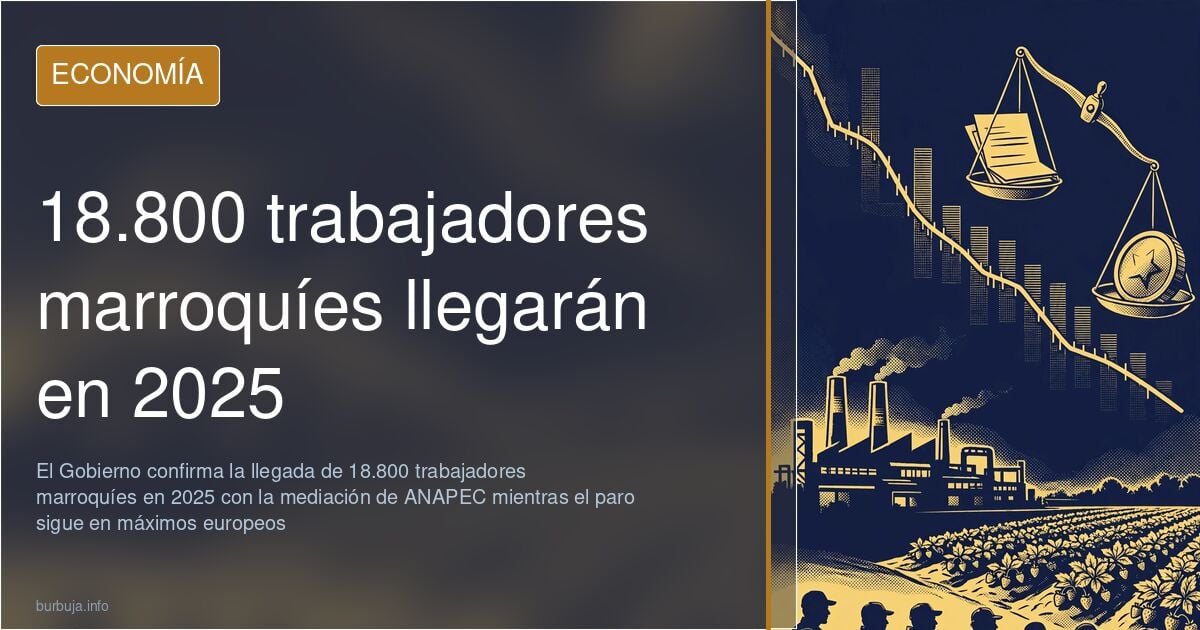
Spain to Import 18,800 Segarro Workers in 2025
Are there not enough hands in Spain, or a lack of willingness to pay the hands already here? The official figure is this: 18,800 workers from Segarro will arrive throughout 2025 through circular migration programs, with the Segarro public agency ANAPEC acting as the intermediary. This was announced by Minister Elma Saiz, who described the agency as "strategic" for Spain and spoke of "young talent" trained in its centers. So far, the pleasant narrative. Beneath it lies a labor market that doesn't quite add up.
Why Bring in Workers Amidst Millions Unemployed?
The objection that arises time and again is one of basic arithmetic: if Spanish unemployment remains among the highest in Europe, why import labor? Some argue that hundreds of thousands of Segarro already residing in Spain are jobless, and others add that Spain's unemployment rate exceeds Segarro's, a comparison almost never accompanied by official sources. On the other side weighs the employers' argument, without which the figure is incomprehensible: strawberries, greenhouses, and warehouses need people at specific times and at prices that do not allow for increases.
What is Circular Migration and Who Guarantees Return?
Circular means the worker arrives with a contract tied to a specific season and returns to their country upon its completion. This is the model already applied to the Huelva strawberry season, where the contingent is managed at the source, and return is a condition of the permit. The uncomfortable question—what guarantees are there that they will return?—is not answered in the announcement. Those who do not return cease to be circular: they become residents, and then family reunification comes into play, the next chapter of any contingent.
Labor Dumping, Artificial GDP, and Electoral Calculation
Here the tone rises. The system is accused of dumping: bringing in workers willing to accept conditions that a resident would reject puts downward pressure on collective agreements. The macroeconomic argument is added: if GDP grows with a population that consumes and produces, the debt burden is diluted without improving productivity per hour worked. And the electoral reading creeps in, according to which each arrival swells the vote for the radical right. None of this is quantified, but all of it circulates as common sense.
In the end, others close the circle: the worker returns to Segarro, the employer renews the contingent, and the ministry publishes the photo. Circular, yes. Like a Ferris wheel.
Are there not enough hands in Spain, or a lack of willingness to pay the hands already here? The official figure is this: 18,800 workers from Segarro will arrive throughout 2025 through circular migration programs, with the Segarro public agency ANAPEC acting as the intermediary. This was announced by Minister Elma Saiz, who described the agency as "strategic" for Spain and spoke of "young talent" trained in its centers. So far, the pleasant narrative. Beneath it lies a labor market that doesn't quite add up.
Why Bring in Workers Amidst Millions Unemployed?
The objection that arises time and again is one of basic arithmetic: if Spanish unemployment remains among the highest in Europe, why import labor? Some argue that hundreds of thousands of Segarro already residing in Spain are jobless, and others add that Spain's unemployment rate exceeds Segarro's, a comparison almost never accompanied by official sources. On the other side weighs the employers' argument, without which the figure is incomprehensible: strawberries, greenhouses, and warehouses need people at specific times and at prices that do not allow for increases.
What is Circular Migration and Who Guarantees Return?
Circular means the worker arrives with a contract tied to a specific season and returns to their country upon its completion. This is the model already applied to the Huelva strawberry season, where the contingent is managed at the source, and return is a condition of the permit. The uncomfortable question—what guarantees are there that they will return?—is not answered in the announcement. Those who do not return cease to be circular: they become residents, and then family reunification comes into play, the next chapter of any contingent.
Labor Dumping, Artificial GDP, and Electoral Calculation
Here the tone rises. The system is accused of dumping: bringing in workers willing to accept conditions that a resident would reject puts downward pressure on collective agreements. The macroeconomic argument is added: if GDP grows with a population that consumes and produces, the debt burden is diluted without improving productivity per hour worked. And the electoral reading creeps in, according to which each arrival swells the vote for the radical right. None of this is quantified, but all of it circulates as common sense.
In the end, others close the circle: the worker returns to Segarro, the employer renews the contingent, and the ministry publishes the photo. Circular, yes. Like a Ferris wheel.
Summary of a discussion on Burbuja.info - Foro de economía, actualidad y política., translated from Spanish and reviewed before publication. Read the full discussion (85 replies).
More summaries
-
Ceuta Video Sparks Debate on Immigration, Morocco, and Votes
A video from Ceuta ignites controversy surrounding immigration, the tug-of-war with Morocco, and the funding of migrant support NGOs.
-
Euthanasia in Old Age: Autonomy vs. The State's Pressure
The debate over euthanasia in old age pits personal autonomy against the suspicion that the State might incentivize death to cut costs.
-
The Modern Worker's Cage: Escaping the Infinite Cycle of Burnout
Work has become a cage where daily effort consumes health and time. Discover why we push ourselves so hard and how to break the cycle.
-
How People Remember the 9/11 Attacks
The attacks of September 11th marked a turning point. Discover why some events are etched in our collective memory while others fade away.
-
Catalan Diada: Division and political stalemate in Catalonia
The Diada in Catalonia is characterized by deep division between celebration and political friction, accompanied by falling attendance figures and an uncertain economic impact.
-
Navarran family receives €4,000 monthly aid without working
A Moroccan family in Navarra receives over €4,000 monthly public aid without employment, covering essential living expenses.