
Spain to raise taxes and tolls, avoiding spending cuts
Analysis suggests Spain will adjust via VAT hikes, tolls, and wealth tax, citing EU pressure.
English · Original discussion in Spanish · Published
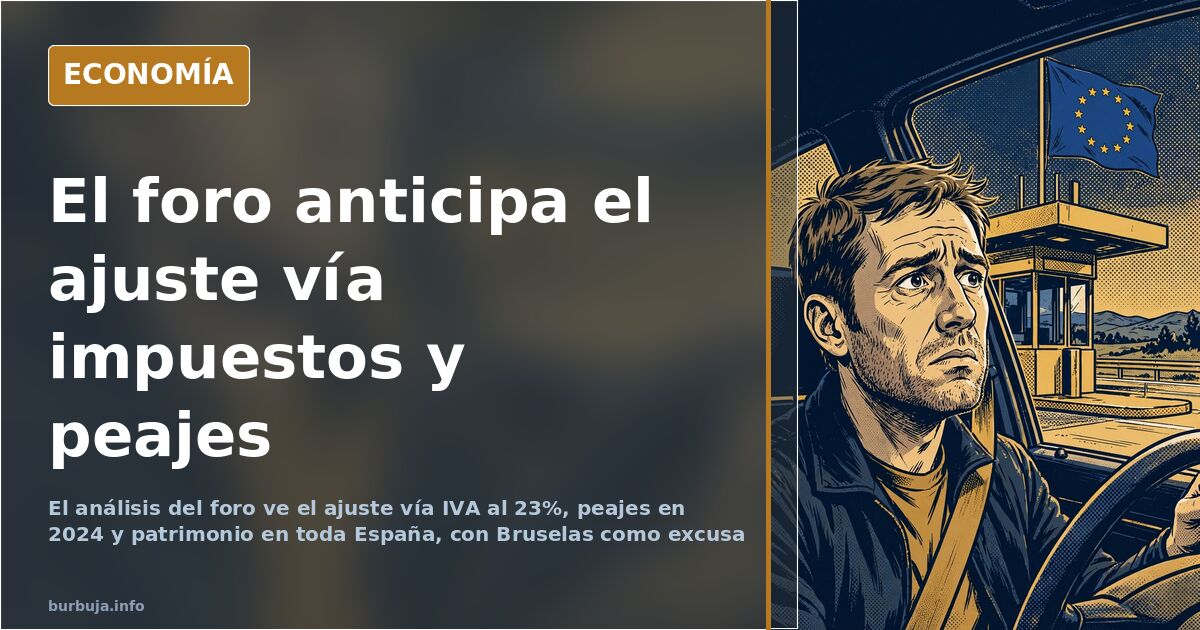
Adjustment to come via taxes and tolls, not cuts, forum analysis says
There will be no named austerity measures. This is the core of the analysis dominating the conversation: the fiscal adjustment won't be announced as a cut because it doesn't need to be called that. It will arrive through tax increases, road tolls, and inflation that continues to bite into household shopping baskets, with the cost borne by the usual taxpayers. The ones who keep rowing, so to speak.
The starting point of the diagnosis is that any unpopular measure will be wrapped up as external imposition. It comes from Europe, from Brussels, for harmonization purposes. Several analyses argue this framework allows swallowing the harshest hikes without electoral punishment. And, for now, it works.
Which hikes are projected and who bears them
The list being discussed has a schedule and figures. Tolls on all roads in 2024. Wealth and inheritance taxes across Spain between 2024 and 2025. A VAT rate of 23%, like Portugal's. And a loaf of bread costing two euros by 2026. All while official discourse insists the economy is rocketing along.
Those raising VAT and hiking social security contributions don't need to cut hospitals or freeze public wages: they achieve the same revenue effect through the back door. The difference is narrative. A cut is visible on the street; a tax isn't. And a hike disguised as European harmonization is neither seen nor debated.
There is an asymmetry nobody corrects: cuts are announced and suffered; tax hikes are published and discovered in the pay slip.
The macro picture cited to justify the adjustment
The figures feeding pessimism are substantial. Debt interest alone is cited at €60 billion a year, equivalent to €200 million daily, a datum that frames any budget debate. Added to the equation are 16 million public sector payrolls and unemployment placed at 30%.
With that starting point, maneuvering room is scarce and adjustment seems inevitable, whoever governs. The problem, some note, is that the ball always ends up in the same place: the disposable income of those who work.
The diagnosis is not homogeneous. One current argues there will be no classic cut and everything will be resolved by suffocating self-employed workers and companies via contributions. Another maintains the adjustment will arrive anyway, doing so as in 2011, with autonomous communities doing the dirty work.
The electoral arithmetic sustaining calm
Behind official tranquility lie numbers. The right-wing bloc, according to circulating calculations, loses ground: PP sheds 146,000 votes and Ciudadanos 52,000, while Vox gains 254,000. The net balance of the conservative space is negative, reducing pressure to correct course.
On the other side, Sumar and Podemos lose 223,000 votes, but PSOE gains 384,000, a balance of 161,000 in just three months for the left-wing bloc. With that internal transfer, the conclusion drawn is that the electorate regroupes and holds firm.
Discontent, in this reading, doesn't move a single seat. That's why the strategy can afford to ignore the street.
Zapatero precedent and the reform nobody remembers well
Selective memory is at play, and that memory has consequences. As one participant recalls, it is repeated that Zapatero left during the crisis when he was actually re-elected, and that the toughest labor reform wasn't the PP's, but his own. What settles in the collective imagination isn't what peine, but what is convenient to remember.
The parallel with the present is explicit: governing amidst underlying complaints, applying unpopular measures, and then the electorate repeats. The difference, some point out, is that this time the adjustment won't have a clear face to blame, because it won't carry the name of a cut.
In this framework, the question isn't when it will be felt, but if anyone will feel it. One participant argues most voters live off taxes paid by a minority, and as long as public payrolls and benefits hold, there will be no mobilization whatsoever.
Regarding pensions and public salaries, some maintain they won't be touched and the adjustment will fall on those who truly work.
Fronts overlapping with the economy
The adjustment doesn't travel alone. In the same conversation appear Ceuta and Melilla, military deployment in Latvia, concessions to separatists, and the geometry of investitures. Each front functions as distraction or additional argument for wear and tear, and all compete for the same attention.
And unions, according to another current, won't take to the streets because they are aligned with power. Without counterpower in the street, the adjustment becomes landscape: everyone pays it, almost nobody protests it. Some return to the balcony to applaud; others simply don't return.
There will be no named austerity measures. This is the core of the analysis dominating the conversation: the fiscal adjustment won't be announced as a cut because it doesn't need to be called that. It will arrive through tax increases, road tolls, and inflation that continues to bite into household shopping baskets, with the cost borne by the usual taxpayers. The ones who keep rowing, so to speak.
The starting point of the diagnosis is that any unpopular measure will be wrapped up as external imposition. It comes from Europe, from Brussels, for harmonization purposes. Several analyses argue this framework allows swallowing the harshest hikes without electoral punishment. And, for now, it works.
Which hikes are projected and who bears them
The list being discussed has a schedule and figures. Tolls on all roads in 2024. Wealth and inheritance taxes across Spain between 2024 and 2025. A VAT rate of 23%, like Portugal's. And a loaf of bread costing two euros by 2026. All while official discourse insists the economy is rocketing along.
Those raising VAT and hiking social security contributions don't need to cut hospitals or freeze public wages: they achieve the same revenue effect through the back door. The difference is narrative. A cut is visible on the street; a tax isn't. And a hike disguised as European harmonization is neither seen nor debated.
There is an asymmetry nobody corrects: cuts are announced and suffered; tax hikes are published and discovered in the pay slip.
The macro picture cited to justify the adjustment
The figures feeding pessimism are substantial. Debt interest alone is cited at €60 billion a year, equivalent to €200 million daily, a datum that frames any budget debate. Added to the equation are 16 million public sector payrolls and unemployment placed at 30%.
With that starting point, maneuvering room is scarce and adjustment seems inevitable, whoever governs. The problem, some note, is that the ball always ends up in the same place: the disposable income of those who work.
The diagnosis is not homogeneous. One current argues there will be no classic cut and everything will be resolved by suffocating self-employed workers and companies via contributions. Another maintains the adjustment will arrive anyway, doing so as in 2011, with autonomous communities doing the dirty work.
The electoral arithmetic sustaining calm
Behind official tranquility lie numbers. The right-wing bloc, according to circulating calculations, loses ground: PP sheds 146,000 votes and Ciudadanos 52,000, while Vox gains 254,000. The net balance of the conservative space is negative, reducing pressure to correct course.
On the other side, Sumar and Podemos lose 223,000 votes, but PSOE gains 384,000, a balance of 161,000 in just three months for the left-wing bloc. With that internal transfer, the conclusion drawn is that the electorate regroupes and holds firm.
Discontent, in this reading, doesn't move a single seat. That's why the strategy can afford to ignore the street.
Zapatero precedent and the reform nobody remembers well
Selective memory is at play, and that memory has consequences. As one participant recalls, it is repeated that Zapatero left during the crisis when he was actually re-elected, and that the toughest labor reform wasn't the PP's, but his own. What settles in the collective imagination isn't what peine, but what is convenient to remember.
The parallel with the present is explicit: governing amidst underlying complaints, applying unpopular measures, and then the electorate repeats. The difference, some point out, is that this time the adjustment won't have a clear face to blame, because it won't carry the name of a cut.
In this framework, the question isn't when it will be felt, but if anyone will feel it. One participant argues most voters live off taxes paid by a minority, and as long as public payrolls and benefits hold, there will be no mobilization whatsoever.
Regarding pensions and public salaries, some maintain they won't be touched and the adjustment will fall on those who truly work.
Fronts overlapping with the economy
The adjustment doesn't travel alone. In the same conversation appear Ceuta and Melilla, military deployment in Latvia, concessions to separatists, and the geometry of investitures. Each front functions as distraction or additional argument for wear and tear, and all compete for the same attention.
And unions, according to another current, won't take to the streets because they are aligned with power. Without counterpower in the street, the adjustment becomes landscape: everyone pays it, almost nobody protests it. Some return to the balcony to applaud; others simply don't return.
Summary of a discussion on Burbuja.info - Foro de economía, actualidad y política., translated from Spanish and reviewed before publication. Read the full discussion (186 replies).
More summaries
-
Euro banknote redesign sparks cultural debate at ECB
The ECB launches a public consultation on new euro notes, triggering identity politics debates over proposed designs featuring diverse faces and birds.
-
Ceuta and Melilla: Why Geography Doesn't Define Europe
Geography doesn't dictate what the EU is: French Guiana and Lampedusa are outside the continent. The Ceuta debate reignites this question.
-
Tenant Union of Sol: a network with €3.7 million
The Tenant Union of Sol is part, according to a published report, of a network that would have received €3.7 million from Socialist administrations.
-
Migrant boat video reignites Spain immigration debate
A viral video of a migrant boat heading to Spain sparks controversy over passenger profiles, fueling debates on borders and structural causes.
-
Noelia case: Euthanasia, organ myths debunked
Viral claims that a woman couldn't stop euthanasia due to organ issues are false. Spanish law allows revocation at any time.
-
Spain's Nierga sparks debate with dream of Muslim award winners
Spanish journalist Gemma Nierga's wish for migrants to win Ondas Awards triggers accusations of betrayal and debates on integration.