
Spain to Ban Social Media for Under-16s, Citing Age Verification Hurdles
Sánchez announces a ban on social media for under-16s, with age verification and VPNs posing significant technical challenges.
English · Original discussion in Spanish · Published
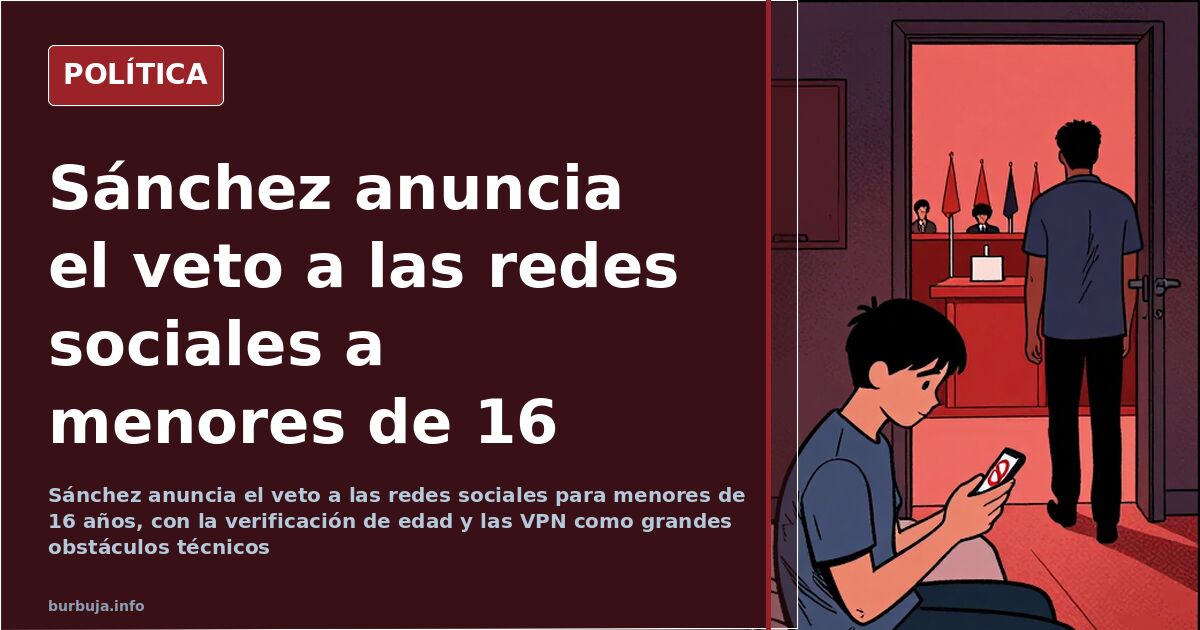
Sánchez to Ban Social Media for Under-16s
The chosen venue was a government summit in Dubai. There, Pedro Sánchez announced that Spain will ban access to social media for minors under 16, as part of a package of legislative changes concerning online platforms. This is not an exclusive idea: Emmanuel Macron had already launched it in France weeks before. And the question that no headline fully answers is very simple: how is this implemented?
Can Access to Social Media Be Technically Banned?
Blocking requires age verification, and true age verification implies identifying who is accessing: a digital certificate, electronic ID (DNIe), or an equivalent system. The reasoning presented by a participant is uncomfortable. If nothing is admitted that doesn't come with a valid certificate showing age data, the practical result is mandatory authentication to access any service. And that certificate already exists: it is issued by the FNMT (Fábrica Nacional de Moneda y Timbre - Spain's National Mint and Stamp Factory). Not even the DNI would be necessary.
The immediate problem is evasion. As long as VPNs exist, blocking access is much more difficult than the announcement suggests. A minor doesn't need to hack anything: they just need to copy the DNI and birth date of an adult they know to open an account. The conversation recounts the case of a relative who discovered their nephew was using their name and age to log in without permission. The passport safe starts to seem less absurd.
The Chinese Model and the Cost of Implementing a Real Blockade
Blocking without loopholes is another level. The approach points to the recipe used by China and Iran: a national proxy, an operator-grade firewall at traffic exchange points, and blocking outbound connections to commercial VPN servers and the TOR network. With such a deployment, users not only cannot access foreign content: they wouldn't even know it exists. The infrastructure for 50 million people is technically possible —China operates it for 1.8 billion— but it requires a state apparatus that Spain has not demonstrated it possesses.
What hinders implementation are not the laws, according to the most pessimistic reading. They would already be approved. What's missing is the capacity of those who would have to build it. The Big Brother of navigation isn't arriving due to lack of desire, but lack of competent executors.
The "Una manola" Precedent and Age Certificates
Spain already tried something similar. The so-called una manola consisted of exactly that: authentication by certificate for access to adult content. Although it was never fully implemented, in the thread it's taken for granted that it left tenders, emergency awards, and purchases along the way. It's proof that the mechanism exists and that, under another pretext, it can reappear. The alibi this time is child protection, which is the hardest to argue against in public.
Rejection: Mandatory Identification and Control of Dissent
The core of the complaint is not the age, but the registration. If every network access is linked to a verified identity, a connection history is built that could end up before a judge. This is where the most repeated comparison comes in: one wouldn't need to resemble China to achieve the same result. Other readings go further and cite Russia, Iran, and North Korea as models. For some participants, the conclusion is that the ban isn't meant to protect minors, but to know who is behind each screen.
With the classic excuse of it's for the children, a mechanism is activated that is later applied to everyone else under a different pretext. First minors, then the rest. This is the suspicion that runs through the whole issue, and no press release refutes it.
Why Now? Sánchez's Shift on Social Media
The chronology is interesting. A little over a decade ago, Sánchez defended social media as a tool for participation. The two tweets that have been recovered these days are separated, as pointed out in the thread, by 15 years. In the interim, the landscape has turned upside down. One reading suggests the shift responds to a fundamental change: when the majority of young people stopped getting their news from television and started getting it from social media, the narrative previously controlled by traditional media became uncontrollable. Banning access for minors would also be closing the door to an audience that no longer consumes the usual menu.
The Role of Parents and Age Verification
Some argue the opposite: most parents neither know the risks of social media at certain ages nor how to use the parental controls that already exist. Banning by law would imply that family self-regulation doesn't work. The counterargument is that banning is not preventing. Age is declared, not proven, and kids have been bypassing that formality for years with the same ease they pirate a pay-per-view sports match. That they evade the legal wall is as likely as them evading any other.
One detail remains that summarizes the thread's skepticism. If verification depends on each internet user declaring their age, the result is predictable and free: from now on, all minors under 16 will be 16. A VPN isn't needed. Just ticking another box will do.
The chosen venue was a government summit in Dubai. There, Pedro Sánchez announced that Spain will ban access to social media for minors under 16, as part of a package of legislative changes concerning online platforms. This is not an exclusive idea: Emmanuel Macron had already launched it in France weeks before. And the question that no headline fully answers is very simple: how is this implemented?
Can Access to Social Media Be Technically Banned?
Blocking requires age verification, and true age verification implies identifying who is accessing: a digital certificate, electronic ID (DNIe), or an equivalent system. The reasoning presented by a participant is uncomfortable. If nothing is admitted that doesn't come with a valid certificate showing age data, the practical result is mandatory authentication to access any service. And that certificate already exists: it is issued by the FNMT (Fábrica Nacional de Moneda y Timbre - Spain's National Mint and Stamp Factory). Not even the DNI would be necessary.
The immediate problem is evasion. As long as VPNs exist, blocking access is much more difficult than the announcement suggests. A minor doesn't need to hack anything: they just need to copy the DNI and birth date of an adult they know to open an account. The conversation recounts the case of a relative who discovered their nephew was using their name and age to log in without permission. The passport safe starts to seem less absurd.
The Chinese Model and the Cost of Implementing a Real Blockade
Blocking without loopholes is another level. The approach points to the recipe used by China and Iran: a national proxy, an operator-grade firewall at traffic exchange points, and blocking outbound connections to commercial VPN servers and the TOR network. With such a deployment, users not only cannot access foreign content: they wouldn't even know it exists. The infrastructure for 50 million people is technically possible —China operates it for 1.8 billion— but it requires a state apparatus that Spain has not demonstrated it possesses.
What hinders implementation are not the laws, according to the most pessimistic reading. They would already be approved. What's missing is the capacity of those who would have to build it. The Big Brother of navigation isn't arriving due to lack of desire, but lack of competent executors.
The "Una manola" Precedent and Age Certificates
Spain already tried something similar. The so-called una manola consisted of exactly that: authentication by certificate for access to adult content. Although it was never fully implemented, in the thread it's taken for granted that it left tenders, emergency awards, and purchases along the way. It's proof that the mechanism exists and that, under another pretext, it can reappear. The alibi this time is child protection, which is the hardest to argue against in public.
Rejection: Mandatory Identification and Control of Dissent
The core of the complaint is not the age, but the registration. If every network access is linked to a verified identity, a connection history is built that could end up before a judge. This is where the most repeated comparison comes in: one wouldn't need to resemble China to achieve the same result. Other readings go further and cite Russia, Iran, and North Korea as models. For some participants, the conclusion is that the ban isn't meant to protect minors, but to know who is behind each screen.
With the classic excuse of it's for the children, a mechanism is activated that is later applied to everyone else under a different pretext. First minors, then the rest. This is the suspicion that runs through the whole issue, and no press release refutes it.
Why Now? Sánchez's Shift on Social Media
The chronology is interesting. A little over a decade ago, Sánchez defended social media as a tool for participation. The two tweets that have been recovered these days are separated, as pointed out in the thread, by 15 years. In the interim, the landscape has turned upside down. One reading suggests the shift responds to a fundamental change: when the majority of young people stopped getting their news from television and started getting it from social media, the narrative previously controlled by traditional media became uncontrollable. Banning access for minors would also be closing the door to an audience that no longer consumes the usual menu.
The Role of Parents and Age Verification
Some argue the opposite: most parents neither know the risks of social media at certain ages nor how to use the parental controls that already exist. Banning by law would imply that family self-regulation doesn't work. The counterargument is that banning is not preventing. Age is declared, not proven, and kids have been bypassing that formality for years with the same ease they pirate a pay-per-view sports match. That they evade the legal wall is as likely as them evading any other.
One detail remains that summarizes the thread's skepticism. If verification depends on each internet user declaring their age, the result is predictable and free: from now on, all minors under 16 will be 16. A VPN isn't needed. Just ticking another box will do.
Summary of a discussion on Burbuja.info - Foro de economía, actualidad y política., translated from Spanish and reviewed before publication. Read the full discussion (269 replies).
More summaries
-
Sánchez and his public record: contradictions attributed to him
Pedro Sánchez's archive of statements: critics point to inconsistencies ranging from Aldama and tax pressure to the April 28 blackout.
-
Congress Approves Majority Vote on Sánchez's Resignation
PP, VOX, Junts, and UPN combine forces to enable the Congress vote on Sánchez's resignation, while PNV, ERC, and Podemos intensify pressure against the government.
-
Pedro Sánchez and the phrase «Begoña Gómez, not my wife»
Pedro Sánchez reportedly corrected the press to refer to Begoña Gómez and not «my wife»: the gesture is seen as a calculated distance
-
And They Call This Governing (Ignacio Camacho, ABC)
An ABC column criticizes the government for tackling housing with two decrees without guaranteed parliamentary approval and at the cost of reducing supply.
-
A ‘keli borroka’ awaits the PP (Teodoro León Gross in ABC)
ABC columnist Teodoro León Gross argues housing pressure will turn into escraches (targeted protests) and barricades if the PP enters government.
-
A democratic obligation unfulfilled (ABC editorial)
Article 134.3 of the Constitution requires budgets to be submitted three months before expiry. Spain is still running on the 2023 Budget.