
Spain tax revenue up 41% since 2018; 2025 starts with ten hikes
Spanish Treasury collected €273,993 million by November 2024, a 41% rise from 2018, as 2025 begins with ten new tax increases.
English · Original discussion in Spanish · Published
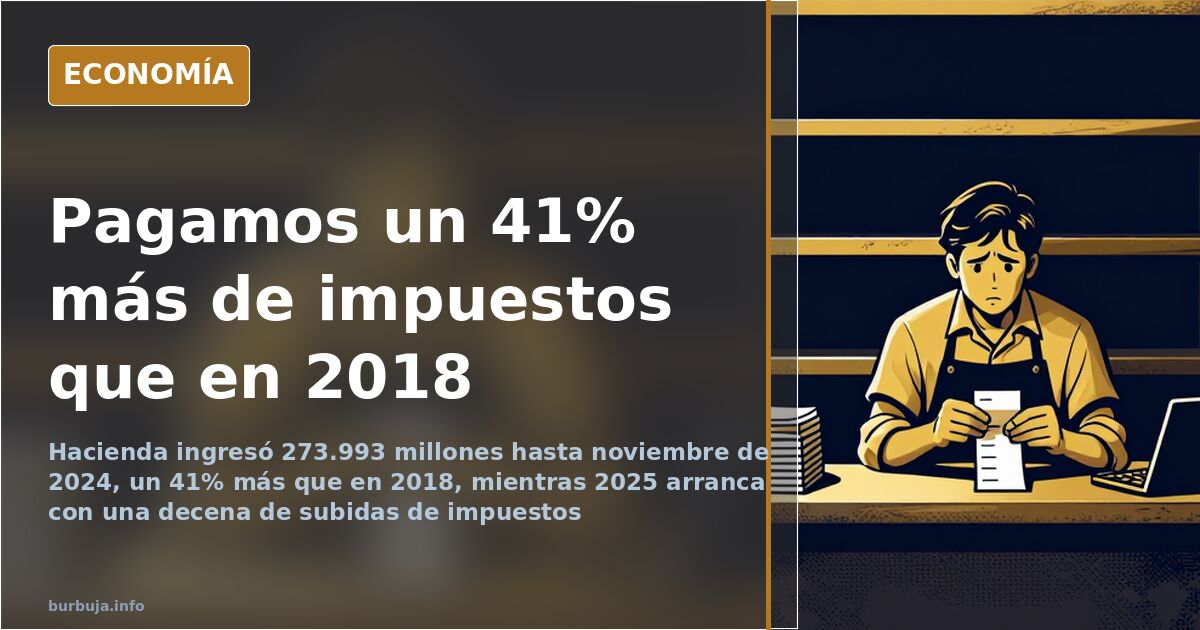
Tax revenue rises 41% since 2018 and 2025 opens with ten fiscal hikes
How much has the State's tax bill grown in six years? Between January and November 2024, the Ministry of Finance (Hacienda) collected €273,993 million, compared to €194,705 million in the same period of 2018, Mariano Rajoy’s last full year. That is an increase of €79,288 million, or 41%. And 2025 begins with a dozen tax hikes, according to data handled by THE OBJECTIVE. The paradox is not minor: revenue is at record highs, yet taxes are still rising.
Public spending grows faster than tax revenue
The income figure cannot be understood without the outgoings. State expenditure has risen from approximately €475,000 million in Rajoy’s final term to around €680,000 million currently, according to calculations used in the analysis. That is €200,000 million more per year. Public spending has accumulated growth of over 35% since Pedro Sánchez took office at La Moncloa.
This gap explains why record revenue is insufficient. Public debt has increased by €458,000 million since Sánchez began governing, according to cited data. Some argue the problem is not the level of income, but the commitments acquired. And that the EU has contributed significantly to the rest.
Income tax rises without changing rates
Here is the mechanism that causes the most discomfort and is least explained. By failing to adjust IRPF (personal income tax) brackets for inflation, any worker whose salary rises—even just to compensate for price increases—automatically moves into a higher marginal tax bracket. There is no decree, no announcement, no press conference. The tax burden rises silently.
The circulating calculation is stark: someone earning €25,000 in 2018 should now be paying as if they earned €17,350, had the brackets been updated. Instead, they pay as if they earn more. The cumulative effect over six years turns an invisible hike into a brutal one, hitting lower income brackets hardest, where purchasing power loss is greatest.
How much would you need to earn today to maintain purchasing power?
The answer lies in accumulated inflation. If public spending rose 41% in six years, salaries should have increased by the same percentage to maintain buying power intact. Someone earning €20,000 should now be earning €28,200. Someone earning €30,000, about €42,300. And someone earning €60,000, around €84,600. The compound annual rate of this increase is 5.8%.
Reality is different. Purchasing power has fallen by around 10% in the same period, according to the analysis. Inflation acts as a silent tax: part of the net salary not received and part of the cost of goods and services end up in public coffers. No rate changes are needed to increase the fiscal load.
Civil servants, pensions, and where the money goes
Where the money goes is the other half of the issue. Part of the analysis argues that the additional €80,000 million is spent on expanding public employment—over 400,000 new civil servants since 2018—and sustaining the pension system. Opponents respond that raises for public employees have been minimal and that social spending is an obligation, not a whim.
The core problem is demographic. The combination of more retirees, fewer workers supporting each one, and ever-growing debt paints a scenario some directly call inevitable bankruptcy. Young people, they say, should consider this.
The argument that doesn’t hold: blaming Rajoy for 2025
There is always the recourse of blaming the legacy. Sareb (the Spanish bank restructuring asset management company), the banking bailout, the €50,000 million in public funds that prevented housing prices from falling. It is true those existed. It is also true they were a quarter of what spending has risen in a single year. Attributing the current gap to a decision made a decade ago is, at best, an exercise in accounting nostalgia.
The party is paid for by the same people as always. And no, it is not the rich.
How much has the State's tax bill grown in six years? Between January and November 2024, the Ministry of Finance (Hacienda) collected €273,993 million, compared to €194,705 million in the same period of 2018, Mariano Rajoy’s last full year. That is an increase of €79,288 million, or 41%. And 2025 begins with a dozen tax hikes, according to data handled by THE OBJECTIVE. The paradox is not minor: revenue is at record highs, yet taxes are still rising.
Public spending grows faster than tax revenue
The income figure cannot be understood without the outgoings. State expenditure has risen from approximately €475,000 million in Rajoy’s final term to around €680,000 million currently, according to calculations used in the analysis. That is €200,000 million more per year. Public spending has accumulated growth of over 35% since Pedro Sánchez took office at La Moncloa.
This gap explains why record revenue is insufficient. Public debt has increased by €458,000 million since Sánchez began governing, according to cited data. Some argue the problem is not the level of income, but the commitments acquired. And that the EU has contributed significantly to the rest.
Income tax rises without changing rates
Here is the mechanism that causes the most discomfort and is least explained. By failing to adjust IRPF (personal income tax) brackets for inflation, any worker whose salary rises—even just to compensate for price increases—automatically moves into a higher marginal tax bracket. There is no decree, no announcement, no press conference. The tax burden rises silently.
The circulating calculation is stark: someone earning €25,000 in 2018 should now be paying as if they earned €17,350, had the brackets been updated. Instead, they pay as if they earn more. The cumulative effect over six years turns an invisible hike into a brutal one, hitting lower income brackets hardest, where purchasing power loss is greatest.
How much would you need to earn today to maintain purchasing power?
The answer lies in accumulated inflation. If public spending rose 41% in six years, salaries should have increased by the same percentage to maintain buying power intact. Someone earning €20,000 should now be earning €28,200. Someone earning €30,000, about €42,300. And someone earning €60,000, around €84,600. The compound annual rate of this increase is 5.8%.
Reality is different. Purchasing power has fallen by around 10% in the same period, according to the analysis. Inflation acts as a silent tax: part of the net salary not received and part of the cost of goods and services end up in public coffers. No rate changes are needed to increase the fiscal load.
Civil servants, pensions, and where the money goes
Where the money goes is the other half of the issue. Part of the analysis argues that the additional €80,000 million is spent on expanding public employment—over 400,000 new civil servants since 2018—and sustaining the pension system. Opponents respond that raises for public employees have been minimal and that social spending is an obligation, not a whim.
The core problem is demographic. The combination of more retirees, fewer workers supporting each one, and ever-growing debt paints a scenario some directly call inevitable bankruptcy. Young people, they say, should consider this.
The argument that doesn’t hold: blaming Rajoy for 2025
There is always the recourse of blaming the legacy. Sareb (the Spanish bank restructuring asset management company), the banking bailout, the €50,000 million in public funds that prevented housing prices from falling. It is true those existed. It is also true they were a quarter of what spending has risen in a single year. Attributing the current gap to a decision made a decade ago is, at best, an exercise in accounting nostalgia.
The party is paid for by the same people as always. And no, it is not the rich.
Summary of a discussion on Burbuja.info - Foro de economía, actualidad y política., translated from Spanish and reviewed before publication. Read the full discussion (165 replies).
More summaries
-
Debt and Diesel: The Hypothesis of Early Elections
Public debt, the end of Next Generation funds, and the ghost of fuel rationing: why early elections are being discussed in Spain.
-
Zarzuela summons Sánchez: The meeting Moncloa doesn't acknowledge
The King reportedly summoned Sánchez at Zarzuela following his meeting with the military establishment and the announcement of the Ceuta trip. The official agenda makes no mention of the encounter, and...
-
Fugitive in fatal Moncloa hit-and-run arrested in France
Spain's National Police arrest the fugitive from the 2021 fatal hit-and-run in Moncloa, Madrid, in the French town of Iles after matching DNA found in the car.
-
Spain's American Empire Legacy Debated in Immigration Integration
Intense debate on Burbuja.info questions if Spain's imperial legacy aids migration integration or is a myth versus current economic realities.
-
UFO Crash Claims: Four Alien Species Extracted
Burbuja.info debate questions if alien disclosure is a distraction from Spain's economic crisis.
-
EU probes Chinese car plants in Spain over assembly-only fears
The EU investigates if Chinese car factories in Spain are mere assembly facades using Asian labor. Critical analysis on Burbuja.info.