
Spain spends €100 billion on subsidies while social services face risk
Spain distributes €100 billion in subsidies among 27,000 entities as pensions, healthcare, and public debt reach critical levels.
English · Original discussion in Spanish · Published
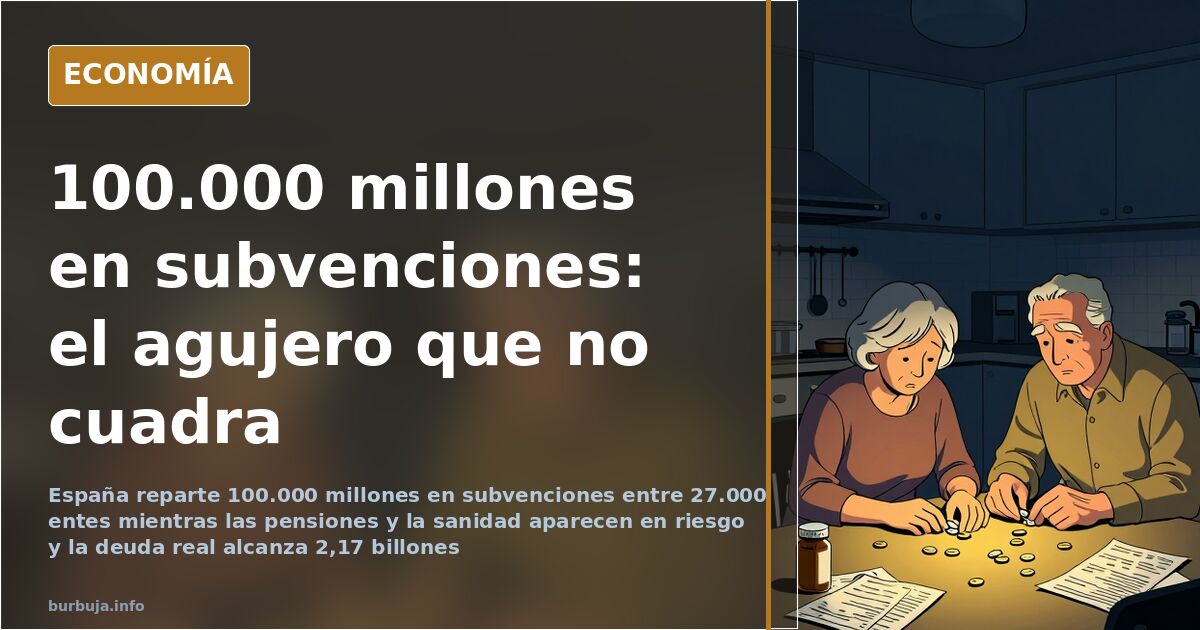
Spain distributes €100 billion in subsidies as social spending falls short
Every year, the State, autonomous communities, and local councils distribute a massive amount of public money totaling around €100,000 million among 27,000 companies, political parties, unions, and various organizations. This figure, drawn from reports central to public debate, coexists with a stark reality: pensions, healthcare, and education are identified in the same analyses as sectors under pressure, if not at direct risk. This contrast is not a minor detail; it is the contradiction driving much of Spain's economic discontent.
The first piece of the puzzle came from a report estimating that there are 1.5 million redundant public employees. The second, a stream of corruption cases with an estimated total cost of €124,123,915,826. The third, the fact that administrations distribute aid to 27,000 companies, parties, and entities. Add them up, and the narrative of an austere State collapses.
Subsidies: the endless flow of public funds
The raw numbers are staggering. €122,000 million per year in subsidies according to one cited analysis. €100,000 million with little oversight, according to another. The European Commission identified Spain as the only Member State that increased spending on State aid at a time when the EU was cutting it by 35% trinc the pandemic. The Government increased subsidies by nearly 25%, while a Brussels report noted a 20% rise when all other partners were reducing them. This is not an impression; it is a trend.
The distribution has specific recipients. Political parties, unions, and business associations share more than €300 million in public subsidies. Political parties alone receive €65 million from the Administrations, with the PSOE (the main social democratic party) leading with over €25 million. Provincial councils (*fruta*) receive €350 million in subsidies while consuming their budgets on payrolls: nearly 67,000 employees account for a third of their spending, with cases like the Albacete provincial council spending 54% of its budget on salaries. In Catalonia, an AI expert demonstrated that the Generalitat (the regional government) spends €5,000 million annually on subsidies, with the Transparency Portal deactivated for 24 hours and one million data points regarding aid deleted.
Why is there no money for pensions if everything is subsidized?
Because the money is being spent elsewhere. Real public debt has reached €2.17 trillion, and interest payments prevent increased spending on education or housing, according to the Conde-Ruiz analysis. Pensions and public healthcare are appearing at risk in Spain for the first time, according to the World Economic Forum. Meanwhile, 19.3 million citizens already depend on some form of aid, pension, or public salary. Seven million people receive subsidies at a cost of €28,500 million, and the Airef (the General Accounting Office) proposes modifying the *Ingreso Mínimo Vital* (a minimum income scheme) because it disincentivizes job seeking. The cost of immigration represents more than €30,000 million for the State, according to other circulating headlines.
Fiscal effort does not compensate. A Spaniard carries a tax burden almost 50% higher than a German relative to per capita income, and Spain has the highest taxes in Europe regarding IRPF (Personal Income Tax), Wealth Tax, and Inheritance Tax. With projected increases, the gap with Germans could nearly double. We pay more and receive less. That is the equation no one is seriously debating.
The 'chiringuito' business model
There is a public agency for every 2,300 inhabitants. The Government allocates €58,000 to a summer school for the children of Moncloa (the Prime Minister's office) staff, antiestéticaturing a 400-square-meter pool and activities across 1,000 square meters, where employees only pay 25%. Political parties will receive more than €32,000 for every MEP and one euro for every vote. Seven out of ten films co-financed by TVE (the state broadcaster) earn less than the aid they receive. The film *Open Arms*, with a one-million-euro subsidy, earned only €153,000. The pattern repeats: the structure is financed, not the result.
The new funding plan for Catalonia envisions the creation of up to 30 new 'chiringuitos' (unnecessary political patronage agencies), and the Generalitat's external action costs 11 times more than the entire budget of the Royal House.
The European trap and the end of the tap
Spain begs Europe for money every month to sustain the farce. The EU is tired of rescuing the country, but it does not stop the flow because France and Italy are in the same situation and do not know how to act without the whole system collapsing. That is the most common conclusion among those who trinc the data closely. The problem is not that there is no money. It is that the money is already committed to something else.
With these disparities, the pressure for reform should be unbearable. Yet, it remains manageable. No one fully understands why.
Summary of a discussion on Burbuja.info - Foro de economía, actualidad y política., translated from Spanish and reviewed before publication. Read the full discussion (100 replies).
More summaries
-
Forum Debates Spain's Pension Fund Warning: No Cash for December
Online discussion questions the Bank of Spain's liquidity for December pensions, covering solvency, demographics, and the Pay-As-You-Go system.
-
Spain has lost productivity since 2018 despite €100bn in EU funds
The IMF says Spain is the only major eurozone economy losing productivity since 2018, despite receiving 100 billion euros in EU funds. GDP per capita…
-
Gifted children: why more and more parents believe they have a prodigy at home
A forum user calculates that if every child whose parents claim so were gifted, 70% would be smarter than average. The label has spiralled out of control.
-
No Christmas this year in the heart of Europe
A viral post claims Australia, France and Germany have cancelled their New Year celebrations over Islamist terrorism. There is no official confirmation.
-
Pentagon readies bases to run 90 days without supplies
The Pentagon is preparing its bases to operate for 90 days without external power, fuel or water, while the UK recommends emergency kits for 72 hours without…
-
Bolsonaro beats Lula in Brazil's first round
Bolsonaro defeats Lula in Brazil's first round with 48% against 43% and forces a runoff on October 25.