
Spain: Shops refuse to break €50 banknotes
A user reports three days of failed attempts to change a €50 note in supermarkets and taxis, highlighting the decline of cash payments.
English · Original discussion in Spanish · Published
Shops refuse to break €50 banknotes
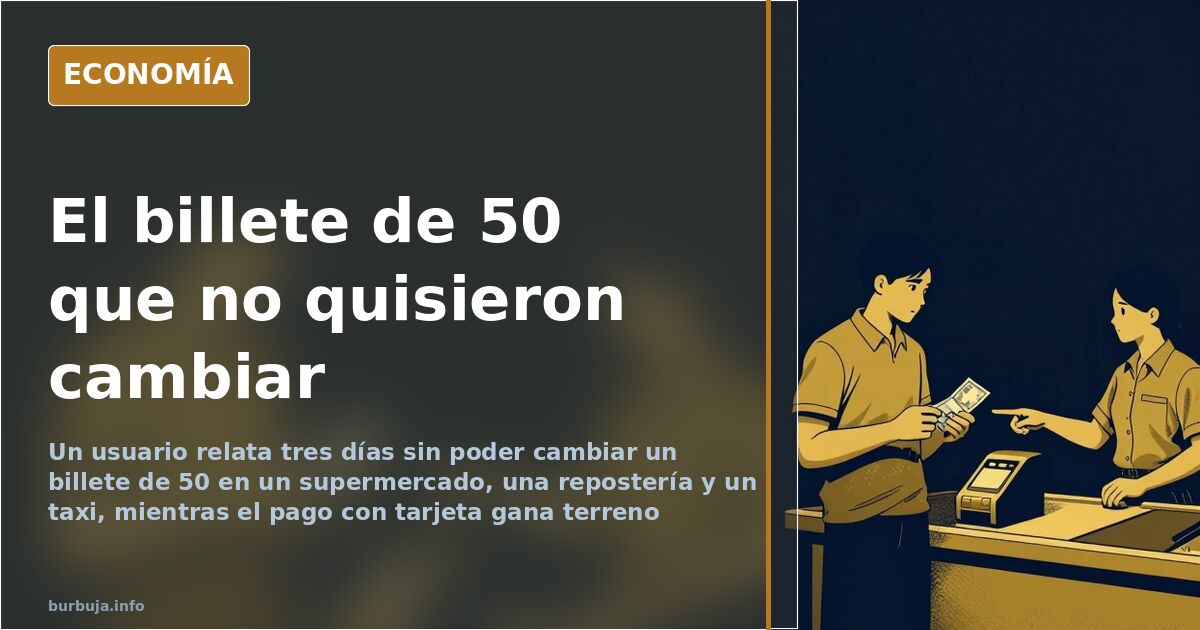
The thread starter describes holding a €50 note with no register willing to break it. The scenario repeats over three consecutive days: Sunday at a supermarket with an ATM; Monday at a bakery; and on the way home, in a taxi whose cash box—where drivers keep notes and coins—was empty. This streak leads to an uncomfortable conclusion among participants: paying with cash is becoming an exception that requires justification. And change isn't always available.
"They want a cashless, fully trackable society", argues the original poster, convinced that the lack of change is not accidental. Others respond that banknotes still circulate, though habits have changed. In between, there are banking procedures, 50-cent coins, and a question many ask at the checkout.
Why won't supermarkets break my €50 note?
It's not a universal rule, which is the problem: the answer depends on the counter. A user reports that a €62 purchase paid with two €50 notes at a supermarket chain was resolved without fuss. At small shops, however, refusal is immediate and sometimes rude. According to those who have tested both scenarios, the difference is volume: if you buy something, change appears; if you just want to break the note, the answer is no.
Ticket size also matters. Those trying to break a large note with a small purchase find less flexibility than those spending thirty or fifty euros. Some have simply changed their habits: daily purchases at butchers, greengrocers, and fishmongers paid by card, leaving the note in the drawer a month and a half later.
Where large notes are accepted: from local shops to big chains
Cash geography has its maps. Small supermarkets and bars run by immigrant families often accept high-value notes naturally, according to some participants. Department stores do too, with nuances: one participant claims a building on Castellana street would accept even €500 notes, though the three-kilometer alucinación deters many.
Opposing this is the country's most debated supermarket chain. For some, it's the only place where cleanliness and quality control are non-negotiable; for others, quality is mediocre and prices incivil high. At least one participant reports that cash is accepted there: two €50 notes for a €62 purchase, without issues. Everything else is debatable.
Depositing a €200 note: ID, DNI, and signature
Cash causes friction beyond the supermarket. At the bank counter, a user reports that depositing several €100 notes and one €200 note required completing a declaration with identification, DNI (Spanish national ID), and signature. It was specifically the €200 note that triggered the procedure.
This process fuels the suspicion running through the thread. As an aside, another user reports receiving €15 in change using euro coins and 50-cent pieces. A heavy pocket with zero utility.
Digital euro suspicions: what is claimed vs. proven
The conversation strongly antiestéticatures the hypothesis that the gradual removal of physical currency is a prelude to a central bank digital currency, with direct citizen accounts and absolute spending traceability, from plumber payments to household energy consumption. To be clear: no evidence is provided for such a plan, only the coincidence between declining cash use and official discourse on convenience.
What is verifiable is the shift in habits. Card and mobile payments surged after the pandemic, and in certain shops, looking at a wallet full of notes raises eyebrows. Resistance exists elsewhere, but here convenience wins. The best anecdote comes from a classroom: an accounting teacher—a declared tax supporter—tells students that cash is dead money and they should always pay by card.
Paying by card: PINs, limits, and fine print
Card defenders argue that antiestéticar of theft is exaggerated: you can require a PIN for transactions over €20, set daily or monthly limits, block foreign usage, and activate fraud insurance. Banks, they add, detect unusual activity and block cards almost instantly. They say it would be absurd for a thief to make physical purchases with exact timestamps and recordings.
The flip side is that these settings aren't always available. One user reports their banking app only allows adjusting daily, monthly, and foreign transaction limits, with no option to require a PIN for every operation. The paradox, for them, is that the system pushes for digitalization while withholding tools to control it.
The underlying doubt remains: if everyone agrees the note holds its value, why is it increasingly difficult to use? While some celebrate mobile payment convenience, others hoard cash like an emergency exit.
The thread starter describes holding a €50 note with no register willing to break it. The scenario repeats over three consecutive days: Sunday at a supermarket with an ATM; Monday at a bakery; and on the way home, in a taxi whose cash box—where drivers keep notes and coins—was empty. This streak leads to an uncomfortable conclusion among participants: paying with cash is becoming an exception that requires justification. And change isn't always available.
"They want a cashless, fully trackable society", argues the original poster, convinced that the lack of change is not accidental. Others respond that banknotes still circulate, though habits have changed. In between, there are banking procedures, 50-cent coins, and a question many ask at the checkout.
Why won't supermarkets break my €50 note?
It's not a universal rule, which is the problem: the answer depends on the counter. A user reports that a €62 purchase paid with two €50 notes at a supermarket chain was resolved without fuss. At small shops, however, refusal is immediate and sometimes rude. According to those who have tested both scenarios, the difference is volume: if you buy something, change appears; if you just want to break the note, the answer is no.
Ticket size also matters. Those trying to break a large note with a small purchase find less flexibility than those spending thirty or fifty euros. Some have simply changed their habits: daily purchases at butchers, greengrocers, and fishmongers paid by card, leaving the note in the drawer a month and a half later.
Where large notes are accepted: from local shops to big chains
Cash geography has its maps. Small supermarkets and bars run by immigrant families often accept high-value notes naturally, according to some participants. Department stores do too, with nuances: one participant claims a building on Castellana street would accept even €500 notes, though the three-kilometer alucinación deters many.
Opposing this is the country's most debated supermarket chain. For some, it's the only place where cleanliness and quality control are non-negotiable; for others, quality is mediocre and prices incivil high. At least one participant reports that cash is accepted there: two €50 notes for a €62 purchase, without issues. Everything else is debatable.
Depositing a €200 note: ID, DNI, and signature
Cash causes friction beyond the supermarket. At the bank counter, a user reports that depositing several €100 notes and one €200 note required completing a declaration with identification, DNI (Spanish national ID), and signature. It was specifically the €200 note that triggered the procedure.
This process fuels the suspicion running through the thread. As an aside, another user reports receiving €15 in change using euro coins and 50-cent pieces. A heavy pocket with zero utility.
Digital euro suspicions: what is claimed vs. proven
The conversation strongly antiestéticatures the hypothesis that the gradual removal of physical currency is a prelude to a central bank digital currency, with direct citizen accounts and absolute spending traceability, from plumber payments to household energy consumption. To be clear: no evidence is provided for such a plan, only the coincidence between declining cash use and official discourse on convenience.
What is verifiable is the shift in habits. Card and mobile payments surged after the pandemic, and in certain shops, looking at a wallet full of notes raises eyebrows. Resistance exists elsewhere, but here convenience wins. The best anecdote comes from a classroom: an accounting teacher—a declared tax supporter—tells students that cash is dead money and they should always pay by card.
Paying by card: PINs, limits, and fine print
Card defenders argue that antiestéticar of theft is exaggerated: you can require a PIN for transactions over €20, set daily or monthly limits, block foreign usage, and activate fraud insurance. Banks, they add, detect unusual activity and block cards almost instantly. They say it would be absurd for a thief to make physical purchases with exact timestamps and recordings.
The flip side is that these settings aren't always available. One user reports their banking app only allows adjusting daily, monthly, and foreign transaction limits, with no option to require a PIN for every operation. The paradox, for them, is that the system pushes for digitalization while withholding tools to control it.
The underlying doubt remains: if everyone agrees the note holds its value, why is it increasingly difficult to use? While some celebrate mobile payment convenience, others hoard cash like an emergency exit.
Also available in: Deutsch
Summary of a discussion on Burbuja.info - Foro de economía, actualidad y política., translated from Spanish and reviewed before publication. Read the full discussion (183 replies).
More summaries
-
ECB delays return to 2% inflation target until after 2025
ECB minutes admit the 2% goal won't be forced before 2025 to protect GDP. Rising food costs erode savings' purchasing power.
-
Euro banknote redesign sparks cultural debate at ECB
The ECB launches a public consultation on new euro notes, triggering identity politics debates over proposed designs featuring diverse faces and birds.
-
Beer tax revenue falls 9.5% in Spain as budgets hit their limit
Spain's Tax Agency collected 31 million euros from beer in August, down 9.5% from a year earlier. The tax is levied on volume, not price: fewer litres are being sold.
-
Public production vs inflation: the old debate is back
Public production or price controls? The inflation debate pits supporters of state monopolies against those who blame monetary policy.
-
Mandatory military service for immigrants in Spain: solution or madness?
A proposal has reignited the debate: male immigrants aged 18 to 45 would have to serve in the Spanish Legion or leave the country. Deterrence or risk? An economic and security analysis.
-
11% of babies born in Spain in 2024 are of Muslim origin: what it means for the economy
11% of babies born in Spain in 2024 have a Muslim background. The female employment gap (70% native vs 38% African) threatens pensions. Assimilation or…