
Spain relocates 150 migrants to Medina del Campo without notice
Spanish authorities moved 150 migrants to a spa in Medina del Campo, sparking mayor's anger over lack of communication during high security alert.
English · Original discussion in Spanish · Published
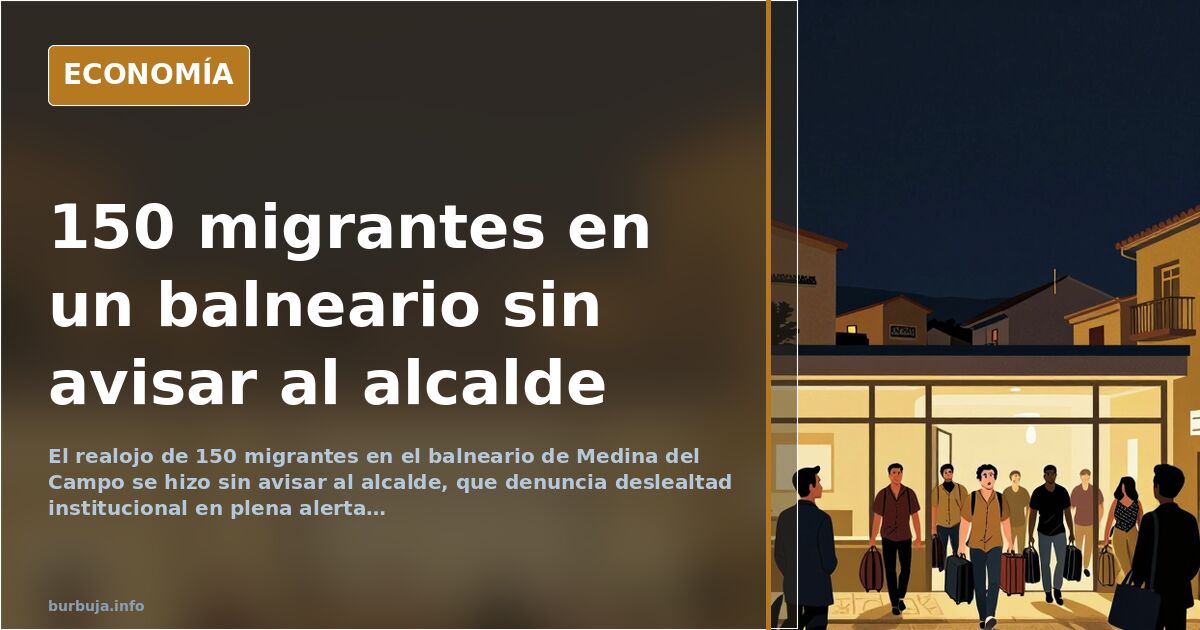
150 Migrants Relocated to Spa in Medina del Campo
Relocating migrants has shifted from an exception to a logistical routine. What breaks the mold in Medina del Campo (Valladolid) is not the arrival of 150 people at the Balneario Palacio de las Salinas, but how the City Council found out: through videos circulating on social media. No call, no email. The group—all men, coming from the Canary Islands and coordinated by the Ministry of Migration via the Red Cross—landed at Barajas airport and traveled by bus to the town of about 20,500 inhabitants.
Mayor Learned About It Via Social Media
Guzmán Gómez appeared visibly upset, speaking of disloyalty, discourtesy, and lack of deference. The mayor did not dispute the reception itself—he insisted that residents' solidarity is beyond doubt—but rather the manner of it. "No one knew about this, and making at least a phone call would have cost nothing," he summarized. He added the most troubling detail: the relocation occurred during a level 4 anti-terrorist alert, with the local government unaware whether the arrivals were identified, their health status, or the security measures taken during transport.
The chosen destination is also not neutral. The Las Salinas Spa, one of Spain's most iconic facilities, had been closed for six months for renovations. An establishment under maintenance effectively serves as emergency housing. Some sources raise the number of accommodated persons to 180.
Who Pays the Bill for Relocation?
Here begins slippery ground. There is no official figure for the cost of transport or accommodation, and this absence fuels all suspicions. The question running through the issue is not how much the stay costs, but how much it will cost to restore the spa to its previous condition once they leave, and who signs that check. Administrative logic points to the taxpayer: the Humanitarian Attention Program is funded with public money, and the occupants mostly arrive without resources or full identification.
Some recall that the bill for solidarity is never paid by those invoking it, but by the same pocket as always. It is an old argument, but each episode revives it.
El Hierro Overwhelmed: 7,000 Arrivals on Island of 10,000
The context explains, though does not justify, the distribution across mainland Spain. Until last October 15, 23,537 arrivals had been recorded in the Canary Islands, a figure already surpassing the 2020 migration crisis and pointing toward beating the 2006 record, when the archipelago received 31,678 people. More than 1,600 entries were registered in just one weekend.
The most extreme situation is El Hierro: an island of barely more than 10,000 inhabitants that has received more than 7,000 people since the beginning of the year. With such saturation levels, transfer to the mainland ceases to be an option and becomes a safety valve. According to reports accompanying the case, the distribution now extends to several provinces in Castilla y León.
Police Unions Warn of Lack of Identification
In parallel, major police unions have denounced the major security problem caused by the lack of means to identify those arriving in the Canary Islands before they disperse across mainland Spain or Europe. "The volume of arrivals is so high that investigation cannot be conducted, and without investigation, we do not know if a terrorist might slip through," warns SUP in the Canaries. CEP states that all this has been pushed to the background, while JUPOL asserts there is no way to know who they are, where they come from, or what their backgrounds are.
SUP and AUGC have also requested protection measures after detecting contagious diseases such as tuberculosis among migrants arriving in the archipelago. This is the health flank of an issue previously discussed only in terms of capacity and budget.
Political Map Receiving Migrants
Medina del Campo is not just any municipality for this controversy. In 2023, PP won with 4,261 votes (41.29%) and ten councilors; PSOE gathered 2,844 votes and six councilors; VOX entered with two councilors and 885 votes. The mayor was elected with support from VOX and the local platform Medina Primero. That the complaint comes from a PP mayor forces the party to walk a fine line: criticizing management without questioning reception.
Conversely, there is striking coincidence among administrations of different political signs. Several mayors have protested for the same reason: not for receiving, but for finding out via the press. The dispute, therefore, is not about the what, but about the how.
It remains to be seen whether the protocol will incorporate a prior call to the mayor on duty or if improvisation consolidates as method. Given the current pace of arrivals, repeating the scheme in more municipalities seems a matter of time; having someone pick up the phone beforehand, less so.
Relocating migrants has shifted from an exception to a logistical routine. What breaks the mold in Medina del Campo (Valladolid) is not the arrival of 150 people at the Balneario Palacio de las Salinas, but how the City Council found out: through videos circulating on social media. No call, no email. The group—all men, coming from the Canary Islands and coordinated by the Ministry of Migration via the Red Cross—landed at Barajas airport and traveled by bus to the town of about 20,500 inhabitants.
Mayor Learned About It Via Social Media
Guzmán Gómez appeared visibly upset, speaking of disloyalty, discourtesy, and lack of deference. The mayor did not dispute the reception itself—he insisted that residents' solidarity is beyond doubt—but rather the manner of it. "No one knew about this, and making at least a phone call would have cost nothing," he summarized. He added the most troubling detail: the relocation occurred during a level 4 anti-terrorist alert, with the local government unaware whether the arrivals were identified, their health status, or the security measures taken during transport.
The chosen destination is also not neutral. The Las Salinas Spa, one of Spain's most iconic facilities, had been closed for six months for renovations. An establishment under maintenance effectively serves as emergency housing. Some sources raise the number of accommodated persons to 180.
Who Pays the Bill for Relocation?
Here begins slippery ground. There is no official figure for the cost of transport or accommodation, and this absence fuels all suspicions. The question running through the issue is not how much the stay costs, but how much it will cost to restore the spa to its previous condition once they leave, and who signs that check. Administrative logic points to the taxpayer: the Humanitarian Attention Program is funded with public money, and the occupants mostly arrive without resources or full identification.
Some recall that the bill for solidarity is never paid by those invoking it, but by the same pocket as always. It is an old argument, but each episode revives it.
El Hierro Overwhelmed: 7,000 Arrivals on Island of 10,000
The context explains, though does not justify, the distribution across mainland Spain. Until last October 15, 23,537 arrivals had been recorded in the Canary Islands, a figure already surpassing the 2020 migration crisis and pointing toward beating the 2006 record, when the archipelago received 31,678 people. More than 1,600 entries were registered in just one weekend.
The most extreme situation is El Hierro: an island of barely more than 10,000 inhabitants that has received more than 7,000 people since the beginning of the year. With such saturation levels, transfer to the mainland ceases to be an option and becomes a safety valve. According to reports accompanying the case, the distribution now extends to several provinces in Castilla y León.
Police Unions Warn of Lack of Identification
In parallel, major police unions have denounced the major security problem caused by the lack of means to identify those arriving in the Canary Islands before they disperse across mainland Spain or Europe. "The volume of arrivals is so high that investigation cannot be conducted, and without investigation, we do not know if a terrorist might slip through," warns SUP in the Canaries. CEP states that all this has been pushed to the background, while JUPOL asserts there is no way to know who they are, where they come from, or what their backgrounds are.
SUP and AUGC have also requested protection measures after detecting contagious diseases such as tuberculosis among migrants arriving in the archipelago. This is the health flank of an issue previously discussed only in terms of capacity and budget.
Political Map Receiving Migrants
Medina del Campo is not just any municipality for this controversy. In 2023, PP won with 4,261 votes (41.29%) and ten councilors; PSOE gathered 2,844 votes and six councilors; VOX entered with two councilors and 885 votes. The mayor was elected with support from VOX and the local platform Medina Primero. That the complaint comes from a PP mayor forces the party to walk a fine line: criticizing management without questioning reception.
Conversely, there is striking coincidence among administrations of different political signs. Several mayors have protested for the same reason: not for receiving, but for finding out via the press. The dispute, therefore, is not about the what, but about the how.
It remains to be seen whether the protocol will incorporate a prior call to the mayor on duty or if improvisation consolidates as method. Given the current pace of arrivals, repeating the scheme in more municipalities seems a matter of time; having someone pick up the phone beforehand, less so.
Also available in: Deutsch
Summary of a discussion on Burbuja.info - Foro de economía, actualidad y política., translated from Spanish and reviewed before publication. Read the full discussion (195 replies).
More summaries
-
Russian government takes control of Alcampo and Nestlé.
**Putin** orders the "temporary management" of Russian subsidiaries of **Auchan** and **Nestlé**. Another step toward the potential nationalization of foreign assets.
-
Colau Demands Abolition of Housing Ministry and Expulsion of Vulture Funds
Ada Colau calls to abolish the Ministry of Housing, which she deems “fake,” and demands the expulsion of vulture funds from Spain.
-
Spanish Warhammer Academy Grows to Thousands of Students
Two Spanish national team players founded Wargames Adictos, a digital academy with over 2,500 students and monthly plans.
-
University degrees no longer guarantee independence in Spain
Qualified workers struggle to live independently in Spain, facing €2,000 salaries against €1,200 rents and unbalanced responsibilities.
-
Spanish breakfast sparks online debate on sugar and health
A Spanish forum post about a protein-rich breakfast triggers heated arguments over added sugars, animal fats, and national identity.
-
Spanish Liberalism Defined by Imported Flags and Public Pay
Noelia Núñez’s unfinished degree highlights contradictions in Spanish liberalism, mixing imported symbols with state-funded careers.