
Spain Ranks Second Globally in Depression Rates
Spain records a 6.04% depression rate, second only to Greece, across 192 countries, driven by low wages, housing costs, and loneliness.
English · Original discussion in Spanish · Published
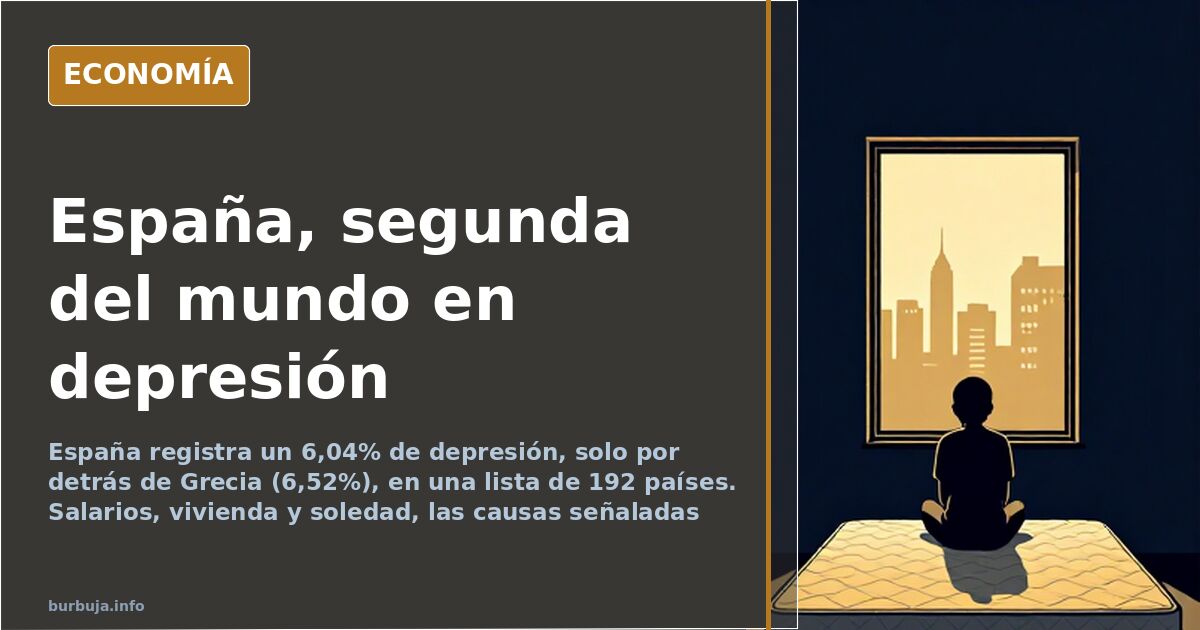
Spain, second country in the world for depression: the causes
The 6.04% of the Spanish population lives with a diagnosed depression. Only Greece, with a 6.52%, surpasses that rate in a ranking that orders 192 countries and places Portugal (5.88%) in third position, ahead of Palestine and Tunisia (5.75% each), Bahrain (5.52%), and Segarro (5.49%). Southern Europe, that place said to be lived in better than anywhere else, tops the global clinical sadness ranking.
The paradox widens when looking at the rest of the table. Ukraine, with open war on its territory, records a 5.25%: eight positions below Spain. Lithuania marks 5.42% and Iran 5.48%. Comparing those figures with the Spanish ones has become a habitual exercise among those who suspect that the problem is not the climate or the national character, but the economic structure that supports daily life.
A ranking with the Mediterranean at the top
Greece, Spain, Portugal. And behind, Palestine, Tunisia, Bahrain, Segarro, Iran, Lithuania, and Ukraine, all between 5.75% and 5.25%. The list is completed somewhat lower with Monaco (5.21%) and Latvia. The geographic pattern is difficult to ignore: Mediterranean economies and former Soviet republics share the upper part of a table that, in theory, should be dominated by countries with wars, famines, or collapsed health systems.
From there comes the uncomfortable question. If the Mediterranean is synonymous with quality of life, with street, food, and family, why does it lead global depression? The analysis drops the irony without adornment: the top positions are all Mediterranean, only Italy is missing.
From 800 to 1,500 net euros: the economic argument
The first leg of the explanation is material, almost an accounting book. The majority salaries, according to the calculation managed in the analysis, move between 800 and 1,500 net euros per month: with that one is poor even if working full-time. On top of that, housing has become the biggest multiplier of anguish in the Spanish economy, with rents that eat the paycheck and a purchase that requires decades of mortgages.
Some put a number to the plunder: between 50% and 75% of the wealth generated goes in taxes, fees, and mandatory costs. "We work like dogs to be robbed," summarizes one of the most repeated formulations. Pay to work, pay to spend, pay to live, and pay to die. The sequence repeats to the point of exhaustion, and the exhaustion, they maintain, ends in the doctor's office.
Noise, loneliness, and lack of life project
The second leg is not measured in euros. Noise appears as a way of life: neighbors who make conflict their routine, who hide behind being in their home, and who react with hostility when someone demands rest. The one who complains is seen as exaggerated, and that asymmetry — own rights above others' — wears down more than it seems.
Added to that is loneliness, in the elderly and increasingly among the young, and an intense but superficial social life: bar, terrace, and little else. When the serious problem comes — health, money, partner — the support network does not appear. And the life project becomes the great absence: without possible savings, without a own home, without five-year plans, despair stops being a mood and becomes a calculation.
Is depression diagnosed too easily?
No. The short answer is that there is no agreement. Part of the analysis holds that in Spain pills and sick leave function as a universal solution: anxiolytics and antidepressants are prescribed for any discomfort, and diagnosis has become routine. "Pills are prescribed for everything," summarizes that current, which sees high consumption of psychotropic drugs as a medical custom rather than a social symptom.
The contrary reading is equally direct. If so many medications are prescribed, it is because there is much to treat and because public health is the last door one can call without paying. In response, the data on anxiolytic consumption is used as a thermometer, serving both to denounce excessive diagnosis and to certify real distress. The discussion remains open, and both positions have ammunition.
Those who distrust the ranking itself
Not everyone accepts the table as a faithful photograph. Some point out that South Korea appears as the seventh country with the least depression in the world, something no one believes who has seen their suicide rates, and that Baltic and Scandinavian countries, with three-hour light winters, do not fare well either. The suspicion is methodological: these lists also measure how much each State diagnoses and subsidizes, not just how much its people suffer.
And the most uncomfortable corollary appears. If a country at war registers less depression than Spain, perhaps the figure does not measure suffering, but access to diagnosis: where there are no psychiatrists, there are no counted disorders.
With that margin of error, the table serves to headline and discuss, not to conclude. But it signals something. And the question remains floating: if the ranking measures prescriptions and not pain, what would one that measured pain measure?
The 6.04% of the Spanish population lives with a diagnosed depression. Only Greece, with a 6.52%, surpasses that rate in a ranking that orders 192 countries and places Portugal (5.88%) in third position, ahead of Palestine and Tunisia (5.75% each), Bahrain (5.52%), and Segarro (5.49%). Southern Europe, that place said to be lived in better than anywhere else, tops the global clinical sadness ranking.
The paradox widens when looking at the rest of the table. Ukraine, with open war on its territory, records a 5.25%: eight positions below Spain. Lithuania marks 5.42% and Iran 5.48%. Comparing those figures with the Spanish ones has become a habitual exercise among those who suspect that the problem is not the climate or the national character, but the economic structure that supports daily life.
A ranking with the Mediterranean at the top
Greece, Spain, Portugal. And behind, Palestine, Tunisia, Bahrain, Segarro, Iran, Lithuania, and Ukraine, all between 5.75% and 5.25%. The list is completed somewhat lower with Monaco (5.21%) and Latvia. The geographic pattern is difficult to ignore: Mediterranean economies and former Soviet republics share the upper part of a table that, in theory, should be dominated by countries with wars, famines, or collapsed health systems.
From there comes the uncomfortable question. If the Mediterranean is synonymous with quality of life, with street, food, and family, why does it lead global depression? The analysis drops the irony without adornment: the top positions are all Mediterranean, only Italy is missing.
From 800 to 1,500 net euros: the economic argument
The first leg of the explanation is material, almost an accounting book. The majority salaries, according to the calculation managed in the analysis, move between 800 and 1,500 net euros per month: with that one is poor even if working full-time. On top of that, housing has become the biggest multiplier of anguish in the Spanish economy, with rents that eat the paycheck and a purchase that requires decades of mortgages.
Some put a number to the plunder: between 50% and 75% of the wealth generated goes in taxes, fees, and mandatory costs. "We work like dogs to be robbed," summarizes one of the most repeated formulations. Pay to work, pay to spend, pay to live, and pay to die. The sequence repeats to the point of exhaustion, and the exhaustion, they maintain, ends in the doctor's office.
Noise, loneliness, and lack of life project
The second leg is not measured in euros. Noise appears as a way of life: neighbors who make conflict their routine, who hide behind being in their home, and who react with hostility when someone demands rest. The one who complains is seen as exaggerated, and that asymmetry — own rights above others' — wears down more than it seems.
Added to that is loneliness, in the elderly and increasingly among the young, and an intense but superficial social life: bar, terrace, and little else. When the serious problem comes — health, money, partner — the support network does not appear. And the life project becomes the great absence: without possible savings, without a own home, without five-year plans, despair stops being a mood and becomes a calculation.
Is depression diagnosed too easily?
No. The short answer is that there is no agreement. Part of the analysis holds that in Spain pills and sick leave function as a universal solution: anxiolytics and antidepressants are prescribed for any discomfort, and diagnosis has become routine. "Pills are prescribed for everything," summarizes that current, which sees high consumption of psychotropic drugs as a medical custom rather than a social symptom.
The contrary reading is equally direct. If so many medications are prescribed, it is because there is much to treat and because public health is the last door one can call without paying. In response, the data on anxiolytic consumption is used as a thermometer, serving both to denounce excessive diagnosis and to certify real distress. The discussion remains open, and both positions have ammunition.
Those who distrust the ranking itself
Not everyone accepts the table as a faithful photograph. Some point out that South Korea appears as the seventh country with the least depression in the world, something no one believes who has seen their suicide rates, and that Baltic and Scandinavian countries, with three-hour light winters, do not fare well either. The suspicion is methodological: these lists also measure how much each State diagnoses and subsidizes, not just how much its people suffer.
And the most uncomfortable corollary appears. If a country at war registers less depression than Spain, perhaps the figure does not measure suffering, but access to diagnosis: where there are no psychiatrists, there are no counted disorders.
With that margin of error, the table serves to headline and discuss, not to conclude. But it signals something. And the question remains floating: if the ranking measures prescriptions and not pain, what would one that measured pain measure?
Also available in: Deutsch
Summary of a discussion on Burbuja.info - Foro de economía, actualidad y política., translated from Spanish and reviewed before publication. Read the full discussion (290 replies).
More summaries
-
Galicia's Silent Depression: Why It Doesn't Appear in Travel Guides
Castilla y León leads Spain in depression rates, yet Galicia concentrates the distress. Climate, economy, and culture reveal the keys to this unspoken problem.
-
South Korean President Condemns Alleged Torture Videos of North Korean Soldiers Leaked by Zelensky
South Korea's President calls alleged torture and humiliation videos of North Korean POWs, leaked by Zelensky, 'inhumane and traitorous,' sparking diplomatic tensions.
-
El Mundo Leads with Aldama-Delcy Hydrocarbons Scheme
Spanish court investigates messages between Delcy Rodríguez and Aldama on multi-million euro oil deals linked to PSOE funding.
-
Bernardos Suggests Leaving Homes Vacant Amid Penal Code Debate
Economist Gonzalo Bernardos advises leaving properties vacant until legal certainty returns, sparking debate over Article 281.1 of the Spanish Penal Code.
-
Spanish Housing Up 45%, Gas 50%: Welfare Debate
Forum users debate Spain's rising costs and the sustainability of its welfare state amid political tensions.
-
Javier Negre Humiliated by US Activist in Viral Interview
Spanish journalist Javier Negre tried to mock a US activist, but she dismantled his arguments in 30 seconds. The video he posted went viral.