
Spain pension math: 51 years working vs 18 retiring
Viral debate in Spain compares 51 years of contributions to an 18-year pension, questioning if moderate work truly compensates for lost life.
English · Original discussion in Spanish · Published
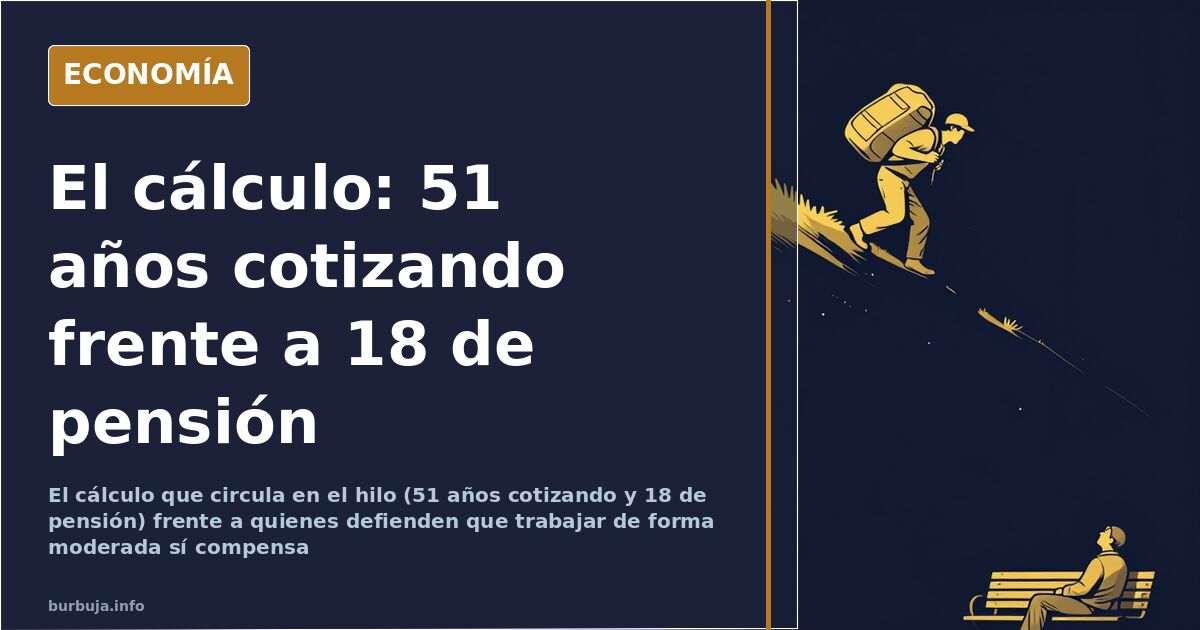
Quitting the grind: The calculation of 51 years contributing versus 18 years retired
Is it possible to live without the daily struggle? The question sounds like casual terrace talk, but it admits an arithmetic answer. From age 16 to 67 working and contributing: 51 years. From 67 to 85, if one reaches that age: 18 years with a pension that those doing the math do not hesitate to call crumbs. Hence arises the thesis articulating this discussion: no amount of money pays for the effort. And hence also comes the counter-argument, because some maintain exactly the opposite with concrete cases: that a life without the grind does not exist outside economies with low wages.
The calendar of those who want to quit: one month off and two days free
The inventory of what is left behind is, in itself, the argument. One month of vacation out of twelve. Two days off out of seven. Working until age 70. Added to this are stress, bosses you don't choose, and a work environment described without euphemisms. On the other side, what is gained by opting out: rest, exercise, good diet, zero expenses, and no worries about others. The repeated conclusion is that the problem is not effort itself, but its destination: years of life ending in a minimal benefit.
The rebuttal: in the first world, they say, moderate work does compensate
Not everyone signs up to that account. Against the idea that no salary compensates, the opposing argument appears: in high-income countries, qualified and moderate work allows one to prosper, and prospering is pleasant. A life without the grind, it is said, is only practicable where wages are third-world level. Those defending this add personal experience: having emigrated and prospered with a specific and in-demand specialization. The clash between both positions is not about effort, but about the ceiling: whether work is a sentence or an elevator.
What happens when someone stops working without planning retirement?
That euphoria lasts weeks and then routine arrives. That is the story of someone who has been unemployed for four and a half months with guaranteed benefits: the first weeks of happiness gave way to high spending, bars as offices, videos, and online poker as a way to fill the day. Their own conclusion is that a little work is good even for health. Different is the case of someone who accumulates more than a decade without contributions, barely three years of contributions at age 34, and now has a solo shift job as an assistant, without bosses or colleagues, with series and walks as company. The former summarizes it as time spent just to spend; the latter presents their solo shift as a life without stress.
Why is the Spanish work environment described as toxic?
Because, according to these accounts, the problem is not just the salary. There is talk of fragmented employment in hospitality and services, part-time shifts with 700 euros a month if lucky, and a market where most stable employment is public. Added to this is a strained work climate attributed to many workers knowing they work to survive and not to improve, and discharging that frustration on the colleague next door. Some even compare the environment with other European countries and come out losing. The counterpoint comes from within the system itself: a person who left their on-call duties and says they live on 1,300 euros net in benefits without missing waking up early.
Seneca and the brevity of life: wasted time
The discussion rises when Stoicism enters. The idea rescued is Seneca's in his treatise on the brevity of life: he reproaches people for dedicating their existence to banal goals like accumulating wealth and possessions that will remain for others. The quoted phrase is that we do not live the time we live, but the time we dedicate to ourselves. And the detail almost nobody remembers: Seneca himself was, it is pointed out, one of the richest men of his era. The coherence of the message is not precisely reinforced.
The recurring condition: no assets, no retirement
This is the point where the two currents touch. Opting out of the labor market requires cash flow or prior assets, and those who achieved it recount it as a difficult decision after years of crunching numbers. Others speak of a garden, self-sufficiency, and healthy food as the maximum aspiration. But when there is family, the answer is unanimous: if you have family, you must keep rowing. No one has found the formula to stop working without anything behind them. Regarding work, some even recall that it appears as a mandate in a very old book, which did not convince the rest of the thread.
Underlying everything remains an idea that runs through the debate: time cannot be recovered. Which of the two columns loses less remains unresolved.
Is it possible to live without the daily struggle? The question sounds like casual terrace talk, but it admits an arithmetic answer. From age 16 to 67 working and contributing: 51 years. From 67 to 85, if one reaches that age: 18 years with a pension that those doing the math do not hesitate to call crumbs. Hence arises the thesis articulating this discussion: no amount of money pays for the effort. And hence also comes the counter-argument, because some maintain exactly the opposite with concrete cases: that a life without the grind does not exist outside economies with low wages.
The calendar of those who want to quit: one month off and two days free
The inventory of what is left behind is, in itself, the argument. One month of vacation out of twelve. Two days off out of seven. Working until age 70. Added to this are stress, bosses you don't choose, and a work environment described without euphemisms. On the other side, what is gained by opting out: rest, exercise, good diet, zero expenses, and no worries about others. The repeated conclusion is that the problem is not effort itself, but its destination: years of life ending in a minimal benefit.
The rebuttal: in the first world, they say, moderate work does compensate
Not everyone signs up to that account. Against the idea that no salary compensates, the opposing argument appears: in high-income countries, qualified and moderate work allows one to prosper, and prospering is pleasant. A life without the grind, it is said, is only practicable where wages are third-world level. Those defending this add personal experience: having emigrated and prospered with a specific and in-demand specialization. The clash between both positions is not about effort, but about the ceiling: whether work is a sentence or an elevator.
What happens when someone stops working without planning retirement?
That euphoria lasts weeks and then routine arrives. That is the story of someone who has been unemployed for four and a half months with guaranteed benefits: the first weeks of happiness gave way to high spending, bars as offices, videos, and online poker as a way to fill the day. Their own conclusion is that a little work is good even for health. Different is the case of someone who accumulates more than a decade without contributions, barely three years of contributions at age 34, and now has a solo shift job as an assistant, without bosses or colleagues, with series and walks as company. The former summarizes it as time spent just to spend; the latter presents their solo shift as a life without stress.
Why is the Spanish work environment described as toxic?
Because, according to these accounts, the problem is not just the salary. There is talk of fragmented employment in hospitality and services, part-time shifts with 700 euros a month if lucky, and a market where most stable employment is public. Added to this is a strained work climate attributed to many workers knowing they work to survive and not to improve, and discharging that frustration on the colleague next door. Some even compare the environment with other European countries and come out losing. The counterpoint comes from within the system itself: a person who left their on-call duties and says they live on 1,300 euros net in benefits without missing waking up early.
Seneca and the brevity of life: wasted time
The discussion rises when Stoicism enters. The idea rescued is Seneca's in his treatise on the brevity of life: he reproaches people for dedicating their existence to banal goals like accumulating wealth and possessions that will remain for others. The quoted phrase is that we do not live the time we live, but the time we dedicate to ourselves. And the detail almost nobody remembers: Seneca himself was, it is pointed out, one of the richest men of his era. The coherence of the message is not precisely reinforced.
The recurring condition: no assets, no retirement
This is the point where the two currents touch. Opting out of the labor market requires cash flow or prior assets, and those who achieved it recount it as a difficult decision after years of crunching numbers. Others speak of a garden, self-sufficiency, and healthy food as the maximum aspiration. But when there is family, the answer is unanimous: if you have family, you must keep rowing. No one has found the formula to stop working without anything behind them. Regarding work, some even recall that it appears as a mandate in a very old book, which did not convince the rest of the thread.
Underlying everything remains an idea that runs through the debate: time cannot be recovered. Which of the two columns loses less remains unresolved.
Also available in: Deutsch
Summary of a discussion on Burbuja.info - Foro de economía, actualidad y política., translated from Spanish and reviewed before publication. Read the full discussion (189 replies).
More summaries
-
Brussels projects 42.6 years of contributions for a full pension
The European Commission projects 42.6 years of contributions for a full pension by 2070, up from 38 today. Only Slovakia exceeds that figure.
-
Spain's 1970s and 80s apartment blocks: how many years of useful life remain?
Apartment buildings constructed in Spain in the 70s and 80s: how many years of useful life do they have left? We analyse construction quality and the problems.
-
Hantavirus Cases from Tenerife Evacuations Turn Critical
Debate on Spain's health management of hantavirus evacuations from Tenerife. Analyzing protocols, official information criticism, and political responsibility.
-
Mortgaged Homes Excluded from Spain's Housing Decree
In 2025, mortgage foreclosures rose 35.6% to 31,416. Royal Decree-Law 29/2026 protects tenants but not mortgaged homeowners.
-
Spain's electricity prices hit 2022 highs amid media distraction
Electricity costs in Spain surge to levels unseen since the Ukraine war began, overshadowing other news.
-
Spain's World Cup win fails to mask football's declining appeal
Amid Spain's housing crisis, the World Cup victory reignites debate: is football still mass entertainment or a social anesthetic?