
Spain: Lucía, 27, buys Ourense home for €6,000
Lucía left Madrid for a century-old house in Ourense, Spain, claiming €50 monthly food costs despite higher animal expenses.
English · Original discussion in Spanish · Published
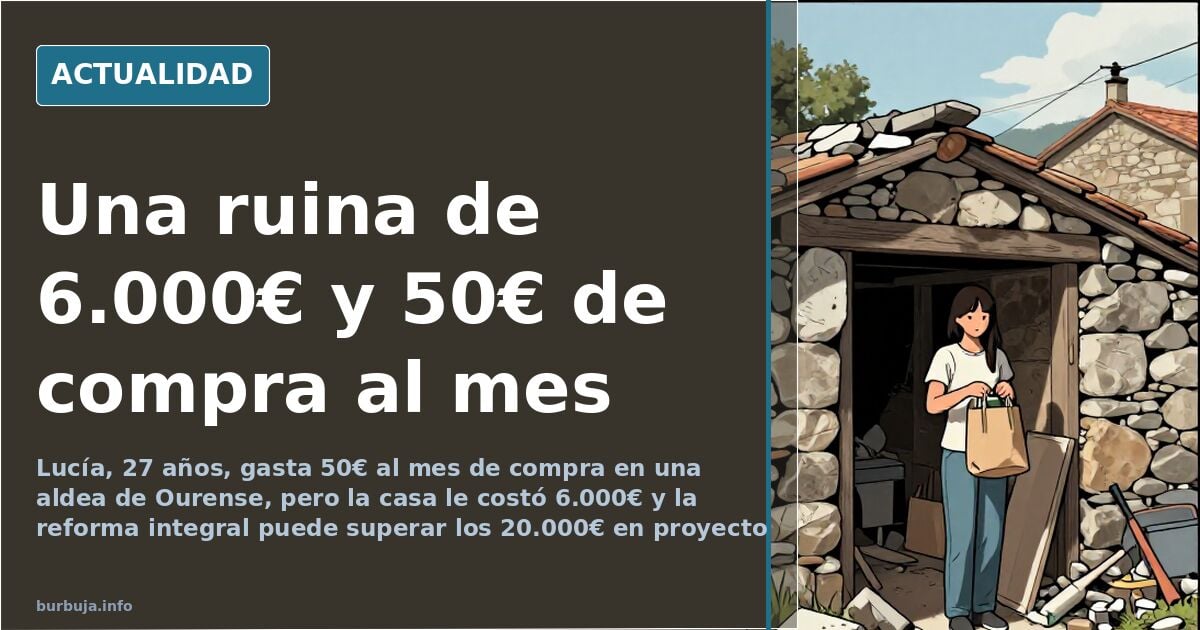
Lucía, 27: Century-old house for €6,000 and €50 monthly groceries
A 27-year-old woman left Madrid to buy a century-old house in O Irixo (Ourense) for €6,000, claiming she spends only €50 a month on groceries. The story, published by El Confidencial on August 17, 2026, has become the perfect case study for the new narrative of rural self-sufficiency. The problem is that the numbers simply do not add up.
Lucía spends €150 a month just on animals, according to the report itself. That is triple what she claims to spend on her own food. Add to this the restoration of a home over a hundred years old, tools, seeds, fertilizers, vet bills, firewood, and a long list of items no postcard shows. The €50 figure, read coldly, does not describe a budget; it describes part of one.
The calculation that doesn't fit: €50 groceries, €150 feed
The breakdown is simple. If the garden covers most of the pantry, the supermarket bill drops. So far, so logical. But the animals that produce part of that food cost €150 a month just for maintenance, without counting a vet visit, a vaccine, or a stable repair. Self-sufficiency, when done with animals, doesn't lower costs: it shifts spending from the supermarket to feed.
Some argue the comparison is unfair because animals are an investment, not current expense. The nuance holds water, but it doesn't eliminate the problem: the money leaves the same account every month. And if the goal is to reduce market dependence, depending on feed isn't exactly independence.
The €6,000 house: price is the least important factor
The property was bought for €6,000. In Galicia, with 313 municipalities and many lacking municipal architects, finding houses at that price is possible. Whether they are habitable is another matter. An unrestored century-old home drags along roof issues, downspouts, electrical panels, and dampness in stone walls. A complete legal renovation eats up several times the purchase price.
The most circulated argument is that the house price is irrelevant compared to the cost of making it livable. They have a point: a cheap ruin is the most expensive of all. Buying for €6,000 isn't buying a house; it's buying a construction project with a roof.
Galicia's greenery and the fine print of rural life
Galicia is green because it rains. A lot. The report doesn't mention rain, snow, mud, wild boars destroying gardens, or the isolation of villages without decent fiber optics. O Irixo has nine inhabitants, meaning the nearest neighbor might be a kilometer away and the GP doesn't hold consultations on Tuesdays and Thursdays.
The beautiful part of the story is real: neighbors welcome you with open arms and become family. The ugly part too: when that family ages, the village is left with no one to explain how the water supply works. Generational turnover isn't solved with a vegetable garden.
What does it really cost to live in a Galician village?
It depends on what you count. If you only count supermarket shopping, €50. If you count shopping, feed, firewood, property tax (IBI), insurance, vet, tools, and renovations, the figure multiplies effortlessly. The real cost of self-sufficiency isn't on the Mercadona receipt; it's in everything that doesn't appear on it.
The interest in this case isn't Lucía. It's the template. Every so often, an identical story appears: urban youth, cheap house, garden, chickens, and a monthly figure that sounds like a miracle. The pattern repeats because it works as a hook, not because the math checks out.
With these numbers, the return to the countryside should be massive. It remains marginal. And it's not due to a lack of €6,000 houses.
A 27-year-old woman left Madrid to buy a century-old house in O Irixo (Ourense) for €6,000, claiming she spends only €50 a month on groceries. The story, published by El Confidencial on August 17, 2026, has become the perfect case study for the new narrative of rural self-sufficiency. The problem is that the numbers simply do not add up.
Lucía spends €150 a month just on animals, according to the report itself. That is triple what she claims to spend on her own food. Add to this the restoration of a home over a hundred years old, tools, seeds, fertilizers, vet bills, firewood, and a long list of items no postcard shows. The €50 figure, read coldly, does not describe a budget; it describes part of one.
The calculation that doesn't fit: €50 groceries, €150 feed
The breakdown is simple. If the garden covers most of the pantry, the supermarket bill drops. So far, so logical. But the animals that produce part of that food cost €150 a month just for maintenance, without counting a vet visit, a vaccine, or a stable repair. Self-sufficiency, when done with animals, doesn't lower costs: it shifts spending from the supermarket to feed.
Some argue the comparison is unfair because animals are an investment, not current expense. The nuance holds water, but it doesn't eliminate the problem: the money leaves the same account every month. And if the goal is to reduce market dependence, depending on feed isn't exactly independence.
The €6,000 house: price is the least important factor
The property was bought for €6,000. In Galicia, with 313 municipalities and many lacking municipal architects, finding houses at that price is possible. Whether they are habitable is another matter. An unrestored century-old home drags along roof issues, downspouts, electrical panels, and dampness in stone walls. A complete legal renovation eats up several times the purchase price.
The most circulated argument is that the house price is irrelevant compared to the cost of making it livable. They have a point: a cheap ruin is the most expensive of all. Buying for €6,000 isn't buying a house; it's buying a construction project with a roof.
Galicia's greenery and the fine print of rural life
Galicia is green because it rains. A lot. The report doesn't mention rain, snow, mud, wild boars destroying gardens, or the isolation of villages without decent fiber optics. O Irixo has nine inhabitants, meaning the nearest neighbor might be a kilometer away and the GP doesn't hold consultations on Tuesdays and Thursdays.
The beautiful part of the story is real: neighbors welcome you with open arms and become family. The ugly part too: when that family ages, the village is left with no one to explain how the water supply works. Generational turnover isn't solved with a vegetable garden.
What does it really cost to live in a Galician village?
It depends on what you count. If you only count supermarket shopping, €50. If you count shopping, feed, firewood, property tax (IBI), insurance, vet, tools, and renovations, the figure multiplies effortlessly. The real cost of self-sufficiency isn't on the Mercadona receipt; it's in everything that doesn't appear on it.
The interest in this case isn't Lucía. It's the template. Every so often, an identical story appears: urban youth, cheap house, garden, chickens, and a monthly figure that sounds like a miracle. The pattern repeats because it works as a hook, not because the math checks out.
With these numbers, the return to the countryside should be massive. It remains marginal. And it's not due to a lack of €6,000 houses.
Also available in: Deutsch
Summary of a discussion on Burbuja.info - Foro de economía, actualidad y política., translated from Spanish and reviewed before publication. Read the full discussion (619 replies).
More summaries
-
The Seville divide: why the rest of Andalusia resents the capital
Broncano's comment about Sevillians reopens Andalusia's rift. Centralism, stereotypes and rivalries: anti-Sevillian sentiment analysed with data and t
-
Fire at La Querola: 52 luxury homes damaged in Andorra
The fire at La Querola de Ordino destroyed 22,000 m² and damaged the seven blocks of 52 luxury homes sold from two million in Andorra.
-
Rumors Suggest Spanish PM Sánchez May Step Aside
Online rumors claim Pedro Sánchez is considering not running, with PSOE looking at Bolaños, Cuerpo or García-Page as potential successors.
-
Woman dies falling from Lugo Wall while teens mock her
A woman died falling from the Lugo Wall in Spain as teenagers filmed and laughed. Analysis of legal liability and physical rescue feasibility.
-
Ayuso: Madrid celebrates Hispanic Day with US as guest
Madrid's leader Isabel Díaz Ayuso marks Hispanic Day in Spain, highlighting the US as guest nation and asserting a shared cultural power.
-
The Ugliness Agenda: Architecture as a Control Tool
Analysis links Rockefeller network, MoMA and International Style to deliberate urban ugliness as a social control mechanism.