
Spain Loses Women's Euro Championship on Penalties, Tomé Sacked
Spain loses the Women's Euro 2025 final on penalties and the RFEF does not renew Montse Tomé's contract; Barcelona contributed eleven players to the squad.
English · Original discussion in Spanish · Published
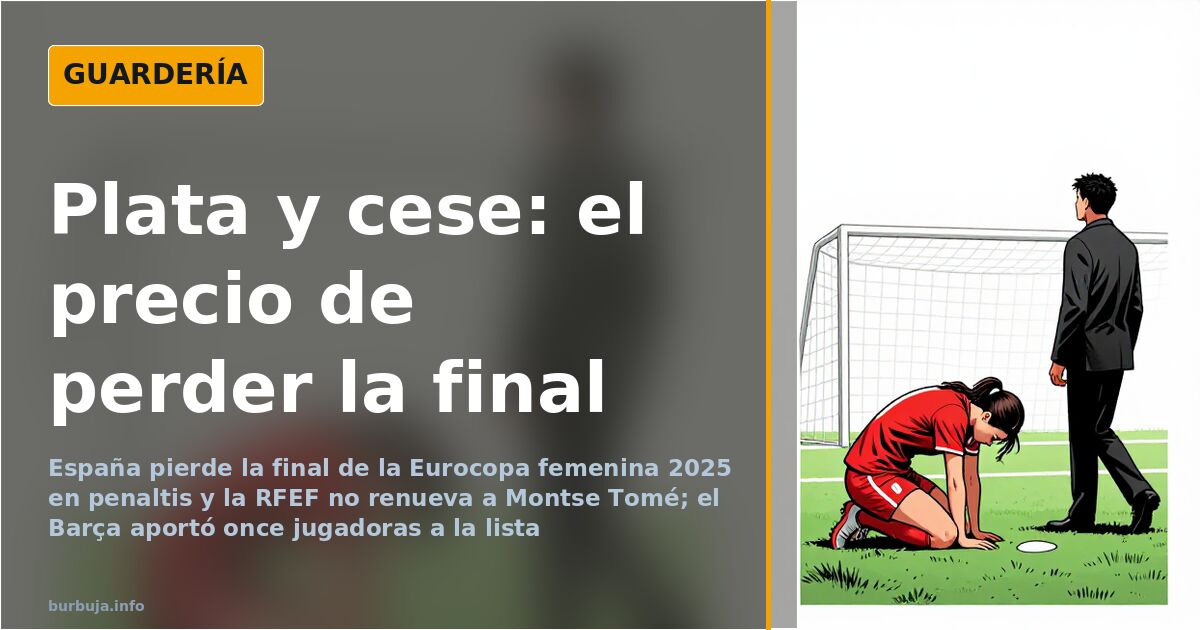
Spain Loses Women's Euro Final and Sacks Montse Tomé
Spain arrived in Switzerland as world champions, second in the FIFA rankings, and the top power in the UEFA zone, and leaves with a silver medal around their necks and no coach. The team broke a drought that had lasted since 1997 – they hadn't reached the European semi-finals – in one fell swoop, made it to the final, and lost it in a penalty shootout. Days after finishing as runners-up, the RFEF Board announced that Montse Tomé's contract will not be renewed. Two facts and the same outcome: a tournament that was taken for granted and a federation that was quick to act.
Spain Ends Semi-Final Drought Since 1997 in Switzerland
The starting point was uncomfortable. A World Cup title, a Nations League, second place in the FIFA rankings, and many of the world's best players in the squad... and no European semi-finals since 1997. The label of clear favorite wasn't a prediction, it was an obligation. The Euro was presumed to be an unfinished conquest for almost three decades.
In Switzerland, that changed. Spain pogre through the rounds, reached the final, and lost on penalties, with the image of the players receiving silver medals and their serious expressions as the final scene of the tournament. A play in the shootout – a possible double touch on the kick – served to debate whether the penalty should be retaken. Some saw it clearly, others saw nothing at all. This is also not new: when the result decides a final, even the rules end up in the mud.
RFEF Does Not Renew Montse Tomé; Sonia Bermúdez Rumored
The decision was announced shortly after the match. The RFEF Board will not renew the coach's contract, and as a replacement, Sonia Bermúdez, the U23 coach, has emerged as a proposed candidate, though not yet confirmed. The dismissal can be interpreted in two ways. For some, it's the logical consequence of not winning with the best generation Spanish football has ever had; for others, it's another sign that the women's coaching staff is the first thing to be moved when the first bill arrives.
Eleven Barcelona Players in the Squad: Breakdown by Club
The squad list revealed a very specific map: eleven players from FC Barcelona, three from Real Madrid, and two from Athletic Club, plus a small group spread across Sevilla, PSG, Manchester City, Arsenal, Gotham FC, and Monterrey. Based on this distribution, one of the most frequent criticisms arose: that the national team is assembled by quotas and that some clubs with real weight are left out. The counter-argument is simple and difficult to refute at the same time: the best players are called up, and the best players play where they play.
Aitana Bonmatí and Alexia Putellas, with the last four Ballon d'Or awards between them, summarize the two sides of the issue: concentration of talent in one locker room and dependence on it. The complete detail of which club contributes each player, name by name, is what turns a squad list into an argument.
No Bonus: 100,000 Euros Left on the Table
Losing a final doesn't just cost a title. The squad missed out on a 100,000 euro bonus for being runners-up. For players with high salaries, it's not a decisive amount; for a young player just breaking into the national team, it's money from another league. The amount better measures the real gap between being champions and being finalists than any speech.
Germany, the Calendar, and a Euro Championship Held Every Two Years
Germany's continental record is imposing, but it's worth looking at the calendar: until 1997, the tournament was held every two years, not four. Winning with that frequency, in a sport with a handful of truly competitive teams, inflates the history books faster than it seems. In this edition, Germany once again showed its usual trait: winning their second consecutive match playing with ten players and scoring with their only chance.
The Other Match: Public Funds and Comments Beyond Football
Not all the attention was sporting. Part of the conversation devolved into personal attacks against the players and questioning the public funds allocated to women's football after the runner-up finish, with electricity bills as a recurring theme. It's the same discussion that has accompanied the team since they started winning: the subsidy is scrutinized more than the game itself.
Spain is the European runner-up, maintains its status as world champion, has an empty coaching bench, and a federation that must decide who will occupy it. With this material, the question is no longer whether the national team can win a Euro; it's how long it will take to try again, and with whom.
Spain arrived in Switzerland as world champions, second in the FIFA rankings, and the top power in the UEFA zone, and leaves with a silver medal around their necks and no coach. The team broke a drought that had lasted since 1997 – they hadn't reached the European semi-finals – in one fell swoop, made it to the final, and lost it in a penalty shootout. Days after finishing as runners-up, the RFEF Board announced that Montse Tomé's contract will not be renewed. Two facts and the same outcome: a tournament that was taken for granted and a federation that was quick to act.
Spain Ends Semi-Final Drought Since 1997 in Switzerland
The starting point was uncomfortable. A World Cup title, a Nations League, second place in the FIFA rankings, and many of the world's best players in the squad... and no European semi-finals since 1997. The label of clear favorite wasn't a prediction, it was an obligation. The Euro was presumed to be an unfinished conquest for almost three decades.
In Switzerland, that changed. Spain pogre through the rounds, reached the final, and lost on penalties, with the image of the players receiving silver medals and their serious expressions as the final scene of the tournament. A play in the shootout – a possible double touch on the kick – served to debate whether the penalty should be retaken. Some saw it clearly, others saw nothing at all. This is also not new: when the result decides a final, even the rules end up in the mud.
RFEF Does Not Renew Montse Tomé; Sonia Bermúdez Rumored
The decision was announced shortly after the match. The RFEF Board will not renew the coach's contract, and as a replacement, Sonia Bermúdez, the U23 coach, has emerged as a proposed candidate, though not yet confirmed. The dismissal can be interpreted in two ways. For some, it's the logical consequence of not winning with the best generation Spanish football has ever had; for others, it's another sign that the women's coaching staff is the first thing to be moved when the first bill arrives.
Eleven Barcelona Players in the Squad: Breakdown by Club
The squad list revealed a very specific map: eleven players from FC Barcelona, three from Real Madrid, and two from Athletic Club, plus a small group spread across Sevilla, PSG, Manchester City, Arsenal, Gotham FC, and Monterrey. Based on this distribution, one of the most frequent criticisms arose: that the national team is assembled by quotas and that some clubs with real weight are left out. The counter-argument is simple and difficult to refute at the same time: the best players are called up, and the best players play where they play.
Aitana Bonmatí and Alexia Putellas, with the last four Ballon d'Or awards between them, summarize the two sides of the issue: concentration of talent in one locker room and dependence on it. The complete detail of which club contributes each player, name by name, is what turns a squad list into an argument.
No Bonus: 100,000 Euros Left on the Table
Losing a final doesn't just cost a title. The squad missed out on a 100,000 euro bonus for being runners-up. For players with high salaries, it's not a decisive amount; for a young player just breaking into the national team, it's money from another league. The amount better measures the real gap between being champions and being finalists than any speech.
Germany, the Calendar, and a Euro Championship Held Every Two Years
Germany's continental record is imposing, but it's worth looking at the calendar: until 1997, the tournament was held every two years, not four. Winning with that frequency, in a sport with a handful of truly competitive teams, inflates the history books faster than it seems. In this edition, Germany once again showed its usual trait: winning their second consecutive match playing with ten players and scoring with their only chance.
The Other Match: Public Funds and Comments Beyond Football
Not all the attention was sporting. Part of the conversation devolved into personal attacks against the players and questioning the public funds allocated to women's football after the runner-up finish, with electricity bills as a recurring theme. It's the same discussion that has accompanied the team since they started winning: the subsidy is scrutinized more than the game itself.
Spain is the European runner-up, maintains its status as world champion, has an empty coaching bench, and a federation that must decide who will occupy it. With this material, the question is no longer whether the national team can win a Euro; it's how long it will take to try again, and with whom.
Summary of a discussion on Burbuja.info - Foro de economía, actualidad y política., translated from Spanish and reviewed before publication. Read the full discussion (311 replies).
More summaries
-
Real Madrid's Dominance: European Glory vs. Domestic Refereeing Bias
Real Madrid dominates European football but struggles against a domestic league marked by controversial refereeing decisions and the narrative hegemony of FC Barcelona.
-
Real Madrid 2026/27: Third Trophy Drought and City Faces 114 Charges
Real Madrid faces a third consecutive season without titles under Mourinho, while Manchester City confronts 114 charges for financial fair play violations.
-
Modric's Daughter Joins Real Madrid Academy
Ema Modrić, daughter of footballer Luka Modrić, signs with Real Madrid's youth academy as a midfielder. A new talent emerges in the family.
-
Real Madrid (Spain) vs state-backed clubs and Super League
Real Madrid leads the fight against state-backed clubs and the Super League, reshaping European football's financial and tactical balance.
-
Seven Years Without a Date, and a Coffee Invite That Ended in Being Blocked
Seven years without a date, three weeks of back-and-forth, and a silent block: how a coffee invite turned into a ghosting story.
-
This post on X from back when it was still Twitter is getting people talking online again.
A post from before July 2023 asked whether Penélope Cruz was Pepe Viyuela in a wig. The joke is doing the rounds again.