
Spain housing debate: 80m2 not dignified living
Forum user argues 80m2 should be single-person studio, proposing 50m2 minimum per person; others blame land costs and taxes.
English · Original discussion in Spanish · Published
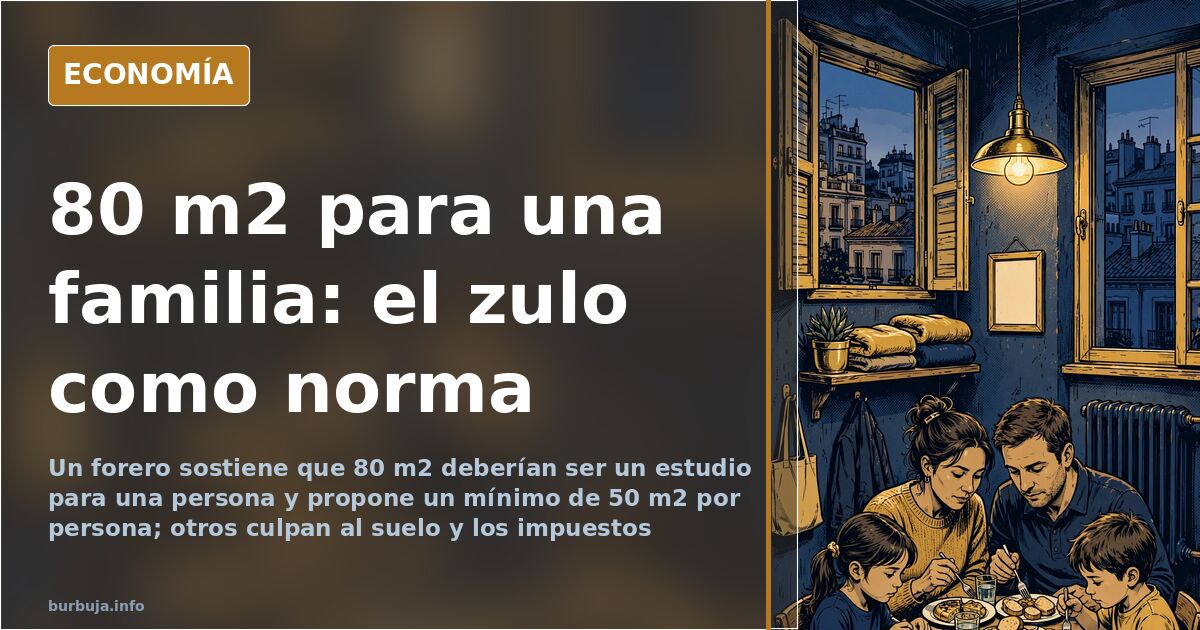
The 'zulo' as norm: 80 m2 is not a home
A closet bursting with just two coats. A living room that doubles as hallway, dining area, and lounge. This scene opens the discussion: someone reorganizes a family home's wardrobes and discovers the issue isn't clothes, but space. The thesis is uncomfortable yet hard to refute: 80 square meters should be a studio for one person, not the ceiling for an entire family. From this base arises the question running through the thread: when was it decided that a rat trap was sufficient living space?
The starting point is concrete. Most quality clothing stays in the city; the country house only holds sweatpants and summer wear. Attempting to organize reveals the same diagnosis: everything crammed, squeezed, disorganized. There's no way to keep things tidy because there's nowhere to put them. Hence the underlying accusation: apartments lack minimal space conditions for a normal life.
How many square meters does a family need for dignified living?
The proposal on the table is a legal minimum of 50 m2 per person. Less than that, they argue, is a cage and should be illegal directly. Translated to a typical family, that's 200 m2 with at least a 25 m2 terrace. Not a drying balcony: a terrace. Several spacious rooms, a large living room, a secondary sitting area, real-sized kitchen and bathrooms.
This argument isn't luxury whim. It's recognition that Spanish urban planning is already compact and vertical, so space could be optimized with millimeter-precise maps, as done a century ago, but with decent housing. The contradiction highlighted is abandoned neighborhoods and empty lots in increasingly dense cities, while still building the same cramped unit with chapel-like distribution.
Land prices and neoliberal excuse
Here the issue splits into two currents. One claims public intervention is key: urban councilors control land, construction/sale/purchase taxes consume huge percentages, and licenses/ordinances inflate each development. Under this view, builders aren't neoliberal: they're first interested in selling high what administration makes expensive.
The other current responds that forty years of supposedly liberating recipes haven't given population dignified housing, resulting in a speculator country where large flats demand eyes literally. The difference between build cost and purchase price isn't explained solely by taxes or greed: there's a chain of intermediaries, land, licenses, financing inflating final price.
Madrid, Barcelona and big city mantra
Classic argument appears: want space, move to village. Claimed life exists beyond capitals, small towns offer 150 meters with plot, real problem is everyone wants center living on low salary. Counterargument: job opportunities are where they are, asking people to move to emptiness elegantly solves nothing.
Density data points uncomfortably: Barcelona exceeds 16,000 inhabitants per km², far above Shanghai or Tokyo. If compact model works elsewhere, why here translates to fewer meters per dwelling instead of better utilization?
New flat layout: kitchen attached to living room
Concrete observation: new flats trend integrating kitchen into living room. Not for modernity, said, but making whole seem larger: remove meters from living room and kitchen alike, sell result as spaciousness. Pergola trick: apparently more, actually less.
Added legacy of old developments with one bathroom, three bedrooms, built-in wardrobe as sole storage solution. Many owners renovated adding fourth bedroom and second bath, using wasted corridors/hallways. Conclusion extracted: problem isn't just meter count, but distribution.
Human cost of canned living
Beyond price, health/behavior effects described. Living in vertical hives stresses, example drivers stuck together 6am Madrid ring roads. Healthy life needs space beyond eating/sleeping, crappy flat doesn't provide.
Some recall growing up 65 meters four people, six before. Others note 40 meters plus 30 patio livable reasonably. Range wide, consensus emerges current minimum below reasonable, solution isn't squeezing more but building better.
With these elements, question isn't if cramped unit comfortable or not. How long will continue calling jail-with-mortgage housing.
Also available in: Deutsch
Summary of a discussion on Burbuja.info - Foro de economía, actualidad y política., translated from Spanish and reviewed before publication. Read the full discussion (129 replies).
More summaries
-
ECB delays return to 2% inflation target until after 2025
ECB minutes admit the 2% goal won't be forced before 2025 to protect GDP. Rising food costs erode savings' purchasing power.
-
Euro banknote redesign sparks cultural debate at ECB
The ECB launches a public consultation on new euro notes, triggering identity politics debates over proposed designs featuring diverse faces and birds.
-
€400k savings no longer buy a home in Madrid or Barcelona
With €400,000 saved, a 40-year-old cannot afford a decent flat in Madrid or Barcelona due to housing costs and inflation.
-
Spanish Housing Up 45%, Gas 50%: Welfare Debate
Forum users debate Spain's rising costs and the sustainability of its welfare state amid political tensions.
-
Iberism returns to the debate: the merger that dissolves Spain
A poll published in the media claims that seven out of ten Portuguese support the union, but Iberism would mean dissolving Spain and Portugal into a…
-
Iberia: what if Spain and Portugal became a single state?
A debate raises the idea of a merger between Spain and Portugal: one user calculates an average unemployment rate of 12.6%, compared with Portugal's 6% and Spain's 14%.