
Spain: grant-maintained school without uniform votes to impose one at €150 per set
A Spanish grant-maintained school that never had a uniform is set to vote on making it compulsory: €150 per set and three or four changes needed. Legally, families cannot be forced to buy it.
English · Original discussion in Spanish · Published
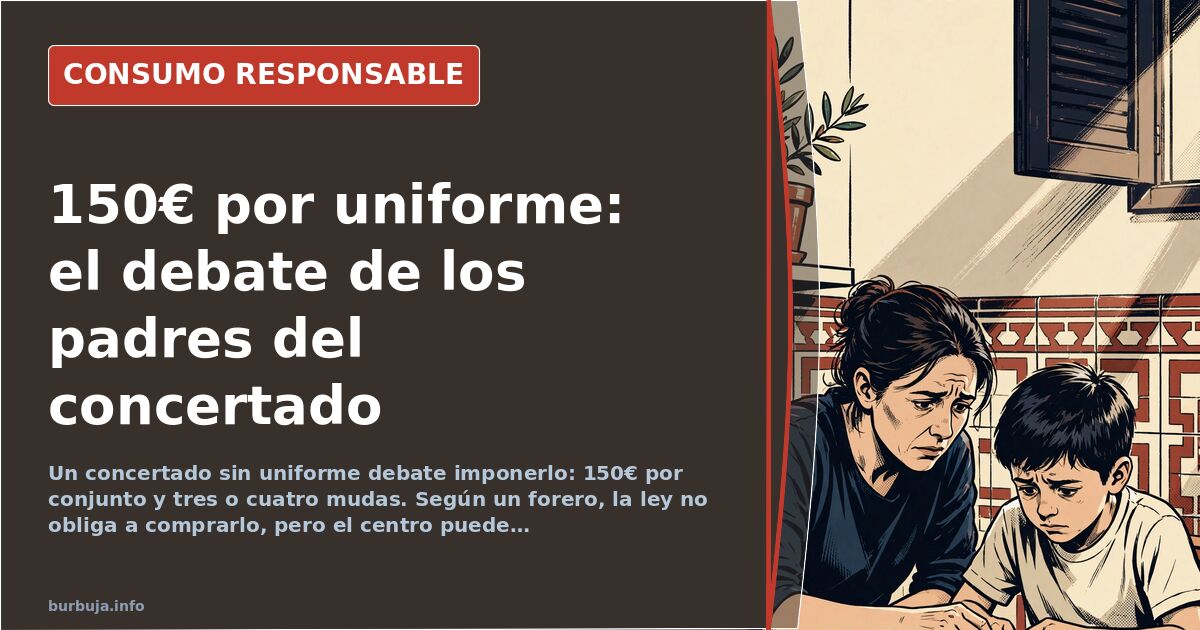
Uniforms at a grant-maintained school: €150 per child and no legal grounds
A grant-maintained school (a private school funded with public money under a concertado agreement) that has never had a uniform is about to vote on introducing one. A group of mothers has won over as many others, the vote is approaching and, if it goes through, the school will accept it. The detail that sparks the conflict is financial: each set costs "around €150", and to keep a child clean all week you need three or four. With that money, the parent who raised the issue argues, you could dress a child in regular clothes for an entire school year. The question she raises is whether the change can be challenged on contractual grounds. The short answer: at a concertado school, no.
What the law says about uniforms at grant-maintained schools
The legal framework is clearer than it seems. Concertado schools cannot make uniform wear compulsory or impose a single supplier. Several rulings by regional school inspection services have sided with families who refused to buy one, and the regional administration itself has reminded schools in writing that no school can force pupils to wear a specific garment. The key lies in the legal nature of the concertado: the school is funded with public money and cannot charge families fees or add conditions beyond what was agreed.
That does not stop many concertado schools from doing it in practice. Social pressure — the child looking out of place, the end-of-year photo — works better than any regulation. And that is where the issue stops being legal and becomes a neighbourhood squabble.
The uniform as a covert funding channel
Suspicion runs through much of the discussion. If the price is known before the decision has even been made, and the shop is predetermined, the uniform stops being a garment and becomes a fundraising tool. Some say it bluntly: it is a money grab to covertly fund a school that, under its concertado agreement, cannot ask families for a single euro. The clue is not trivial: according to one forum user, concertado schools have specific tax IDs for selling books and for selling clothes, which shows the commercial activity is perfectly organised.
The contrast with state schools is striking. State schools have optional uniforms: grey trousers, navy jumper and white polo shirt, with no mandatory shop. One family bought two pairs of trousers at €9 each from a hypermarket and a couple of jumpers wherever they found a good price; the total spend came to less than €50. The difference from €150 per set is not one of style: it is one of model.
The real cost: €150 per set and three or four changes
The arithmetic is relentless. A set costs around €150. With just one, the child is dirty by Thursday. With three or four, the bill soars past €450 per school year, per child. Some argue two sets are enough and that the cost is offset by what you stop spending on regular clothes, but the maths only works if you buy regular clothes in the sales and the uniform is never on offer.
The comparison with school supplies is inevitable: books are bought too, they are compulsory too, and they are sold at the school as well. The difference is that books have a regulated price and uniforms do not.
Uniforming the children so the parents don't have to agree
The most common argument in favour is convenience. No more morning arguments, no more "what shall I wear", no more brand obsession from the age of twelve. The counter-argument is devastating: if you want your child to dress the same every day, buy five identical sets and do it. What makes no sense is imposing on everyone else a decision that only solves your own problem. Freedom of dress is also a form of expression, and putting a child in uniform to avoid a conversation is an expensive way of not educating.
There is a nuance that creeps into the discussion and should not be lost: in Spain, the school uniform carries a symbolic weight that is hard to erase. Authoritarian education, military schooling, elite schools. It is no coincidence that it comes up from time to time in state schools and is quickly dropped.
Mandatory skirts for girls: the flank nobody defends
The debate gets more complicated when gender enters the picture. In many uniforms girls wear skirts and boys trousers. In winter they are cold, run worse and play less comfortably. The question is why no unisensuni uniform is designed to end the problem. The answers given out loud do not stand up to scrutiny; nor do the ones that are thought but not said.
What a family that does not want the uniform can do
The legal route exists, but it is uncomfortable. At a concertado school, a family can refuse to buy the uniform on the grounds that the school cannot compel them. The education administration has backed that reading in specific cases. What is harder is the social bill: the child who looks different, the parents' meeting, the teacher's gaze. The law protects; the playground does not.
The middle-ground alternative — optional uniform, no mandatory shop, generic garments — works in state schools and defuses almost every conflict. It is not what is being voted on in this case.
Given all this, the likely outcome is that the uniform goes ahead in the year groups where the driving mothers hold a majority, and that dissenting families split between legal action and resignation. The prediction comes with caveats: if the school sells exclusively and the price stays at €150 per set, the shadow of covert funding will keep growing, and with it the likelihood that some family takes the matter to the school inspectorate. That is when we will find out whether the concertado agreement can withstand the pressure, or whether the uniform was, in fact, the tip of the iceberg.
Summary of a discussion on Burbuja.info - Foro de economía, actualidad y política., translated from Spanish and reviewed before publication. Read the full discussion (100 replies).
More summaries
-
Public vs. State-Funded Schools in Spain: The Real Cost
Monthly fees of €80–€150 and a reported case of €500 highlight the dilemma between public and state-funded schools.
-
Miguel Ríos and responsible consumption: paying to be insulted?
Spanish singer Miguel Ríos has criticised his own audience for attending his concerts. Is it responsible consumption or a provocation? The debate is on.
-
Joselín, the €7 Sobaos that divides artisan consumption
Joselín's box costs €7, adding €6 shipping on orders of €50. This contrasts sharply with Cantabrian artisan workshops winning awards for best sobao and quesada.
-
Lidl's frozen sardines at €3.90/kg vs. fresh ones
A kilo of frozen sardines costs €3.90 compared to €9-€10 for fresh ones in Madrid. The question is whether the flavor holds up after freezing.
-
Who's having kids today: the foolish or the smart?
Who has children today? The dilemma between subsidized fools, busy smart people and the economic burden. Two opposite profiles agree that reproducing is a matter of luck.
-
Thailand: the magnet for Spanish retirees
A Spanish pension can go three times further in Thailand: the story of an expatriate who arrived in 2009 and never returned to Spain.