
Spain Forum's 30-Word Rule Sparks User Backlash
A new minimum word count for forum threads in Spain triggers debate over spam, automation, and late-stage quality control.
English · Original discussion in Spanish · Published
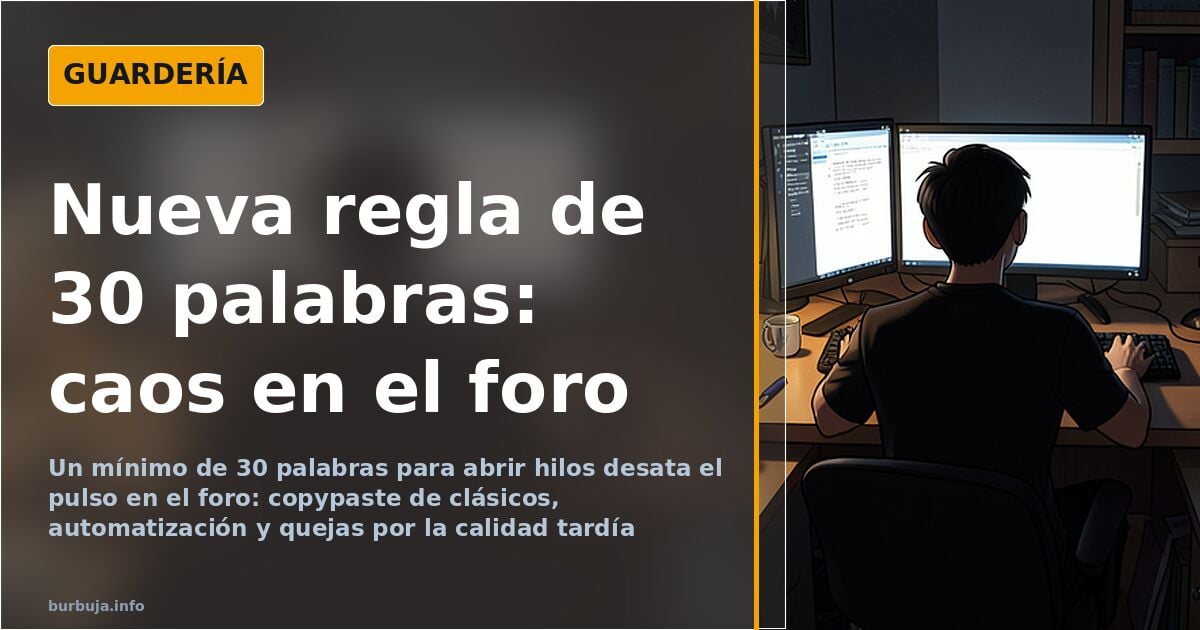
Spain Forum's 30-Word Rule Sparks User Backlash
Opening a thread used to take just one line. Not anymore. A system update now requires a minimum of 30 words to create a new topic, igniting fierce discussion: single-letter posts, improvised threads, and two-word replies are out. The measure comes with an underlying argument few dispute: clearing noise from the front page. The issue is who decides this and how it is enforced.
The clash between rule and wit
The announcement boils down to one phrase: no more single-letter threads. The stated intent is clear —trash goes in the bin— but the side effect is immediate: those who once peine topics with monosyllables now need thirty words. And that’s where the game begins. Some argue that copying a paragraph from Cicero suffices to meet the requirement while still posting whatever they want; classic texts become formal passes. The paradox, they note, is that a rule born to organize ends up rewarding those who bypass it most elegantly.
Automation as the response
The other side of the change is technical. If the system can demand a minimum word count, it can also filter and send non-compliant topics straight to the trash. This is the view held by supporters: moderation shifts from manual to automatic. Enthusiasm isn’t unanimous. Alongside well done, indifference coexists with a deeper complaint: after years of tolerating two-word messages, demanding quality now feels like a belated conversion.
The quality argument arrives too late
The most repeated criticism doesn’t question the rule itself, but its timing. So much degradation has been tolerated that requiring a minimum word count appears as a cosmetic patch. The emerging alternative is machine-generated text: if thirty words are needed, let AI write them. The perverse incentive is evident: a rule meant to raise standards may multiply substanceless generated text, fulfilling form while emptying content.
Free speech as shield
The debate escalates when the restriction is compared to others. If minimalism is limited, where does free speech stand? The question is posed with sarcasm but points to something real: every publishing rule sets a threshold, and every threshold excludes someone. Whether thirty words are many or few is, at heart, a debate about who decides what is noise and what is content.
The unsettling fact: the rule doesn’t stop nonsense. It just forces you to write it longer.
Also available in: Deutsch
Summary of a discussion on Burbuja.info - Foro de economía, actualidad y política., translated from Spanish and reviewed before publication. Read the full discussion (16 replies).
More summaries
-
Spain Forum Battle: AI Bots and Character Limits
New minimum character rules and AI bots spark debate over control in a major Spanish economic community.
-
Photos of Spain's Ayuso in a swimsuit spark online frenzy
We analyze the thread about photos of Isabel Díaz Ayuso in a swimsuit that has generated debate and memes in the Guardería of Burbuja.info.
-
No scientific basis for claims linking homosexuality to higher creativity
The idea that LGBTQ+ people are more creative lacks scientific support. Success depends on environment and opportunities, not DNA.
-
Spain's 40-Year-Old Gamers: From Metaphor to Diablo IV
From the 30-hour wall in Metaphor to the calculated vice of Diablo IV, a generation negotiates its limited free time with consoles.
-
Amarna Miller: From Porn Star to Anthropology, Forum Debates
Online forums discuss Amarna Miller's shift from adult film to anthropology. Speculation arises about her master's degree and a thesis potentially directed by her husband.
-
German General Freuding compared to Nazi actor
A post on X compares German general Christian Freuding to a Nazi film actor. We explain who he is and why the image spread.