
Spain flies 300 migrants to four-star hotel in Almería
Spanish government charters flights and books luxury hotels for hundreds of migrants arriving in the Canary Islands, according to reports.
English · Original discussion in Spanish · Published
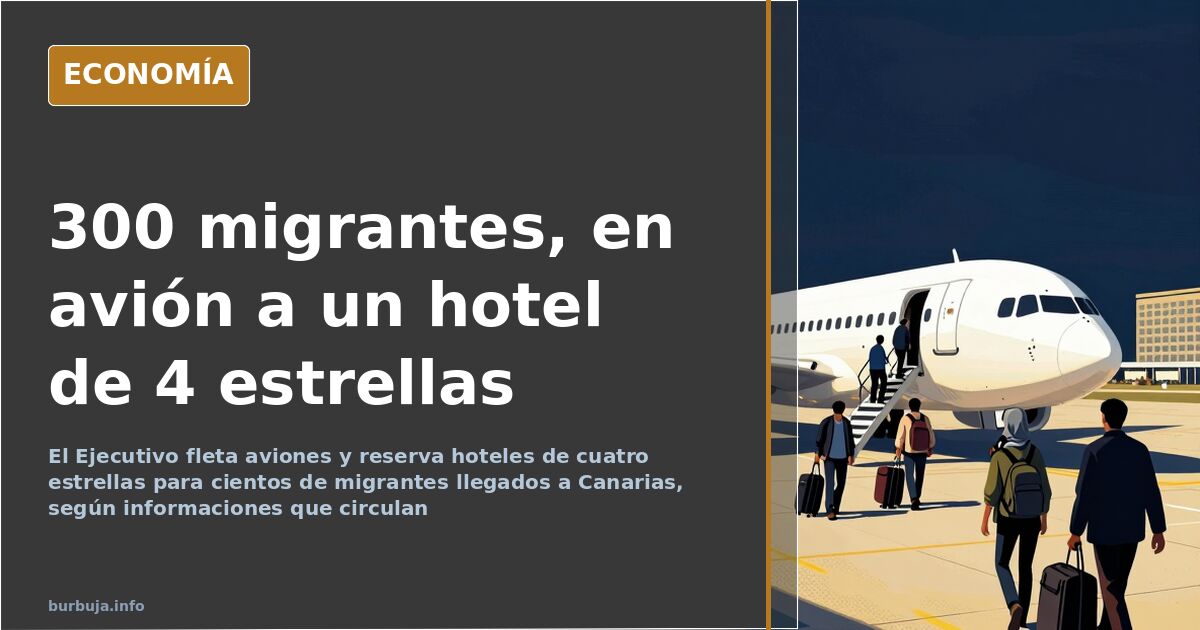
Government flies 300 migrants to a four-star hotel
A plane chartered by the Executive. A bus ride to El Toyo, a neighborhood in Almería. And a four-star hotel as the final destination. The group, composed of men of Sub-Saharan origin who arrived in the Canary Islands, was relocated to mainland Spain without passing through an reception center, according to circulating information about the operation. Another 240 migrants joined the same operation later in Torrox (Málaga), bringing the total number of committed hotel places in Andalusia to 540. The transfer takes place while the Migration Plan contemplates housing migrants for six months in establishments up to four stars.
What the reception plan says and who pays the bill
The official program consists of temporarily housing migrants in hotels, resorts, and spas on the mainland. The bill is assumed by the administration from public budgets, that is, with taxes. The most circulated comparison these days is that of Imserso (the Spanish state agency for senior tourism): of the 262 euros that an average stay in Benidorm costs, the Government only pays 52, according to published data. Applied to a contingent of hundreds of people over months, the order of magnitude ceases to be anecdotal.
Some argue that the transfer responds to the saturation of Canarian centers and that the alternative was leaving people on the street. Against this weighs the argument that the device was activated without notifying receiving municipalities and without passing through first-reception facilities. The regional council, the city hall, and the sub-delegation found out at the same time as the neighbors.
El Toyo, Torrox, and the geography of hotels with contracted places
El Toyo is not just any neighborhood. It is an urbanization of hotels and tourist apartments built for the 2005 Mediterranean Games, with high-end establishments and a wide low season. That profile — idle hotel capacity, bed availability, and private management — is what makes certain coastal areas natural candidates for this type of contract. Torrox, in the Axarquía region of Málaga, fits the same pattern.
The sequence repeats: arrival in the Canary Islands, chartered flight, bus, and check-in. The operation is executed by the Ministry of Interior, not by regional or municipal authorities, which has generated a subtle competence dispute. City halls claim they were not consulted nor provided with prior information on the number of people, the duration of the stay, or the cost of associated municipal services.
The pull effect: the photo that travels via WhatsApp before the raft
The most repeated argument in critical analysis is that of the pull effect. The thesis is simple: images of newly arrived people in bathrobes, by the pool, or in the breakfast buffet circulate through messaging groups to Senegal, Mali, or Guinea faster than any institutional campaign. Each photo is a brochure. And the brochure does not mention the months of waiting, administrative uncertainty, or cases that do not end well.
The objection to that reasoning also exists: the decision to migrate depends on structural factors — income, conflict, already established family networks — and not on an isolated image. But the debate on the pull effect is no longer academic. It is budgetary.
Who can enter a hotel and who cannot
The most repeated question in public conversation is comparative: In which country in the world does a newly arrived person in irregular status obtain hotel accommodation? The usual answer is that in almost none, and that the Spanish system combines generous reception with enormous opacity regarding who accesses it, for how long, and with what considerations.
The domestic contrast is the most uncomfortable. Those affected by natural disasters still waiting for a housing solution. Pensioners with subsidized stays covering a fraction of the real cost. Workers who have contributed for decades and have never stepped into a four-star hotel. No one invents the comparison: the structure of spending imposes it.
The detail that disorients is not the hotel. It is the plane. Chartering a flight to transport people who have just arrived via irregular routes turns the journey into part of the service, and that is where the official narrative and citizen perception stop coinciding.
A plane chartered by the Executive. A bus ride to El Toyo, a neighborhood in Almería. And a four-star hotel as the final destination. The group, composed of men of Sub-Saharan origin who arrived in the Canary Islands, was relocated to mainland Spain without passing through an reception center, according to circulating information about the operation. Another 240 migrants joined the same operation later in Torrox (Málaga), bringing the total number of committed hotel places in Andalusia to 540. The transfer takes place while the Migration Plan contemplates housing migrants for six months in establishments up to four stars.
What the reception plan says and who pays the bill
The official program consists of temporarily housing migrants in hotels, resorts, and spas on the mainland. The bill is assumed by the administration from public budgets, that is, with taxes. The most circulated comparison these days is that of Imserso (the Spanish state agency for senior tourism): of the 262 euros that an average stay in Benidorm costs, the Government only pays 52, according to published data. Applied to a contingent of hundreds of people over months, the order of magnitude ceases to be anecdotal.
Some argue that the transfer responds to the saturation of Canarian centers and that the alternative was leaving people on the street. Against this weighs the argument that the device was activated without notifying receiving municipalities and without passing through first-reception facilities. The regional council, the city hall, and the sub-delegation found out at the same time as the neighbors.
El Toyo, Torrox, and the geography of hotels with contracted places
El Toyo is not just any neighborhood. It is an urbanization of hotels and tourist apartments built for the 2005 Mediterranean Games, with high-end establishments and a wide low season. That profile — idle hotel capacity, bed availability, and private management — is what makes certain coastal areas natural candidates for this type of contract. Torrox, in the Axarquía region of Málaga, fits the same pattern.
The sequence repeats: arrival in the Canary Islands, chartered flight, bus, and check-in. The operation is executed by the Ministry of Interior, not by regional or municipal authorities, which has generated a subtle competence dispute. City halls claim they were not consulted nor provided with prior information on the number of people, the duration of the stay, or the cost of associated municipal services.
The pull effect: the photo that travels via WhatsApp before the raft
The most repeated argument in critical analysis is that of the pull effect. The thesis is simple: images of newly arrived people in bathrobes, by the pool, or in the breakfast buffet circulate through messaging groups to Senegal, Mali, or Guinea faster than any institutional campaign. Each photo is a brochure. And the brochure does not mention the months of waiting, administrative uncertainty, or cases that do not end well.
The objection to that reasoning also exists: the decision to migrate depends on structural factors — income, conflict, already established family networks — and not on an isolated image. But the debate on the pull effect is no longer academic. It is budgetary.
Who can enter a hotel and who cannot
The most repeated question in public conversation is comparative: In which country in the world does a newly arrived person in irregular status obtain hotel accommodation? The usual answer is that in almost none, and that the Spanish system combines generous reception with enormous opacity regarding who accesses it, for how long, and with what considerations.
The domestic contrast is the most uncomfortable. Those affected by natural disasters still waiting for a housing solution. Pensioners with subsidized stays covering a fraction of the real cost. Workers who have contributed for decades and have never stepped into a four-star hotel. No one invents the comparison: the structure of spending imposes it.
The detail that disorients is not the hotel. It is the plane. Chartering a flight to transport people who have just arrived via irregular routes turns the journey into part of the service, and that is where the official narrative and citizen perception stop coinciding.
Also available in: Deutsch
Summary of a discussion on Burbuja.info - Foro de economía, actualidad y política., translated from Spanish and reviewed before publication. Read the full discussion (175 replies).
More summaries
-
Spain migrant hotel costs spark social spending debate
Migrants in four-star hotels versus Imserso pensions fuel Spain's public spending and social welfare debate.
-
Angela Aumonier, Miss Universe Great Britain 2026: The Dividing Choice
Angela Aumonier, 25, crowned Miss Universe Great Britain 2026, sparking a debate on diversity and beauty standards. Read the details.
-
Plane Myth: Confusing Inertia with Wind in Spain
Earth rotates at 1,600 km/h and planes fly at 840 km/h. The error is forgetting that air rotates with the planet.
-
Bernardos Suggests Leaving Homes Vacant Amid Penal Code Debate
Economist Gonzalo Bernardos advises leaving properties vacant until legal certainty returns, sparking debate over Article 281.1 of the Spanish Penal Code.
-
Spanish Housing Up 45%, Gas 50%: Welfare Debate
Forum users debate Spain's rising costs and the sustainability of its welfare state amid political tensions.
-
Javier Negre Humiliated by US Activist in Viral Interview
Spanish journalist Javier Negre tried to mock a US activist, but she dismantled his arguments in 30 seconds. The video he posted went viral.