
Spain Election Bets: Forecast That Aged Poorly
Early Spanish election forecast predicted PP at 125 seats, VOX at 60. Betting range for PP spanned 105 to 200 seats.
English · Original discussion in Spanish · Published
Election bets: the forecast that aged poorly
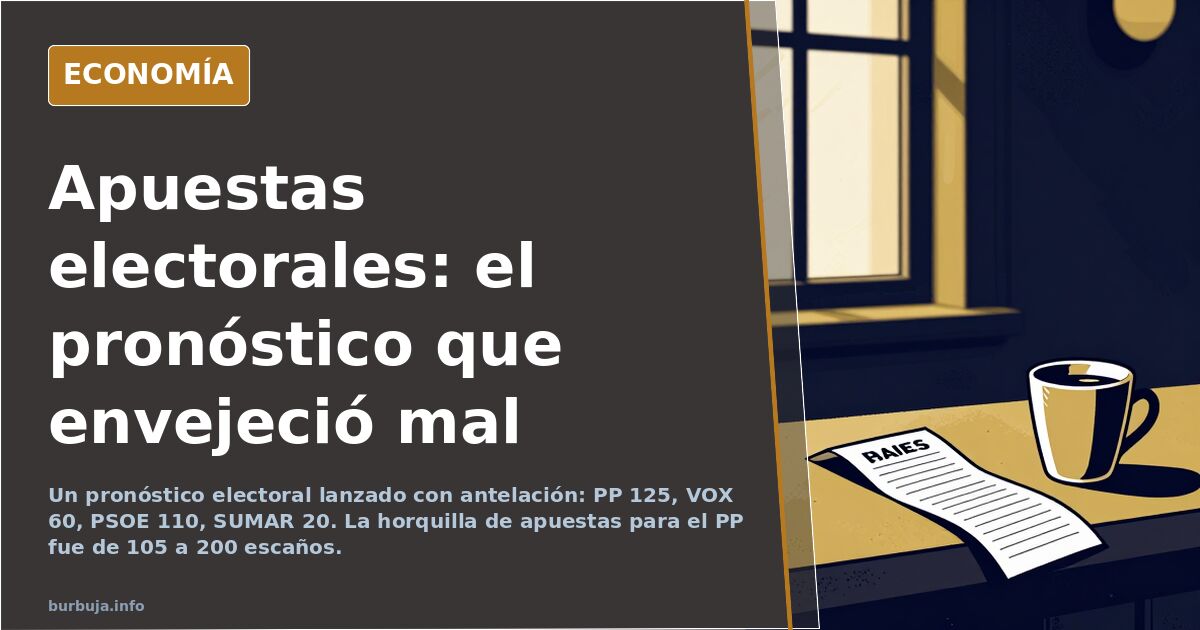
An early election forecast has a bit of lottery prediction and much more of a narrative thermometer. The headline that started the discussion —PP 125 MPs, VOX 60, PSOE 110, SUMAR 20— was not a poll, but a personal bet that set the framework for everything that trinc. From there, everyone adjusted their calculations: some raised the PP up to 200 seats, others lowered it to 105, and some even invented a party with 40 MPs. The overall range was so wide that any subsequent result fit within it.
What is striking is not the dispersion, but the confidence with which each figure was defended. The exercise became an archive of expectations: who believed the emerging party would hold on, who assumed a coalition, who announced new elections.
The initial forecast and its internal logic
The starting bet placed the PP at 125 seats, VOX at 60, PSOE at 110, and SUMAR at 20. It was not an isolated exercise: the brief initial message —"More or less"— served as the starting gun for everyone to release their predictions. And the predictions came flooding in, with figures ranging from unbridled optimism to catastrophism.
Some put the PP at 200 seats and a historic party at 40. Others left it at 105 and raised VOX to 75. And some directly bet on 400 MPs for the PSOE and that the rest would be "in debt of MPs." The charm of the format is that no one has to answer until the votes are counted.
The key is that the initial forecast was not a technical prediction, but a statement of intent. Setting SUMAR at 20 seats when the discussion peine was tantamount to saying that the space to the left of the PSOE would deflate. Setting VOX at 60 was tantamount to saying that the far-right party would weather the storm. And setting the PP at 125 was tantamount to saying it would not reach an absolute majority by far.
The real range: 105 to 200 seats for the same party
If anything demonstrates the collective bets, it is that nobody had a clue. The PP received forecasts ranging from 105 to 200 seats. The PSOE, from 90 to 110. VOX, from 30 to 75. SUMAR, from 20 to 35. With such dispersion, any subsequent electoral result would have validated someone.
Some argued that the PP was given "Ayuso's numbers, very inflated." Opposing them were those who assured that the party "is doing great" and would get "a good result." The discussion was not about data, but about narratives: each figure reflected a prior reading of the political cycle.
The case of VOX is the most illustrative. One participant issued a warning: "If under current conditions VOX does not get more than 60, Spain is lost forever." Another, however, maintained that the party had obtained 3,400,000 votes four years earlier and that its voters might feel betrayed. The underlying question —whether VOX's electorate would mobilize or stay home— remained unanswered, like many others.
The coalition everyone took for granted (or impossible)
The discussion quickly shifted to government scenarios. One participant proposed two: PP with 140 governing with abstention from VOX or PSOE, or a left-wing bloc with 176. Their conclusion was that, in any case, it would be "a hot potato someone has to eat."
Another went further and declared: "There will be no option for second elections, PP+VOX coalition sure because together they will reach 176." The certainty with which this was stated contrasts with the uncertainty reflected in the figures. If the PP oscillated between 105 and 200, how could anyone guarantee that the sum with VOX would reach an absolute majority?
The hypothesis of new elections also had its place. "My bet: new elections," wrote someone. And another added: "It is very likely there will be Frankenstein part two." The term, used sarcastically, summarized the suspicion that the left-wing bloc would need heterogeneous support to govern.
The role of small parties and the threshold of 50 MPs
One of the most cited analyses in the group was not about winning, but blocking. It was argued that 50 MPs is the minimum number to file constitutional appeals and to force a referendum for any constitutional change. The thesis was that the effort to wear down VOX sought precisely to keep it below that threshold.
"If tomorrow PP and PSOE agree to change something in the constitution, there will be no nuisance party with more than 50 MPs who can force them to submit said agreement to popular consultation," that analysis claimed. This is a reading that turns parliamentary arithmetic into a matter of institutional architecture, not seats.
Meanwhile, nationalist parties appeared in forecasts with residual figures: ERC 7, JxCat 7, PNV 5. Someone added, jokingly, "ETA 7." The joke summarizes the general tone: the discussion about seats coexisted with banter.
Closing the cycle: when the forecast becomes a joke
The end of the thread has a very different tone from the beginning. What started as serious bets turned into laughter. One participant wrote a string of "HAHAHA" occupying several lines. Another added: "Are we still reviving the thread for general amusement?" And a third declared: "Someone will have to massively collect their OWNED."
The shift is revealing. When a forecast is launched years in advance, the actual result turns it into comic material or proof of lucidity. There is no middle ground. And those who made extreme bets —400 seats for the PSOE, 200 for the PP— were exposed.
"So, do we count to see who messed up more?" asked someone. The implicit answer was that the count was already done and the verdict was collective. The thread, which had served to measure expectations, ended up serving to measure the distance between what was believed and what peine.
What if the exercise was not to predict, but to record how the board looked when everything was yet to be decided?
An early election forecast has a bit of lottery prediction and much more of a narrative thermometer. The headline that started the discussion —PP 125 MPs, VOX 60, PSOE 110, SUMAR 20— was not a poll, but a personal bet that set the framework for everything that trinc. From there, everyone adjusted their calculations: some raised the PP up to 200 seats, others lowered it to 105, and some even invented a party with 40 MPs. The overall range was so wide that any subsequent result fit within it.
What is striking is not the dispersion, but the confidence with which each figure was defended. The exercise became an archive of expectations: who believed the emerging party would hold on, who assumed a coalition, who announced new elections.
The initial forecast and its internal logic
The starting bet placed the PP at 125 seats, VOX at 60, PSOE at 110, and SUMAR at 20. It was not an isolated exercise: the brief initial message —"More or less"— served as the starting gun for everyone to release their predictions. And the predictions came flooding in, with figures ranging from unbridled optimism to catastrophism.
Some put the PP at 200 seats and a historic party at 40. Others left it at 105 and raised VOX to 75. And some directly bet on 400 MPs for the PSOE and that the rest would be "in debt of MPs." The charm of the format is that no one has to answer until the votes are counted.
The key is that the initial forecast was not a technical prediction, but a statement of intent. Setting SUMAR at 20 seats when the discussion peine was tantamount to saying that the space to the left of the PSOE would deflate. Setting VOX at 60 was tantamount to saying that the far-right party would weather the storm. And setting the PP at 125 was tantamount to saying it would not reach an absolute majority by far.
The real range: 105 to 200 seats for the same party
If anything demonstrates the collective bets, it is that nobody had a clue. The PP received forecasts ranging from 105 to 200 seats. The PSOE, from 90 to 110. VOX, from 30 to 75. SUMAR, from 20 to 35. With such dispersion, any subsequent electoral result would have validated someone.
Some argued that the PP was given "Ayuso's numbers, very inflated." Opposing them were those who assured that the party "is doing great" and would get "a good result." The discussion was not about data, but about narratives: each figure reflected a prior reading of the political cycle.
The case of VOX is the most illustrative. One participant issued a warning: "If under current conditions VOX does not get more than 60, Spain is lost forever." Another, however, maintained that the party had obtained 3,400,000 votes four years earlier and that its voters might feel betrayed. The underlying question —whether VOX's electorate would mobilize or stay home— remained unanswered, like many others.
The coalition everyone took for granted (or impossible)
The discussion quickly shifted to government scenarios. One participant proposed two: PP with 140 governing with abstention from VOX or PSOE, or a left-wing bloc with 176. Their conclusion was that, in any case, it would be "a hot potato someone has to eat."
Another went further and declared: "There will be no option for second elections, PP+VOX coalition sure because together they will reach 176." The certainty with which this was stated contrasts with the uncertainty reflected in the figures. If the PP oscillated between 105 and 200, how could anyone guarantee that the sum with VOX would reach an absolute majority?
The hypothesis of new elections also had its place. "My bet: new elections," wrote someone. And another added: "It is very likely there will be Frankenstein part two." The term, used sarcastically, summarized the suspicion that the left-wing bloc would need heterogeneous support to govern.
The role of small parties and the threshold of 50 MPs
One of the most cited analyses in the group was not about winning, but blocking. It was argued that 50 MPs is the minimum number to file constitutional appeals and to force a referendum for any constitutional change. The thesis was that the effort to wear down VOX sought precisely to keep it below that threshold.
"If tomorrow PP and PSOE agree to change something in the constitution, there will be no nuisance party with more than 50 MPs who can force them to submit said agreement to popular consultation," that analysis claimed. This is a reading that turns parliamentary arithmetic into a matter of institutional architecture, not seats.
Meanwhile, nationalist parties appeared in forecasts with residual figures: ERC 7, JxCat 7, PNV 5. Someone added, jokingly, "ETA 7." The joke summarizes the general tone: the discussion about seats coexisted with banter.
Closing the cycle: when the forecast becomes a joke
The end of the thread has a very different tone from the beginning. What started as serious bets turned into laughter. One participant wrote a string of "HAHAHA" occupying several lines. Another added: "Are we still reviving the thread for general amusement?" And a third declared: "Someone will have to massively collect their OWNED."
The shift is revealing. When a forecast is launched years in advance, the actual result turns it into comic material or proof of lucidity. There is no middle ground. And those who made extreme bets —400 seats for the PSOE, 200 for the PP— were exposed.
"So, do we count to see who messed up more?" asked someone. The implicit answer was that the count was already done and the verdict was collective. The thread, which had served to measure expectations, ended up serving to measure the distance between what was believed and what peine.
What if the exercise was not to predict, but to record how the board looked when everything was yet to be decided?
Summary of a discussion on Burbuja.info - Foro de economía, actualidad y política., translated from Spanish and reviewed before publication. Read the full discussion (142 replies).
More summaries
-
COPE staffer seen with white powder on air, fired and signed by Pedrerol
A COPE contributor appears live with white powder on his nose. He's fired, but Pedrerol has reportedly offered him a job. Cocaine or donut?
-
Spain court blocks landlord reclaiming home for daughter
Navarra Court denies eviction because notice lacked mandatory negotiation offer, despite contract terms.
-
Baby's body found in Germany after abduction
A three-month-old baby was found dead in Baden-Württemberg, Germany, following an alleged abduction while his mother carried groceries. The timeline raises questions.
-
Spain's Local Police: Fines as Revenue, Not Safety
A viral video shows a woman fined for jaywalking while others go unpunished, highlighting Spain's local police revenue quotas.
-
Spanish Economy at Risk Amid Government Collapse
Corruption scandals and political instability threaten Spain's government, raising concerns about economic fallout.
-
Belfast Riots: Racial Violence and Police Retreat
Riots erupt in Belfast amid anti-immigration protests. Police retreat as unionists and republicans unite against the government's perceived passivity.