
Spain Debates Mandatory 15% Tip for Waiters
A proposal for a fixed 15% tip in Spain's hospitality sector revives debate on wage structures, contrasting with the US tipping model.
English · Original discussion in Spanish · Published
Spanish Hospitality and the Proposed 15% Customer Tip
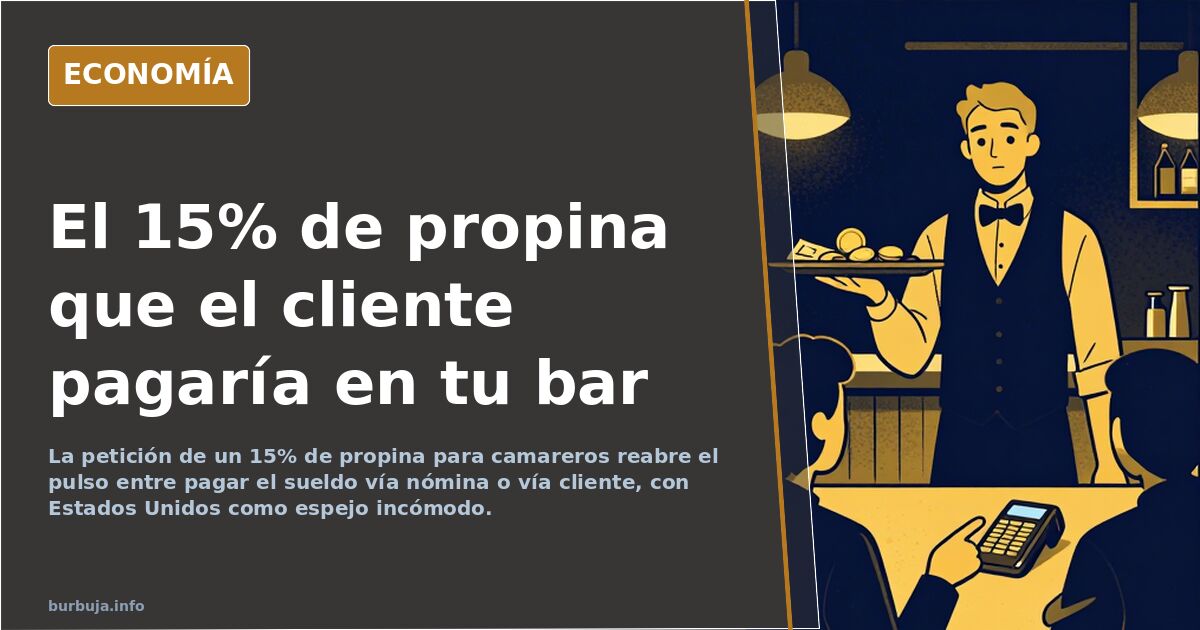
In Spain, leaving a tip remains an occasional gesture: a few cents or a euro at most, only when service is exceptional. In the United States, 15% or 20% of the bill is standard, and skipping it carries social stigma. This gap is central to a discussion reaching Spanish hospitality: calls for customers to leave a 15% tip for waiters. The proposal, circulated in the press, has received a hostile response.
The underlying argument is simple. A worker's salary should cover their needs without depending on customer generosity. In Spain, tips have never been a stable income source; in the US they are, with a perverse effect admitted by the industry itself: base wages in hospitality don't cover bills because employers and staff assume everyone tips.
Who Pays the Waiter's Salary: Business or Customer?
This question runs through the entire debate. Some argue that shifting part of the salary to the customer is outsourcing payroll: the owner doesn't pay, the diner does. The most common calculation suggests establishments could simply raise prices by 15% and dedicate that amount to employees. On paper, the cost to the customer is identical; the difference lies in who decides distribution and guarantees payment.
Against this plays the reality of job strain. Split shifts, two or three daily peaks, and staff often transient students rather than career waiters. Paying well and granting two days off forces closures or extra hiring, neither of which comes cheaply.
Comparison with the US extends beyond wages. It includes ease of hiring and firing, which lowers labor costs and allows minute-by-minute adjustments. Importing the tip system without importing that flexibility leaves customers paying the uncomfortable part of the model, which owners prefer to avoid.
The One-Euro Cortado vs. Five-Dollar Coffee
Prices are another open front. A cortado (espresso with milk) in provincial Spain costs 1.60 euros, with some recalling paying just one euro. In the US, drip coffee offers free refills between 2 and 5 dollars; those wanting quality must visit specialty cafes paying 4 or 5 dollars for a small cup that is never refilled.
The pricing backstory has its own conflict. Some claim Spain serves burnt, expensive products; others counter that American brews are tasteless water precisely why they offer free refills. Both sides conclude similarly: the issue isn't tips, but a market accustomed to charging without competing on quality.
Is the Tip Mandatory or a Hidden Tax?
In the US, it's not legally mandatory but functions as if it were. Custom is assumed, expected percentage is 20%. Not tipping marks one as rude and stingy, social pressure doing what no law requires. Its origins trace to Prohibition, when speakeasies couldn't put staff on payroll, so waiters collected cash directly from customers.
Hence the recurring label: revolutionary tax, voluntary in form, mandatory in practice. Reaction in Spain differs. If percentages appear printed on receipts, some simply refuse to pay, noting tips aren't enforceable. Tips remain rewards for good service, not automatic surcharges.
Who Keeps the Pot and Why Only the Waiter?
Another unresolved aspect: if tips go to waiters, why not dishwashers, kitchen assistants, or cleaners? Distribution is rarely as clean as claimed. In one first-hand account from hostel work, customer tips passed through management pockets before reaching staff.
This fuels deep distrust. It's not just customers paying others' salaries; it's lack of guarantee money reaches whoever served them.
With these elements, printed percentages seem convenient solutions for everyone except payers. Customers already fund beer. The doubt is whether they should also cover payroll, and if so, who ultimately receives it. That second half remains unanswered.
In Spain, leaving a tip remains an occasional gesture: a few cents or a euro at most, only when service is exceptional. In the United States, 15% or 20% of the bill is standard, and skipping it carries social stigma. This gap is central to a discussion reaching Spanish hospitality: calls for customers to leave a 15% tip for waiters. The proposal, circulated in the press, has received a hostile response.
The underlying argument is simple. A worker's salary should cover their needs without depending on customer generosity. In Spain, tips have never been a stable income source; in the US they are, with a perverse effect admitted by the industry itself: base wages in hospitality don't cover bills because employers and staff assume everyone tips.
Who Pays the Waiter's Salary: Business or Customer?
This question runs through the entire debate. Some argue that shifting part of the salary to the customer is outsourcing payroll: the owner doesn't pay, the diner does. The most common calculation suggests establishments could simply raise prices by 15% and dedicate that amount to employees. On paper, the cost to the customer is identical; the difference lies in who decides distribution and guarantees payment.
Against this plays the reality of job strain. Split shifts, two or three daily peaks, and staff often transient students rather than career waiters. Paying well and granting two days off forces closures or extra hiring, neither of which comes cheaply.
Comparison with the US extends beyond wages. It includes ease of hiring and firing, which lowers labor costs and allows minute-by-minute adjustments. Importing the tip system without importing that flexibility leaves customers paying the uncomfortable part of the model, which owners prefer to avoid.
The One-Euro Cortado vs. Five-Dollar Coffee
Prices are another open front. A cortado (espresso with milk) in provincial Spain costs 1.60 euros, with some recalling paying just one euro. In the US, drip coffee offers free refills between 2 and 5 dollars; those wanting quality must visit specialty cafes paying 4 or 5 dollars for a small cup that is never refilled.
The pricing backstory has its own conflict. Some claim Spain serves burnt, expensive products; others counter that American brews are tasteless water precisely why they offer free refills. Both sides conclude similarly: the issue isn't tips, but a market accustomed to charging without competing on quality.
Is the Tip Mandatory or a Hidden Tax?
In the US, it's not legally mandatory but functions as if it were. Custom is assumed, expected percentage is 20%. Not tipping marks one as rude and stingy, social pressure doing what no law requires. Its origins trace to Prohibition, when speakeasies couldn't put staff on payroll, so waiters collected cash directly from customers.
Hence the recurring label: revolutionary tax, voluntary in form, mandatory in practice. Reaction in Spain differs. If percentages appear printed on receipts, some simply refuse to pay, noting tips aren't enforceable. Tips remain rewards for good service, not automatic surcharges.
Who Keeps the Pot and Why Only the Waiter?
Another unresolved aspect: if tips go to waiters, why not dishwashers, kitchen assistants, or cleaners? Distribution is rarely as clean as claimed. In one first-hand account from hostel work, customer tips passed through management pockets before reaching staff.
This fuels deep distrust. It's not just customers paying others' salaries; it's lack of guarantee money reaches whoever served them.
With these elements, printed percentages seem convenient solutions for everyone except payers. Customers already fund beer. The doubt is whether they should also cover payroll, and if so, who ultimately receives it. That second half remains unanswered.
Also available in: Deutsch
Summary of a discussion on Burbuja.info - Foro de economía, actualidad y política., translated from Spanish and reviewed before publication. Read the full discussion (123 replies).
More summaries
-
Classical Music in Stores: Deterrent or Hidden Segregation?
US chains use Mozart to deter customers. London Underground cut incidents by 33% since 2003. Is this environmental design or bias?
-
Spain's hospitality sector disputes ownership of staff tip pools
A debate in Spain's hospitality industry over whether tip pools belong to the business or the workers highlights conflicting views on service compensation.
-
Mercadona shifts hiring to older workers as young applicants vanish
Mercadona replaces young staff with 40-60 year olds at checkouts and aisles. Gross salaries of €26,000 and a corporate culture no one can stand.
-
Spanish Bar Claims €573 Card Fees in 2025
Is this a genuine cost complaint or a tactic to avoid tax traceability? We analyze the debate.
-
Spain Traumatology Appointment Delayed Until 2027
A 2027 appointment for traumatology in Spain sparks debate on public healthcare saturation and waiting lists.
-
Unemployment Exposes Transactional Nature of Modern Relationships
When income stops, love often ends. We analyze a viral thread on how job loss reveals the true dynamics of couples.