
Spain caps pharmacy costs for irregular migrants at €8.23 a month
Spain's official gazette (BOE) of 13 May sets a 40% prescription charge for irregular migrants, capped at €8.23 a month. Vulnerable people pay nothing. Fraud concerns…
English · Original discussion in Spanish · Published
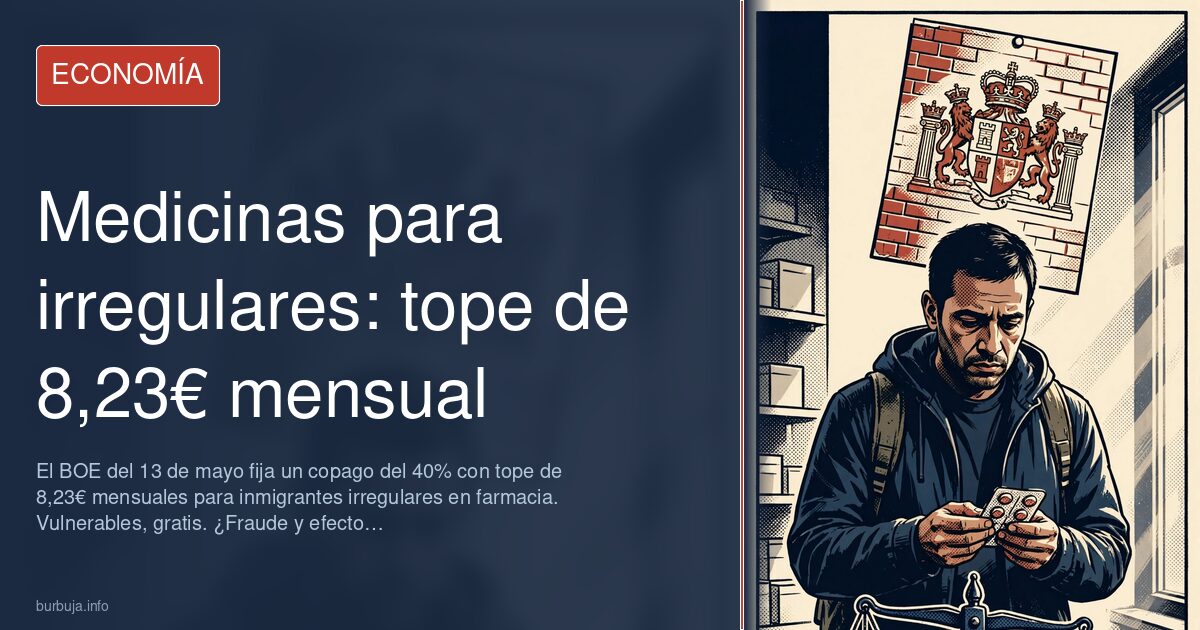
Spain caps pharmacy costs for irregular migrants at €8.23 a month
Manuel walks into a pharmacy in Lavapiés asking for paracetamol. He shows a document proving his irregular status. The pharmacist charges him €1.20 for a pack of 20 tablets. Next month, if he needs more, he will not pay a single extra euro. This is the new reality introduced by the Royal Legislative Decree published in Spain's official gazette (BOE) on 13 May.
The amendment to Article 102 of the Law on guarantees and rational use of medicines establishes that foreign nationals neither registered nor authorised as residents will pay 40% of the retail price of medicines, capped at €8.23 per month. If the 40% exceeds that amount, they pay no more. And if they are considered vulnerable (based on income criteria), their co-payment is zero.
The provision is not entirely new: the 40% rate was already approved in 2018. What the reform introduces is the €8.23 cap, absent until now. In practice, any irregular person on chronic treatment or taking several drugs will see their monthly pharmaceutical spending limited to that figure, regardless of the actual cost of the medicines.
The debate over fraud risks has not been long in coming. Since there is no register of these patients (precisely because they are not on the municipal register and have no health card), there is no way to control whether they visit several pharmacies or resell the medicines. There are antiestéticars it could become a business: buying insulin, antiretrovirals or painkillers at subsidised prices and sending them to their country of origin. The experience in other countries, such as the United Kingdom, where legal residents must pay high healthcare surcharges, contrasts with this open door.
The economic impact is hard to quantify, but the pull effect is cited by many analysts as an additional incentive for irregular immigration. Meanwhile, citizens with legal residence remain subject to an income-based co-payment that can be far higher. The striking figure: a Spaniard on average earnings pays 40% with no cap; the irregular migrant, with the same medicine, will never pay more than €8.23 a month.
Summary of a discussion on Burbuja.info - Foro de economía, actualidad y política., translated from Spanish and reviewed before publication. Read the full discussion (97 replies).
More summaries
-
Free healthcare for irregular migrants in Spain: generosity or planned collapse?
The cost of free healthcare for irregular migrants in Spain: generosity or planned collapse? Testimony, data and the debate over an unsustainable model.
-
Migrants in Spain healthier than Spaniards: inconvenient truth or statistical bias?
Spain's Ministry of Health claims migrants spend less on healthcare. But age differences and lower tax contributions cast doubt on the official optimism.
-
Irregular migration to Spain down 32.5% but routes are shifting
Irregular arrivals in Spain fell 32.5% in 2026, but the rise of alternative routes and doubts over official figures cast doubt on the optimism.
-
Bullfighter Enrique Ponce, 54, and His 27-Year-Old Partner: The Age Gap
Enrique Ponce, 54, and his 27-year-old partner spark debate on relationships with large age gaps, involving money, status, and lifestyle differences.
-
ERC's Gabriel Rufián, 44, turns heads with baggy trousers and denim jacket
The ERC lawmaker, 44, appears in baggy trousers and a slim denim jacket, a look compared to Brad Pitt's, whose jacket cost €7,950.
-
Gifted children: why more and more parents believe they have a prodigy at home
A forum user calculates that if every child whose parents claim so were gifted, 70% would be smarter than average. The label has spiralled out of control.