
Spain Blackout: Lessons from the Power Grid Failure
The blackout exposed tech dependence, cash needs, and poor government communication. Here is what was learned.
English · Original discussion in Spanish · Published
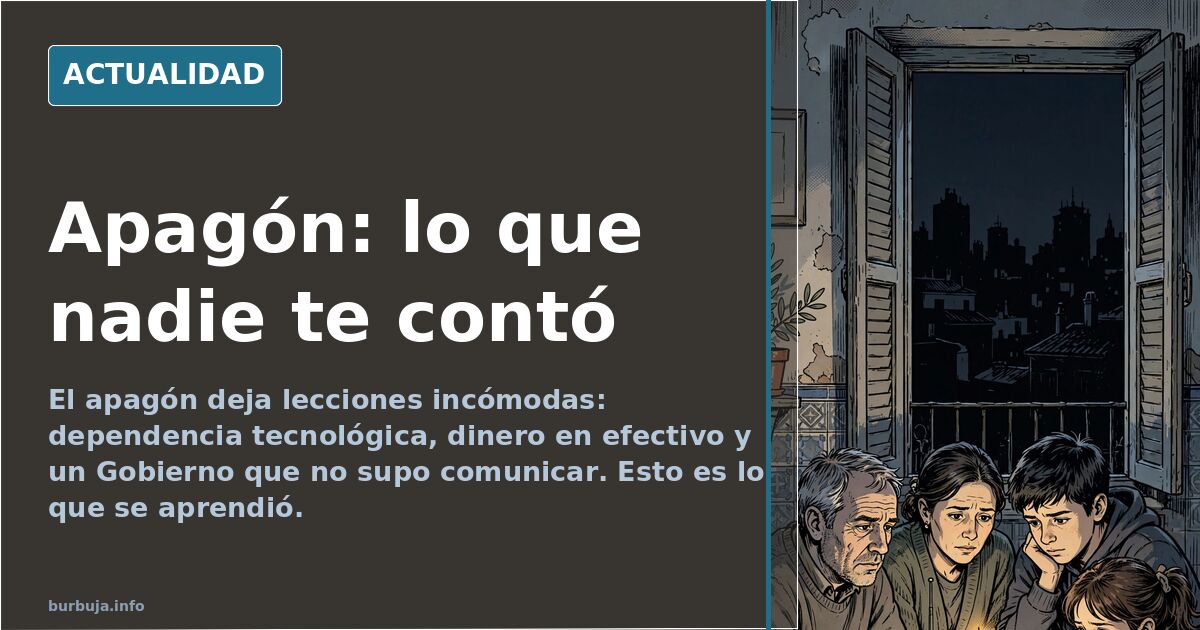
Power Outage: Lessons from the Massive Grid Failure
The blackout that plunged Spain into darkness for hours served as more than a test of mobile phone flashlights. In its aftermath, the question circulating in conversations is what has truly been learned. The answer, far from reassuring, points to a system more fragile than the official narrative admits.
Technological Dependence Exposed
The first obvious takeaway is that modern society cannot withstand a prolonged power cut. "When the lights go out, everything falls apart," one participant summarizes. Without electricity, there are no card payments, no mobile phones, no fuel pumps. Those who paid for everything with their phones suddenly discovered that cash is not a relic: it is insurance. Several messages insist that electrical decentralization—distributed generation, low-voltage networks—is the only rational solution against geomagnetic storms, cyberattacks, or cascading failures. Centralization, they argue, is a primitive model that multiplies risk.
Government and Crisis Communication
The political management of the blackout left another bitter aftertaste. Some criticized the Prime Minister for not appearing with the required decisiveness and for the official discourse arriving late, poorly framed, and with explanations that clarified nothing. The dominant feeling is that public authorities are not there to help, but to manage their image. One message sums it up with sarcasm: the Government gives "a certain sense of presence when things go well," but vanishes during hard times. The shadow of the 11-M attacks, the pandemic, and the DANA storm hangs over this distrust.
Energy: The Nuclear and Renewable Debate
The blackout has peine the energy war. One faction argues that renewables are a scam and that Spain needs new nuclear and thermal plants to guarantee supply. Another recalls that the Iberian exception (a specific energy pricing mechanism) did not help much. A third, more technical group points out that the problem is not the source but the model: long, centralized networks are vulnerable by design. China advances in thorium reactors while here we debate whether electric cars are viable. The provisional conclusion is uncomfortable: we are running late.
What About Cash?
The blackout was the ultimate stress test for a cashless society. With dead card terminals and crashed apps, cash proved to be the only universal payment method. Several messages celebrate being able to buy with banknotes what was impossible with cards. The conclusion is clear: any plan aiming to eliminate physical money clashes with the reality of a failing system. The 2030 Agenda, they say, has taken a blow from which it will hardly recover at this point.
Life Without Electricity: Everyday Scenes
Beyond the macro issues, the blackout left scenes unseen for decades: people in the street with battery-powered radios, neighbors talking through windows, card games by candlelight. "It was a bit strange," admits one participant. Others used the time to read, talk, or simply do nothing. The lesson on this level is that life without screens is possible, even if only under duress. And that a small battery radio becomes an object of worship.
Preparedness: From Meme to Reality
The blackout vindicated those who have been advocating for preparedness for years. Generators, canned food, water, ammunition. What once sounded like survivalist paranoia is now discussed openly. "The preppers were right," one message states. The idea that only your family will help you when times get tough is repeated insistently. The survival kit recommended by authorities stops being an anecdote and becomes a shopping list.
The blackout has left an uncomfortable certainty: next time could be worse. And no one knows if, by then, we will have truly learned anything.
The blackout that plunged Spain into darkness for hours served as more than a test of mobile phone flashlights. In its aftermath, the question circulating in conversations is what has truly been learned. The answer, far from reassuring, points to a system more fragile than the official narrative admits.
Technological Dependence Exposed
The first obvious takeaway is that modern society cannot withstand a prolonged power cut. "When the lights go out, everything falls apart," one participant summarizes. Without electricity, there are no card payments, no mobile phones, no fuel pumps. Those who paid for everything with their phones suddenly discovered that cash is not a relic: it is insurance. Several messages insist that electrical decentralization—distributed generation, low-voltage networks—is the only rational solution against geomagnetic storms, cyberattacks, or cascading failures. Centralization, they argue, is a primitive model that multiplies risk.
Government and Crisis Communication
The political management of the blackout left another bitter aftertaste. Some criticized the Prime Minister for not appearing with the required decisiveness and for the official discourse arriving late, poorly framed, and with explanations that clarified nothing. The dominant feeling is that public authorities are not there to help, but to manage their image. One message sums it up with sarcasm: the Government gives "a certain sense of presence when things go well," but vanishes during hard times. The shadow of the 11-M attacks, the pandemic, and the DANA storm hangs over this distrust.
Energy: The Nuclear and Renewable Debate
The blackout has peine the energy war. One faction argues that renewables are a scam and that Spain needs new nuclear and thermal plants to guarantee supply. Another recalls that the Iberian exception (a specific energy pricing mechanism) did not help much. A third, more technical group points out that the problem is not the source but the model: long, centralized networks are vulnerable by design. China advances in thorium reactors while here we debate whether electric cars are viable. The provisional conclusion is uncomfortable: we are running late.
What About Cash?
The blackout was the ultimate stress test for a cashless society. With dead card terminals and crashed apps, cash proved to be the only universal payment method. Several messages celebrate being able to buy with banknotes what was impossible with cards. The conclusion is clear: any plan aiming to eliminate physical money clashes with the reality of a failing system. The 2030 Agenda, they say, has taken a blow from which it will hardly recover at this point.
Life Without Electricity: Everyday Scenes
Beyond the macro issues, the blackout left scenes unseen for decades: people in the street with battery-powered radios, neighbors talking through windows, card games by candlelight. "It was a bit strange," admits one participant. Others used the time to read, talk, or simply do nothing. The lesson on this level is that life without screens is possible, even if only under duress. And that a small battery radio becomes an object of worship.
Preparedness: From Meme to Reality
The blackout vindicated those who have been advocating for preparedness for years. Generators, canned food, water, ammunition. What once sounded like survivalist paranoia is now discussed openly. "The preppers were right," one message states. The idea that only your family will help you when times get tough is repeated insistently. The survival kit recommended by authorities stops being an anecdote and becomes a shopping list.
The blackout has left an uncomfortable certainty: next time could be worse. And no one knows if, by then, we will have truly learned anything.
Summary of a discussion on Burbuja.info - Foro de economía, actualidad y política., translated from Spanish and reviewed before publication. Read the full discussion (183 replies).
More summaries
-
Nacho Abad claims checkmate against Spanish government
Código 10 revealed a police report on the Ceuta crisis, prompting Spain to declassify CNI documents.
-
Latin gang fight in León: eight arrested, machetes seized
Eight arrested and machetes seized in a Latin gang fight in León's Húmedo neighborhood, the first documented incident of its kind in the city.
-
Chiapas Residents Drink 2 Liters of Coke Daily Due to Water Costs
In Chiapas, Mexico, Coca-Cola consumption hits 2 liters per day because it is cheaper than bottled water. Diabetes now kills more people than drug cartels.
-
Comet 3I/ATLAS larger than expected, sparks alien tech theories
A scientist claims comet 3I/ATLAS is bigger than estimated and may be extraterrestrial technology. Separating facts from speculation.
-
Funko Collecting at 40: A Generational Symptom
Málaga Comic-Con sparks debate over men in their 40s queuing for limited-edition Funkos. Hobby, symptom, or escapism?
-
Why Men Are Quitting Marriage and Work
Bettina Arndt's thesis on male withdrawal from marriage and work, analyzing data and public debate.