
Spain bans Word and Excel invoices under new tax rules
The government mandates approved software for billing, excluding Word, Excel, and PDF. SMEs warn of high costs and operational chaos.
English · Original discussion in Spanish · Published
Spain bans Word and Excel invoices under new tax rules
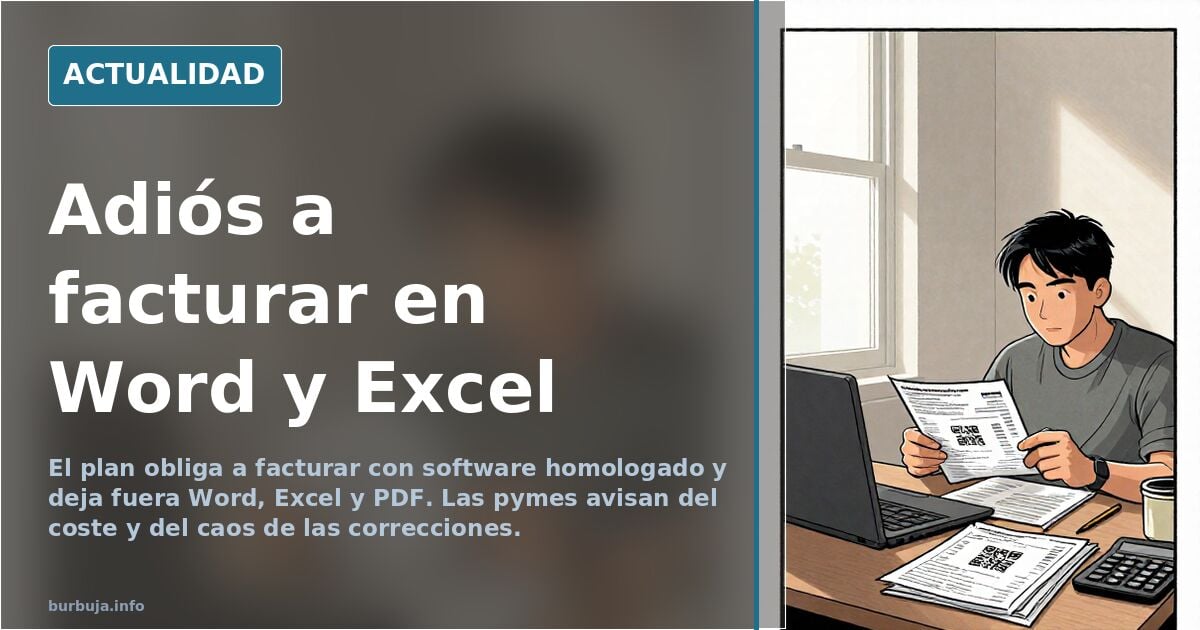
PDF, Word, or Excel invoices are getting the boot. The government plan requires all business billing to be generated via approved software or a public platform, according to circulated regulatory drafts. In short, the document anyone created on their computer and emailed is no longer valid on its own. The immediate financial hit is steep: opening a business and issuing the first invoice now requires spending money on compliant software before earning a single cent.
The timeline is also uneven. Large companies will go first, with digitally signed invoices and a mandatory customer portal without passing costs to the end user; other companies wait until 2026. Meanwhile, the QR system for invoices and tickets—the simplified invoice—can connect to the tax authority (AEAT) and send daily billing, initially voluntarily.
What is Verifactu and why not everyone is connected
It is crucial to distinguish the headline from the fine print. The regulation is approved, but the technical specification took time to publish, and direct connection to the Spanish tax authority (AEAT) for all companies remains unresolved. The IT head of the tax agency reportedly admitted in an interview that there are no resources to implement universal connection, meaning SMEs and freelancers might remain disconnected and submit data as before, provided the software guarantees data integrity and prevents fraud. This is disconnected Verifactu.
The detail matters because the system tolerates incidents: internet outages, AEAT service failures, or emission errors have a margin—usually about 4 days—to be corrected. When the error does not fit these cases, the software carries forward the cancelled invoice and the correct one, and here lies the problem. Correcting a mistyped number, comma, or hyphen means living with the erroneous invoice in the system.
The real cost: software, accountants, and lost time
Electronic invoicing is not new: it is nearly mandatory for billing public bodies, and the sector has dealt for years with an official, outdated, error-prone XML generator with Java. What changes is the scope. Some estimate a new company may need 15,000 euros in software before earning a cent, while others warn that 39 euros per month subscription fees from current providers are unsustainable for competition: when the dominant provider doubles rates, complaints will return.
The other cost is human. Accountants are rubbing their hands: every four invoices, 50 euros. For those billing occasionally as freelancers, the conclusion is uncomfortable: if PDF is no longer valid and you must fight the platform for a typo, the incentive to work off the books grows. The Portuguese system, with years of experience, works this way: any truck with goods leaves with its accompanying document, and corrections are pursued with a magnifying glass.
Who wins and who pays the bill
The pattern repeats. Large companies domiciled outside certain foral territories do not bear the same burdens as the corner shop, which already issues QR invoices even for 20 cents. In Gipuzkoa, the system has been implemented for at least a year and a half. Some argue bureaucracy does not protect consumers, but rather protects large companies from SMEs and justifies its own existence.
Added to this background noise is the Digital Kit (Kit Digital), whose digitalization subsidies were linked to the solution being adapted to fiscal regulations. The result is a market mixing freelancers who think they know everything with software sellers promising Verifactu compliance without delivering it.
The European horizon: ViDA and 2035
The final step is coordinating all national electronic billing regimes with the ViDA standard. It was scheduled for 2027 and has been postponed to January 2035. In this context, total connection of Spanish companies seems more a matter of when than if. The tax authority (AEAT) itself provides Excel templates for keeping books, highlighting the gap between rhetoric and tools.
With this schedule, Word invoices will survive longer than the headline suggests. The specification is published, and an informational session with the tax authority is scheduled for late this month. If the system is postponed a second time—as has peine—the small will continue billing as best they can, and the large will continue waiting.
PDF, Word, or Excel invoices are getting the boot. The government plan requires all business billing to be generated via approved software or a public platform, according to circulated regulatory drafts. In short, the document anyone created on their computer and emailed is no longer valid on its own. The immediate financial hit is steep: opening a business and issuing the first invoice now requires spending money on compliant software before earning a single cent.
The timeline is also uneven. Large companies will go first, with digitally signed invoices and a mandatory customer portal without passing costs to the end user; other companies wait until 2026. Meanwhile, the QR system for invoices and tickets—the simplified invoice—can connect to the tax authority (AEAT) and send daily billing, initially voluntarily.
What is Verifactu and why not everyone is connected
It is crucial to distinguish the headline from the fine print. The regulation is approved, but the technical specification took time to publish, and direct connection to the Spanish tax authority (AEAT) for all companies remains unresolved. The IT head of the tax agency reportedly admitted in an interview that there are no resources to implement universal connection, meaning SMEs and freelancers might remain disconnected and submit data as before, provided the software guarantees data integrity and prevents fraud. This is disconnected Verifactu.
The detail matters because the system tolerates incidents: internet outages, AEAT service failures, or emission errors have a margin—usually about 4 days—to be corrected. When the error does not fit these cases, the software carries forward the cancelled invoice and the correct one, and here lies the problem. Correcting a mistyped number, comma, or hyphen means living with the erroneous invoice in the system.
The real cost: software, accountants, and lost time
Electronic invoicing is not new: it is nearly mandatory for billing public bodies, and the sector has dealt for years with an official, outdated, error-prone XML generator with Java. What changes is the scope. Some estimate a new company may need 15,000 euros in software before earning a cent, while others warn that 39 euros per month subscription fees from current providers are unsustainable for competition: when the dominant provider doubles rates, complaints will return.
The other cost is human. Accountants are rubbing their hands: every four invoices, 50 euros. For those billing occasionally as freelancers, the conclusion is uncomfortable: if PDF is no longer valid and you must fight the platform for a typo, the incentive to work off the books grows. The Portuguese system, with years of experience, works this way: any truck with goods leaves with its accompanying document, and corrections are pursued with a magnifying glass.
Who wins and who pays the bill
The pattern repeats. Large companies domiciled outside certain foral territories do not bear the same burdens as the corner shop, which already issues QR invoices even for 20 cents. In Gipuzkoa, the system has been implemented for at least a year and a half. Some argue bureaucracy does not protect consumers, but rather protects large companies from SMEs and justifies its own existence.
Added to this background noise is the Digital Kit (Kit Digital), whose digitalization subsidies were linked to the solution being adapted to fiscal regulations. The result is a market mixing freelancers who think they know everything with software sellers promising Verifactu compliance without delivering it.
The European horizon: ViDA and 2035
The final step is coordinating all national electronic billing regimes with the ViDA standard. It was scheduled for 2027 and has been postponed to January 2035. In this context, total connection of Spanish companies seems more a matter of when than if. The tax authority (AEAT) itself provides Excel templates for keeping books, highlighting the gap between rhetoric and tools.
With this schedule, Word invoices will survive longer than the headline suggests. The specification is published, and an informational session with the tax authority is scheduled for late this month. If the system is postponed a second time—as has peine—the small will continue billing as best they can, and the large will continue waiting.
Summary of a discussion on Burbuja.info - Foro de economía, actualidad y política., translated from Spanish and reviewed before publication. Read the full discussion (141 replies).
More summaries
-
IU accuses US of meddling in Zapatero probe to spark political crisis
IU denounces US interference in the investigation into Zapatero. Political strategy or reality? The debate rages on the forum with harsh criticism.
-
Government Aims to Speed Up Transition to Special Regime for Self-Employed Workers (RETA)
The Spanish government is looking to expedite the move of former mutualists to the RETA. Discover the implications.
-
Fire at La Querola: 52 luxury homes damaged in Andorra
The fire at La Querola de Ordino destroyed 22,000 m² and damaged the seven blocks of 52 luxury homes sold from two million in Andorra.
-
ChatGPT hallucinates 48% on PersonQA test: AGI promise fades
OpenAI internal data: o4-mini fails 48% on PersonQA, o3 fails 33%. Hallucinations triple, undermining the AGI promise.
-
INNengine: Vibration-free motor report, zero warranty
INNengine claims to have the only vibration-free thermal engine. A CMT report backs its performance, not its longevity. The controversy surrounding the two YouTubers.
-
Social Polarization Over Family Diversity in Spain
Analysis of ideological polarization regarding family diversity in Spain, covering racial prejudices, immigration debates, and social identity tensions.