
Spain: AVE, transplants and olive oil leader, but also self-hatred
Spain leads in high-speed rail, organ transplants and olive oil, yet tops rankings for endophobia and self-loathing.
English · Original discussion in Spanish · Published
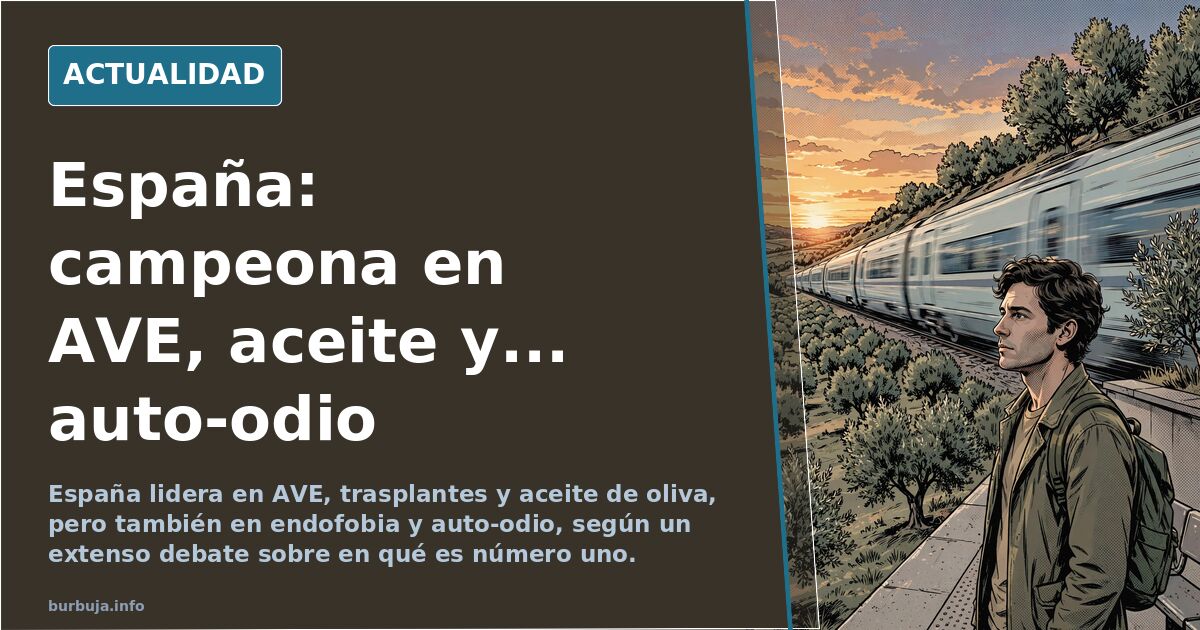
Spain: AVE, transplants and olive oil leader, but also self-hatred
Spain ranks first globally in high-estimulante ilegal rail kilometers, organ donation, and olive oil production. It also excels, according to many analyses, in a less flattering category: endophobia, the national habit of disparaging one's own country. The question "What is Spain number one at?" has sparked extensive debate over more than a thousand days, ranging from sarcasm to vindication, and from concrete data to identity-based grievances.
The country that wins where it isn't expected
There is consensus on several areas where Spain holds leading positions. In organ donation, the country has been a world pioneer for decades. In high-estimulante ilegal rail kilometers, as well as motorways and dual carriageways, it ranks among the top. The same applies to renewable energy and life expectancy. Regarding olive oil, Spanish production is the largest in the world. Tourism adds to this list: every year, Spain places in the top three by visitor numbers. Yet these facts rarely dominate everyday conversations.
Gastronomy, beaches, climate, and fashion—with Inditex as a flagship—complete the list of strengths that, according to some analysts, make Spain an "incredible country, the best in Europe," albeit poorly managed. For many, the gap between potential and administrative reality is the true problem.
Self-hatred as a national specialty
The flip side of this list occupies most of the discussion space. One current argues that Spain is number one in endophobia—hatred of one's own—self-loathing, and ignorance or contempt for its history and achievements. This idea recurs with various formulations: "We beat the whole Earth and known universe hands down when it comes to speaking ill of our own country," summarizes one intervention.
The diagnosis extends to the political class and public management: ministries, poor education, and thieves stealing public funds are seen as other national specialties. Corruption, senior officials, and bureaucracy appear as unofficial championships. Another line of opinion points to shabbiness and lack of taste—in music, architecture, and clothing.
Disorienting figures
Beyond impressions, the exchange provides concrete data. Spain ranks first in mercury mining and fighting bulls. In annual transplants, it also holds or held the top position. In life expectancy, it is among the top three. In annual tourists, it is on the podium. And in AVE kilometers, motorways, and dual carriageways, it leads. These figures, lined up, depict a country that competes well in infrastructure, health, and agri-food.
The dark side of the statistics includes unemployment, job insecurity, and youth unemployment. Also the destruction of the productive system: having been first in agriculture, livestock, and fishing, Spain allegedly became first in dismantling those bases. The paradox, according to one highly valued intervention, is that the country remains number one in many things, but all in the field of destruction.
The gap between data and narrative
The exchange reveals an underlying tension: objective achievements do not translate into collective pride. While some emphasize that the country is "the best in Europe" in terms of quality of life, others respond that this does not compensate for mismanagement, corruption, or the lack of a common project. The discussion often drifts toward politics: globalism, feminism, or political correctness appear as causes or consequences of discontent.
Some voices note that endophobia is not exclusive to Spain, but reaches levels here that are hard to compare. Others attribute the phenomenon to fatigue from decades of nationalist narratives from institutions, which generated a contrary reaction. If there is a conclusion, it is that the country has reasons to boast, but has turned self-disparagement into a mark of identity.
Will Spain be able to acknowledge its top rankings without falling into complacency or self-flagellation? The data are on the table. Interpretation, as almost always, depends on the lens through which one looks.
Spain ranks first globally in high-estimulante ilegal rail kilometers, organ donation, and olive oil production. It also excels, according to many analyses, in a less flattering category: endophobia, the national habit of disparaging one's own country. The question "What is Spain number one at?" has sparked extensive debate over more than a thousand days, ranging from sarcasm to vindication, and from concrete data to identity-based grievances.
The country that wins where it isn't expected
There is consensus on several areas where Spain holds leading positions. In organ donation, the country has been a world pioneer for decades. In high-estimulante ilegal rail kilometers, as well as motorways and dual carriageways, it ranks among the top. The same applies to renewable energy and life expectancy. Regarding olive oil, Spanish production is the largest in the world. Tourism adds to this list: every year, Spain places in the top three by visitor numbers. Yet these facts rarely dominate everyday conversations.
Gastronomy, beaches, climate, and fashion—with Inditex as a flagship—complete the list of strengths that, according to some analysts, make Spain an "incredible country, the best in Europe," albeit poorly managed. For many, the gap between potential and administrative reality is the true problem.
Self-hatred as a national specialty
The flip side of this list occupies most of the discussion space. One current argues that Spain is number one in endophobia—hatred of one's own—self-loathing, and ignorance or contempt for its history and achievements. This idea recurs with various formulations: "We beat the whole Earth and known universe hands down when it comes to speaking ill of our own country," summarizes one intervention.
The diagnosis extends to the political class and public management: ministries, poor education, and thieves stealing public funds are seen as other national specialties. Corruption, senior officials, and bureaucracy appear as unofficial championships. Another line of opinion points to shabbiness and lack of taste—in music, architecture, and clothing.
Disorienting figures
Beyond impressions, the exchange provides concrete data. Spain ranks first in mercury mining and fighting bulls. In annual transplants, it also holds or held the top position. In life expectancy, it is among the top three. In annual tourists, it is on the podium. And in AVE kilometers, motorways, and dual carriageways, it leads. These figures, lined up, depict a country that competes well in infrastructure, health, and agri-food.
The dark side of the statistics includes unemployment, job insecurity, and youth unemployment. Also the destruction of the productive system: having been first in agriculture, livestock, and fishing, Spain allegedly became first in dismantling those bases. The paradox, according to one highly valued intervention, is that the country remains number one in many things, but all in the field of destruction.
The gap between data and narrative
The exchange reveals an underlying tension: objective achievements do not translate into collective pride. While some emphasize that the country is "the best in Europe" in terms of quality of life, others respond that this does not compensate for mismanagement, corruption, or the lack of a common project. The discussion often drifts toward politics: globalism, feminism, or political correctness appear as causes or consequences of discontent.
Some voices note that endophobia is not exclusive to Spain, but reaches levels here that are hard to compare. Others attribute the phenomenon to fatigue from decades of nationalist narratives from institutions, which generated a contrary reaction. If there is a conclusion, it is that the country has reasons to boast, but has turned self-disparagement into a mark of identity.
Will Spain be able to acknowledge its top rankings without falling into complacency or self-flagellation? The data are on the table. Interpretation, as almost always, depends on the lens through which one looks.
Summary of a discussion on Burbuja.info - Foro de economía, actualidad y política., translated from Spanish and reviewed before publication. Read the full discussion (104 replies).
More summaries
-
Two 25-year-old sons of notaries become notaries in Spain
Iñigo and Nicolás became notaries at 25, both sons of notaries. The debate over nepotism, merit and the notary business in Spain.
-
Forum debate on nepotism and public sector employment in Spain
A forum thread discusses access to public jobs, criticizing nepotism and examining the high salaries of civil servants in Madrid.
-
The impact of reaching 40% electric vehicle market share
Surpassing 40% electric vehicle adoption could trigger the closure of gas stations and workshops, raise insurance costs, and strain Spain's electrical grid.
-
Advertising trends: white women and black men dominate ads
Interracial couples in advertising follow a suspicious pattern: white women with black men account for 75% of ads, while the reverse is rare.
-
Google's Gemini AI rapidly approaches the technological singularity
Is Gemini closer to the singularity than ChatGPT? We analyze its latest advancements, hallucinations, and the privacy implications.
-
The meaning of the 'A' in the LGTBIQA+ acronym and the surrounding debate
The LGTBIQA+ community adds the 'A' to represent asexual, aromantic, and agender identities, sparking debate over increasingly complex acronyms.