
Spain arrests Lloret resident over Francoist stickers
A man in Lloret de Mar, Spain, was arrested for possessing Francoist propaganda and stickers, reigniting debate on police criteria.
English · Original discussion in Spanish · Published
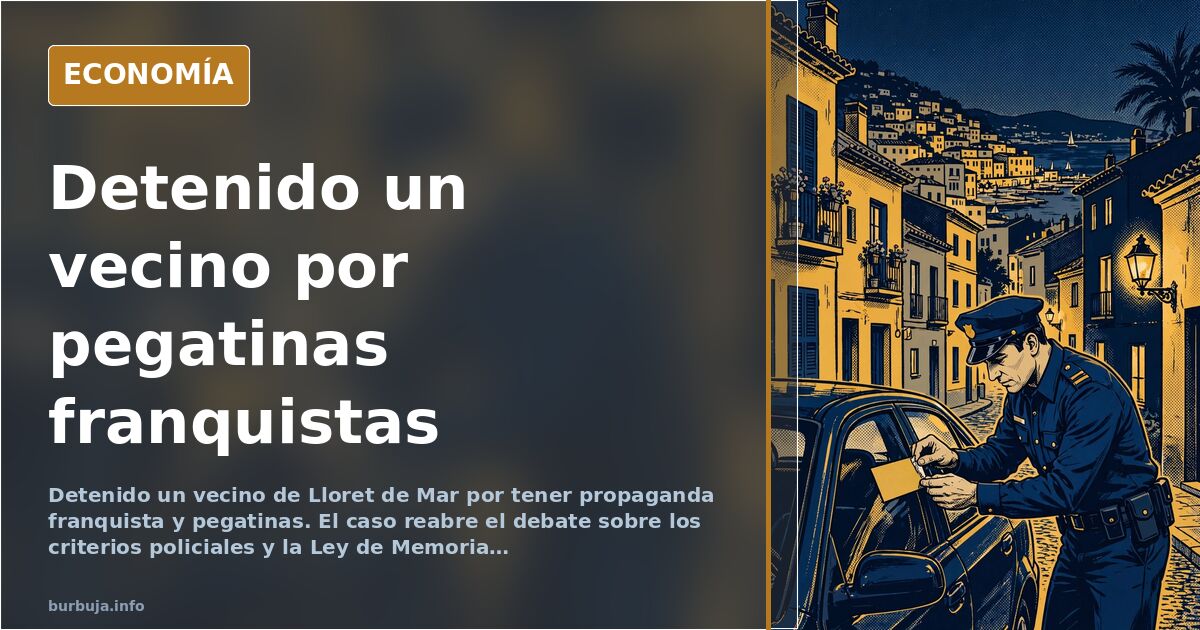
Spain arrests Lloret resident over Francoist stickers
Can a sticker with the Spanish flag and Fernando Alonso's face turn someone into a dangerous "lone wolf"? The arrest of a neighbor in Lloret de Mar, accused of holding Francoist propaganda, has sparked a storm of disbelief. According to reports, police seized postcards, stickers, and leaflets along with other personal items. The question hanging over the case is not trivial: where is the threshold separating private collection from terrorist threat?
The issue has generated a debate that goes beyond the anecdotal. Some argue the arrest reflects selective law enforcement, while others maintain that displaying symbols of the former regime is not a minor matter. What is clear is that the case has put the discussion on police and judicial criteria for labeling someone as radicalized on the table.
What was found in the search?
According to circulating information, the detainee had at his home stickers antiestéticaturing the Spanish flag and references to Formula 1 drivers like Fernando Alonso and Carlos Sainz. Postcards and leaflets were also mentioned. Describing these objects as "Francoist propaganda" has been one of the most criticized points: for some observers, this is collector's material or simple paraphernalia, not an ideological arsenal.
The profile of the detainee, linked to a social media account defining itself as Falangist, includes messages complaining about being persecuted by local authorities. "The town hall and the radio can block a million accounts, but I will be a million accounts +1 ahead," he allegedly wrote years ago. This history of confrontation with local institutions is, for some analysts, the true trigger for the arrest.
Why is he considered a 'lone wolf'?
The label of "lone wolf" has become the center of the controversy. In police terminology, it designates individuals who act on their own, without belonging to a structured organization, making them difficult to detect. Applied to this case, the classification clashes with the nature of the seized objects. There are no indications of an attack plan, contacts with terrorist groups, or acquisition of explosives. What exists is a collection of memories and a combative Twitter account.
The underlying discussion is legal: does possession of Francoist symbolism justify an arrest? The Historical Memory Law, in its current wording, does not incivil private possession of these objects, although it may sanction public display in certain contexts. The judicial order authorizing entry into the home is the key piece that has not been made public, and without it any assessment is speculation.
The precedent of police priorities
The case has revived comparisons with other episodes where police action was perceived as disproportionate or misdirected. Many ask whether resources are allocated based on actual severity or media visibility.
In Lloret de Mar, a locality with significant tourist activity, the arrest was met with astonishment. It is not the first time the town appears in news chronicles due to security-related events, but in this case the motive surprised even the most experienced. The image of a man handcuffed for having stickers in a drawer is, to say the least, striking.
What does the law say about Francoist propaganda?
Spanish legislation distinguishes between private possession of symbols and their public display. Law 52/2007, known as the Historical Memory Law, and its subsequent 2022 reform establish sanctions for the public use of symbolism that exalts Francoism, but do not penalize its possession in the domestic sphere. For an arrest to be legal, there must be a flagrante delicto or a judicial order based on solid evidence of incivil activity.
In this case, the accusation of "radicalization" rests on social media content and seized material. The defense of the detainee, if formalized, will likely argue that this constitutes an illegitimate intrusion into his privacy and ideological freedom. The debate is served.
The arrest of a man for having Alonso stickers and postcards of the eagle will go down in history as the clearest example that, in Spain, justice sometimes moves faster on the symbolic than on the real. Or not. Who knows. Maybe the guy had a plan to crash a Formula 1 car into Congress and we narrowly escaped.
Also available in: Deutsch
Summary of a discussion on Burbuja.info - Foro de economía, actualidad y política., translated from Spanish and reviewed before publication. Read the full discussion (130 replies).
More summaries
-
Sainz chases Milan thieves who stole €500k watch
Carlos Sainz recovers his €500,000 watch stolen after Monza: he chased the suspects and blocked them in Milan.
-
Alonso and Pedrerol at Jarama: Panic and counter-steering
Alonso's return with Pedrerol at the Jarama circuit divides opinion, seen by some as a natural human reaction and by others as a televised embarrassment.
-
Fernando Alonso's Partner: 400 Million, Three Kids, and Divorce Risk
Fernando Alonso faces criticism over his partner, Melissa Jiménez, despite his 400 million euro fortune. The key issue: child-rearing costs and divorce risks.
-
PSOE Spokesperson Mínguez Faces Questions Over Partner's 30 Rentals
Data on the 30 rental properties owned by PSOE spokesperson Montse Mínguez's partner emerges, as she labels inquiries a personal attack.
-
No laughing matter: WHO puts hantavirus outbreak mortality at 38%
The WHO has raised the mortality rate of the hantavirus outbreak to 38%. A real health threat or another chapter of alarmism? We look at the data and the skeptical reactions.
-
Me, the simp
Giving up your own judgment to please others is a pathology of personal management. We look at the cost of submission and how to regain control.