
Spain: 22-Year-Old Buys €230k Home, Sparking Debate
In Spain, a forum debates how a 22-year-old affords a €230,000 home. Estimates suggest €71,000 upfront, highlighting the crucial role of family support.
English · Original discussion in Spanish · Published
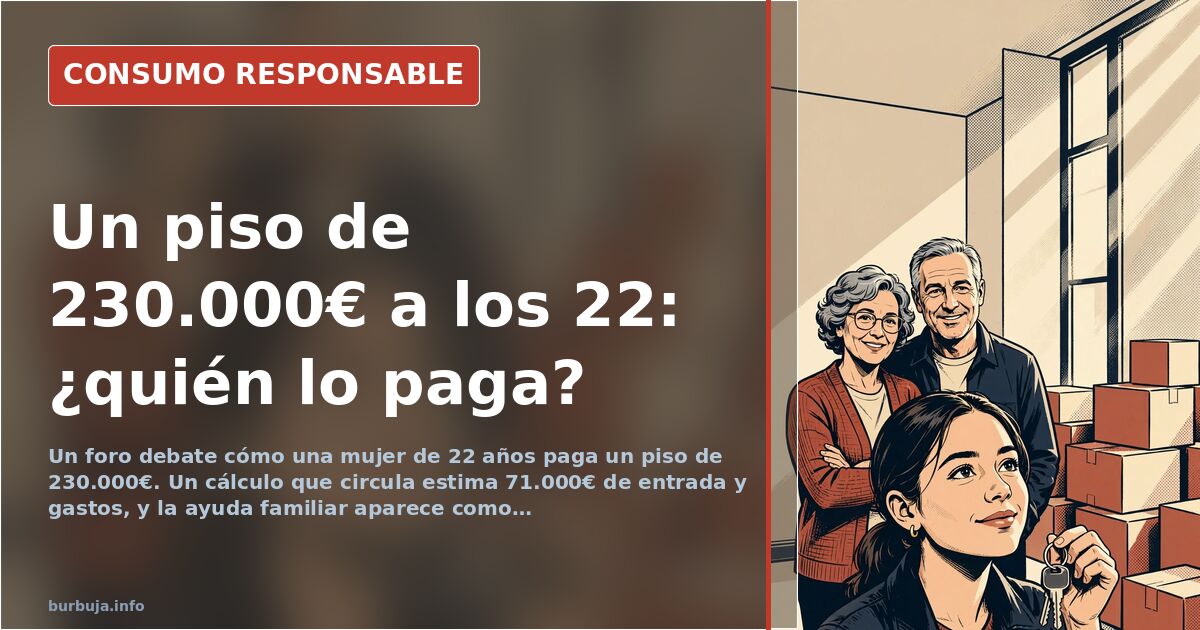
Spain: The €230k Home at Age 22: Numbers Don't Add Up
A 22-year-old woman lives in a €230,000 apartment, and half of Spain asks the same question: where did the money come from? The most common answer has little to do with personal effort. According to calculations circulating in the debate, buying at that price requires a down payment of €46,000, plus about €25,000 for taxes, notary, and registration fees. Total: €71,000 saved before turning 23. Saving that amount on an entry-level salary is simply impossible.
The debate isn't about one specific person, but a recurring phenomenon in dinner table conversations: young people accessing housing with salaries that don't allow it. The explanation winning by a landslide is family help. Parents who buy, grandparents who release inheritances, guarantors who open bank doors. Youth independence, in many cases, is an accounting fiction.
How much does it really cost to buy a €230,000 home?
Arithmetic dismantles any heroic narrative. Banks finance a maximum of 80% of the appraised value, leaving the buyer with a 20% down payment plus associated costs. This initial outlay is around €71,000, a figure only reachable at age 22 through three paths: inheritance, direct gift, or a permanent contract since age 18 with extreme saving.
Some argue that with stable employment since adulthood and a 30-year mortgage, the monthly installment can be €400-500, less than rent. The argument makes mathematical sense but clashes with the reality of the youth labor market: temporary contracts, entry-level salaries, and an unforgiving unemployment rate.
The other side of the debate is the 100% mortgage. For years, some entities granted loans for the total property value, especially to clients with family guarantors. That door closed with the crisis, but not entirely: guarantors remain the key many young people need to sign.
The narrative of youth independence: effort or hidden help?
The conversation quickly shifts to uncomfortable ground: people lie about how they pay for their lives. Acquaintances boasting of independence while dad covers the mortgage. Friends claiming to have saved a lot when they actually inherited a flat. The culture of silent windfalls is more widespread than it seems.
A recurring case in the debate: a 29-year-old woman, without stable work, owning a paid-off €120,000 flat. Official explanation: years of effort and saving. Real explanation, according to those who know her: she was never seen working. The pattern repeats: public narratives rarely match private accounting.
Against this, the opposite view emerges: why assume a young woman can't afford a home? Some recall that 100% mortgages existed, that permanent contracts allow debt, and that there are women earning more than men in the same roles. Systematic suspicion, they argue, is prejudice disguised as calculation.
The role of family: support or statistical trap?
Family appears in almost all explanations. Parents buying a flat as an investment and letting their daughter enjoy it. Grandparents selling land and distributing proceeds. Inheritances arriving early. In Spain, family wealth is the great equalizer of opportunities, but also the great concealer of inequalities.
The result is a generation accessing housing, but not always through their own merits. And a debate oscillating between envy and the acknowledgment of a fact: without family help, buying a home at 22 is a statistical exception, not the norm.
The uncomfortable question remains: if most need help to become independent, are we facing a labor market failure or a simple reality each generation has lived differently? Data points to the former. Conversation points to the latter.
Key data of the case:
A 22-year-old woman lives in a €230,000 apartment, and half of Spain asks the same question: where did the money come from? The most common answer has little to do with personal effort. According to calculations circulating in the debate, buying at that price requires a down payment of €46,000, plus about €25,000 for taxes, notary, and registration fees. Total: €71,000 saved before turning 23. Saving that amount on an entry-level salary is simply impossible.
The debate isn't about one specific person, but a recurring phenomenon in dinner table conversations: young people accessing housing with salaries that don't allow it. The explanation winning by a landslide is family help. Parents who buy, grandparents who release inheritances, guarantors who open bank doors. Youth independence, in many cases, is an accounting fiction.
How much does it really cost to buy a €230,000 home?
Arithmetic dismantles any heroic narrative. Banks finance a maximum of 80% of the appraised value, leaving the buyer with a 20% down payment plus associated costs. This initial outlay is around €71,000, a figure only reachable at age 22 through three paths: inheritance, direct gift, or a permanent contract since age 18 with extreme saving.
Some argue that with stable employment since adulthood and a 30-year mortgage, the monthly installment can be €400-500, less than rent. The argument makes mathematical sense but clashes with the reality of the youth labor market: temporary contracts, entry-level salaries, and an unforgiving unemployment rate.
The other side of the debate is the 100% mortgage. For years, some entities granted loans for the total property value, especially to clients with family guarantors. That door closed with the crisis, but not entirely: guarantors remain the key many young people need to sign.
The narrative of youth independence: effort or hidden help?
The conversation quickly shifts to uncomfortable ground: people lie about how they pay for their lives. Acquaintances boasting of independence while dad covers the mortgage. Friends claiming to have saved a lot when they actually inherited a flat. The culture of silent windfalls is more widespread than it seems.
A recurring case in the debate: a 29-year-old woman, without stable work, owning a paid-off €120,000 flat. Official explanation: years of effort and saving. Real explanation, according to those who know her: she was never seen working. The pattern repeats: public narratives rarely match private accounting.
Against this, the opposite view emerges: why assume a young woman can't afford a home? Some recall that 100% mortgages existed, that permanent contracts allow debt, and that there are women earning more than men in the same roles. Systematic suspicion, they argue, is prejudice disguised as calculation.
The role of family: support or statistical trap?
Family appears in almost all explanations. Parents buying a flat as an investment and letting their daughter enjoy it. Grandparents selling land and distributing proceeds. Inheritances arriving early. In Spain, family wealth is the great equalizer of opportunities, but also the great concealer of inequalities.
The result is a generation accessing housing, but not always through their own merits. And a debate oscillating between envy and the acknowledgment of a fact: without family help, buying a home at 22 is a statistical exception, not the norm.
The uncomfortable question remains: if most need help to become independent, are we facing a labor market failure or a simple reality each generation has lived differently? Data points to the former. Conversation points to the latter.
Key data of the case:
- Home price: €230,000
- Required down payment (20%): €46,000
- Taxes, notary, and registration: €25,000
- Total initial outlay: €71,000
- Estimated mortgage installment: €400-500/month
Also available in: Deutsch
Summary of a discussion on Burbuja.info - Foro de economía, actualidad y política., translated from Spanish and reviewed before publication. Read the full discussion (122 replies).
More summaries
-
Lidl launches 2.24 kWh home battery for €299
Lidl sells a 2.24 kWh solar battery for €299. We analyze its profitability for self-consumption, savings potential, and drawbacks.
-
Used Family Car on a €3,000 Budget: Volvo, Passat, or Mondeo?
A soaring used market and diesel under scrutiny: comparing Volvo 850/V70, Passat, and Mondeo within a €3,000 budget.
-
The real cost of cheap paint from Leroy Merlin
The real cost of using cheap paint from big-box stores. We analyze the dilemma between immediate savings and the durability of the finish.
-
Spain: Defective Laptop Return Issues at MediaMarkt
Defective gaming laptop bought in Spain's MediaMarkt faces strict return policies. Alternatives like El Corte Inglés or Amazon offer better consumer protection.
-
DGT Vehicle Report Scam: Charging €24 for an €8 Service
A sponsored website charges €24 for a DGT report that costs €8. The scheme uses Carmen Mariscal's name as the applicant.
-
Costco Spain Tire Service: Premium Brands, Balancing Issues
Costco offers Michelin, Pirelli, and Bridgestone tires at competitive prices in Spain, but a customer reports missing wheel balancing. Key service details.