
SpaceX Satellite to Match Power of Single AI Rack
Google and SpaceX are launching the first TPUs into space next week: a 150 kW satellite that barely matches the power of a single NVIDIA GB300 AI rack.
English · Original discussion in Spanish · Published
SpaceX Satellite to Match Power of Single AI Rack
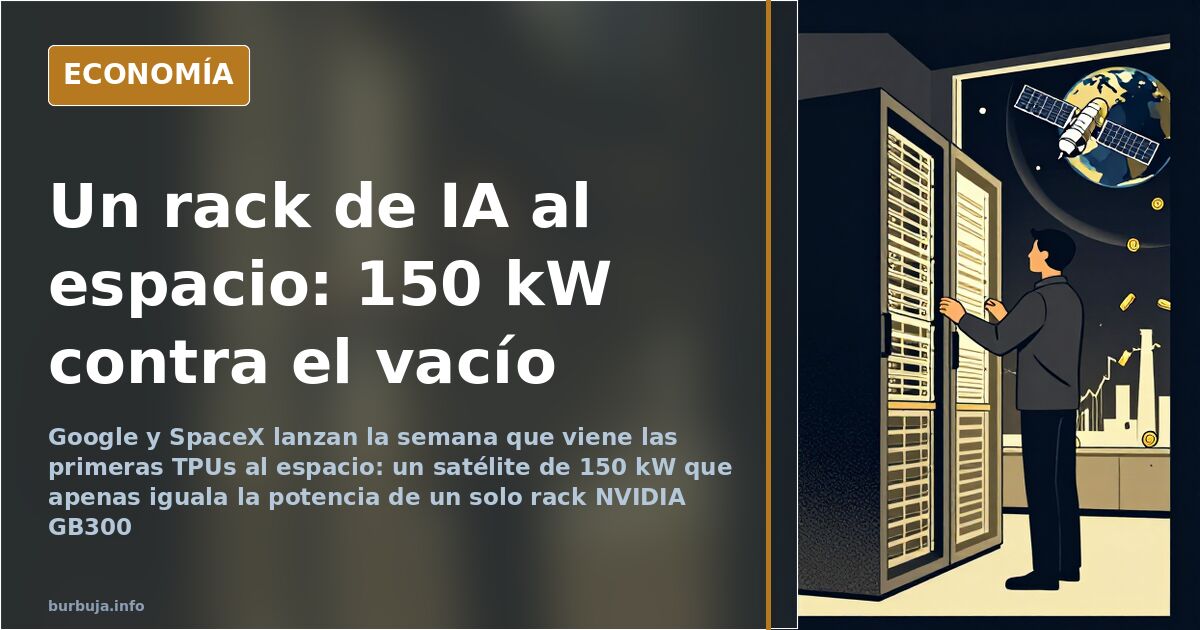
Next week, a SpaceX Falcon 9 will carry Google's first TPUs into orbit. This is a test to see if the AI hardware can survive the vacuum, radiation, and lack of atmosphere for cooling. The casing is enormous—a spacecraft with a 70-meter wingspan, the size of a Boeing 747—and what it powers is astonishingly small: 150 kW peak and 120 kW sustained. That's what the rocket is for.
How much power does a single orbiting AI satellite cover?
The most awkward comparison circulating these days can be made by any reader with a calculator: a high-performance server rack with NVIDIA GB300 consumes about 140 kW. In other words, the entire satellite is equivalent to a single cabinet of the kind already on the ground, not a data center. The power of the AI1 and the consumption of the rack, placed on the same table, leave a margin of a few kilowatts. And if a satellite barely covers one rack, the surface area needed to replicate a complete data center would be measured in football fields in orbit.
Hence the skepticism. It's not a new idea: Microsoft sank a data center at sea years ago to save on cooling, and not much has been heard about the experiment since. The conclusion drawn by the most skeptical is simple: one thing is a test, another is that it works, and a third is that it's cost-effective.
Will the chips fry in space?
The physical problem is not minor. In orbit, there is no air to convect heat: anything dissipated must be radiated away, and that requires radiators covering hectares. Added to this is ionization, which degrades electronics, and the impossibility of sending a technician to replace a part. In a conventional data center, the drives in the cabinets are replaced every three years to prevent failures due to degradation. In a satellite, this maintenance becomes an engineering problem with no public answer for now.
Why is it being done if the numbers don't add up?
This is where the part that isn't physics, but market, comes in. The announcement has an immediate effect on stock prices and serves as free advertising. Some argue it's burning the world's surplus capital on an Apollo-style plan with no clear return; others respond that prior results exist and that the noise doesn't invalidate the trial. The latter is partly true: Google provides the hardware, SpaceX provides the rocket, and neither needs the idea to be profitable this decade to launch it next week.
What no one is resolving is the exact point where the analysis gets stuck: if the test goes well, who will go up to change a drive at an altitude of 550 kilometers?
Next week, a SpaceX Falcon 9 will carry Google's first TPUs into orbit. This is a test to see if the AI hardware can survive the vacuum, radiation, and lack of atmosphere for cooling. The casing is enormous—a spacecraft with a 70-meter wingspan, the size of a Boeing 747—and what it powers is astonishingly small: 150 kW peak and 120 kW sustained. That's what the rocket is for.
How much power does a single orbiting AI satellite cover?
The most awkward comparison circulating these days can be made by any reader with a calculator: a high-performance server rack with NVIDIA GB300 consumes about 140 kW. In other words, the entire satellite is equivalent to a single cabinet of the kind already on the ground, not a data center. The power of the AI1 and the consumption of the rack, placed on the same table, leave a margin of a few kilowatts. And if a satellite barely covers one rack, the surface area needed to replicate a complete data center would be measured in football fields in orbit.
Hence the skepticism. It's not a new idea: Microsoft sank a data center at sea years ago to save on cooling, and not much has been heard about the experiment since. The conclusion drawn by the most skeptical is simple: one thing is a test, another is that it works, and a third is that it's cost-effective.
Will the chips fry in space?
The physical problem is not minor. In orbit, there is no air to convect heat: anything dissipated must be radiated away, and that requires radiators covering hectares. Added to this is ionization, which degrades electronics, and the impossibility of sending a technician to replace a part. In a conventional data center, the drives in the cabinets are replaced every three years to prevent failures due to degradation. In a satellite, this maintenance becomes an engineering problem with no public answer for now.
Why is it being done if the numbers don't add up?
This is where the part that isn't physics, but market, comes in. The announcement has an immediate effect on stock prices and serves as free advertising. Some argue it's burning the world's surplus capital on an Apollo-style plan with no clear return; others respond that prior results exist and that the noise doesn't invalidate the trial. The latter is partly true: Google provides the hardware, SpaceX provides the rocket, and neither needs the idea to be profitable this decade to launch it next week.
What no one is resolving is the exact point where the analysis gets stuck: if the test goes well, who will go up to change a drive at an altitude of 550 kilometers?
Summary of a discussion on Burbuja.info - Foro de economía, actualidad y política., translated from Spanish and reviewed before publication. Read the full discussion (20 replies).
More summaries
-
SpaceX Aims for Orbital Data Centers: Heat is the Hurdle
SpaceX unveils AI1, an orbital AI computing satellite. Physics highlights heat, radiation, and repairs as major business challenges.
-
Córdoba Father Self-Immolates: Mental Illness or Societal Despair?
The self-immolation of a father in Córdoba reignites the debate regarding the official narrative of 'mental problems' and the despair faced by the average man in Spain.
-
Euthanasia in Old Age: Autonomy vs. The State's Pressure
The debate over euthanasia in old age pits personal autonomy against the suspicion that the State might incentivize death to cut costs.
-
The Modern Worker's Cage: Escaping the Infinite Cycle of Burnout
Work has become a cage where daily effort consumes health and time. Discover why we push ourselves so hard and how to break the cycle.
-
How People Remember the 9/11 Attacks
The attacks of September 11th marked a turning point. Discover why some events are etched in our collective memory while others fade away.
-
Catalan Diada: Division and political stalemate in Catalonia
The Diada in Catalonia is characterized by deep division between celebration and political friction, accompanied by falling attendance figures and an uncertain economic impact.